
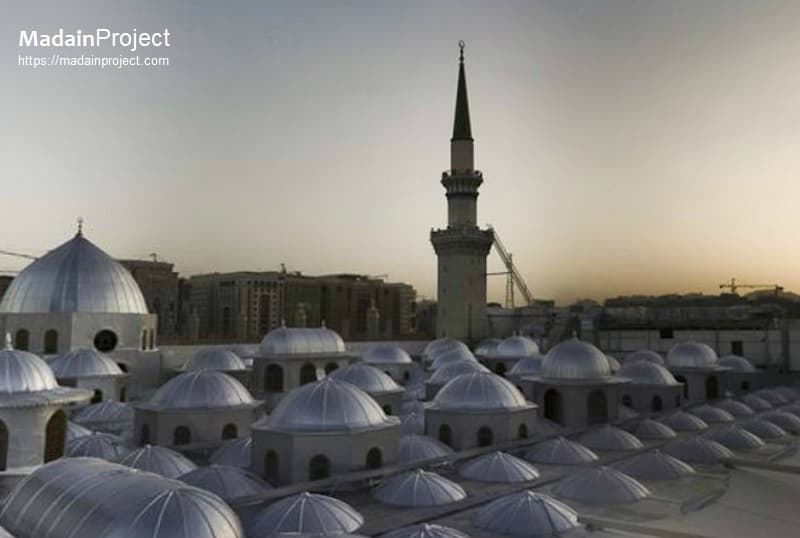
The Bab as-Salam Minaret (مئذنة باب السلام) is one of the most historical minarets of al-Masjid al-Nabawi in Medina, positioned over the Bab as-Salam, the “Gate of Peace”, on the western side of the Prophet’s Mosque, and traditionally associated with the ceremonial and devotional entrance through which worshippers have approached the sacred precinct for centuries. Bab as-Salam Minaret was originally commissioned to be built in 1307 CE by Muhammad ibn Kalavun. Bab as-Salam Minaret is the fifth one added to the original four minarets of Umer.
The Bab as-Salam occupies a distinctive place within the spatial and symbolic organization of al-Masjid al-Nabawi. As a principal western gateway, it has long served pilgrims arriving from the city side, and the minaret associated with it functioned both as an architectural marker of the entrance and as a vertical element integrated into the mosque’s system of calling to prayer.
The minaret’s identity is inseparable from the layered architectural history of the mosque itself, which underwent successive expansions under early Islamic rulers, Mamluk sultans, Ottoman caliphs, and the modern Saudi state. While the mosque today contains multiple minarets of varying periods, the Bab as-Salam Minaret is most closely connected with the Ottoman phase of construction that gave the sanctuary a coherent monumental form prior to twentieth-century expansions.
circa

The area around Bab as-Salam developed as a formal entrance during the medieval period, when the western side of the mosque became increasingly important for urban access. Major structural intervention occurred under the Ottoman sultan ʿAbd al-Majid I, whose comprehensive rebuilding of al-Masjid al-Nabawi took place between 1849 and 1861. This project, supervised by Ottoman architects and engineers sent from Istanbul, replaced much of the earlier fabric while respecting established sacred loci such as the Prophet’s Chamber. During this reconstruction, minarets were regularized in form and placement, and the minaret adjoining Bab as-Salam was rebuilt in the Ottoman style, integrating it into a unified architectural composition.
Earlier Mamluk patronage, particularly under Sultan al-Ashraf Qaytbay in the late fifteenth century, had already introduced prominent minarets to the mosque following damage from fires and structural decay. Although those earlier structures did not survive intact into the modern period, they established the precedent for associating minarets with key gates. The Ottoman rebuilding effectively absorbed this tradition, anchoring a minaret at Bab as-Salam that continued to define the western approach. In the twentieth century, large-scale Saudi expansions beginning under King ʿAbd al-ʿAziz and continuing under Kings Fahd and ʿAbdallah dramatically enlarged the mosque. While numerous new minarets were added during these phases, the historically significant Ottoman minarets, including the one at Bab as-Salam, were preserved and incorporated into the expanded complex as visible links to the pre-modern sanctuary.
circa

The Bab as-Salam Minaret is located at the northwestern corner of the Ottoman prayer hall of al-Masjid al-Nabawi and constitutes one of the most historically layered architectural elements of the sanctuary. The minaret was originally commissioned in 1307 CE (706 Hijri) by the Mamluk sultan al-Nasir Muhammad ibn Qalawun, making it the fifth minaret of the mosque, added to the four earlier towers erected during the Umayyad expansion under al-Walid ibn ʿAbd al-Malik. Its present appearance, however, is the result of a major stylistic transformation carried out during the Ottoman period, particularly under Sultan Mehmed IV in the seventeenth century, when the structure was reshaped in accordance with Ottoman architectural conventions.
In its current form, the minaret exhibits a vertically articulated composition typical of Ottoman religious architecture, organized through a deliberate progression of geometric volumes. The structure rises from a square stone base that anchors it firmly to the mosque’s masonry fabric. Above this, the body transitions into an octagonal shaft, which then narrows into a cylindrical upper section, emphasizing height and visual lightness. This gradual modulation of form reflects the Ottoman preference for elegant verticality while maintaining structural equilibrium. The minaret is crowned by a conical spire topped with a gilded bronze crescent, a defining emblem of Ottoman sacred monuments and a clear marker of the minaret’s early modern reconfiguration.
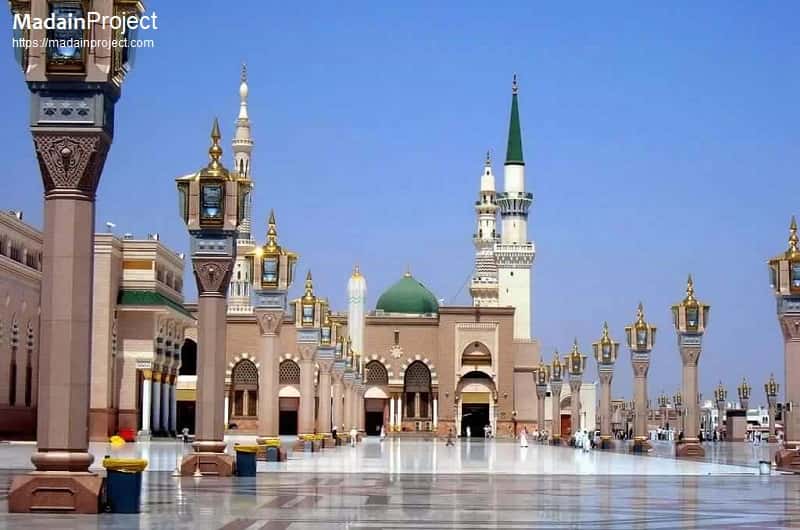
In contrast to the towering 104-meter minarets introduced during the Saudi expansion of 1994, the Bab as-Salam Minaret is the shortest and oldest of the ten minarets presently standing within the mosque complex. Its survival is particularly significant, as several other Ottoman-era minarets were dismantled or rebuilt in Mamluk-revival or modern styles during twentieth-century expansions. The preservation of the Bab as-Salam Minaret thus renders it a rare extant example of pre-modern craftsmanship within the contemporary sanctuary. Beyond its architectural value, the minaret continues to serve as an important spatial and symbolic landmark, closely associated with Bab as-Salam, the Gate of Peace, through which pilgrims traditionally enter on their way toward Riyaz ul-Jannah and the Prophet’s tomb.

Signup for our monthly newsletter / online magazine.
No spam, we promise.

The Madain Project is an online archive of Abrahamic History and Archaeology.
Abrahamic History & Archaeology is the study of history and archaeology with respect to the three Abrahamic Faiths without considering the religious and theological aspects. The goal of Abrahamic History is to understand how and why the religious doctrines and behaviours have evlovled and changed over time. Searching for patterns in the evolution of significant cultural events such as the development of farming, the emergence of cities, or the collapse of major civilizations for clues of why and how these have influenced the three major Abrahamic religions.
Cloud Drive -
About -
Help -
Editorial Policy -
AI Policy -
Privacy Policy -
Contact
Madain Project: Encyclopedia of Abrahamic History & Archaeology.
Copyright MadainProject 2017 - 2026.


