
The al‑Ijaba Mosque in Mecca (مسجد الاجابة بمكة) is a historical mosque located in the al-Maʿabda neighborhood of the city of Makkah, in the present day Saudi Arabia. The mosque is situated near the Masjid al‑Haram and is associated with a location where the Prophet Muhammad is reported to have prayed. It is also historically known by the name Khayf Banī Kinānah, or al-Muhassab, a geographic designation referring to a sloping area extending between al-Hajun and Mina. Owing to its proximity to central Mecca and several major administrative and historical landmarks, the mosque has long been considered one of the notable religious sites in the city. There's another mosque with the same name, Ijabah Masjid, near Masjid Nabawi, in the historic city of Medina, as well.
The al-Ijaba Mosque is located at the beginning of al-Ijaba Street in the al-Maʿabda district, along an internal road leading toward the Grand Mosque in Mecca. The road is connected to the historic Riʿa Dhākher area, which in turn links to the Third Ring Road of the city. The Masjid al-Ijabah is located approx. 2.5 kilometers north-east of the Kaaba, approx. 125 meters north of the King Abdulaziz Grand Mosque.
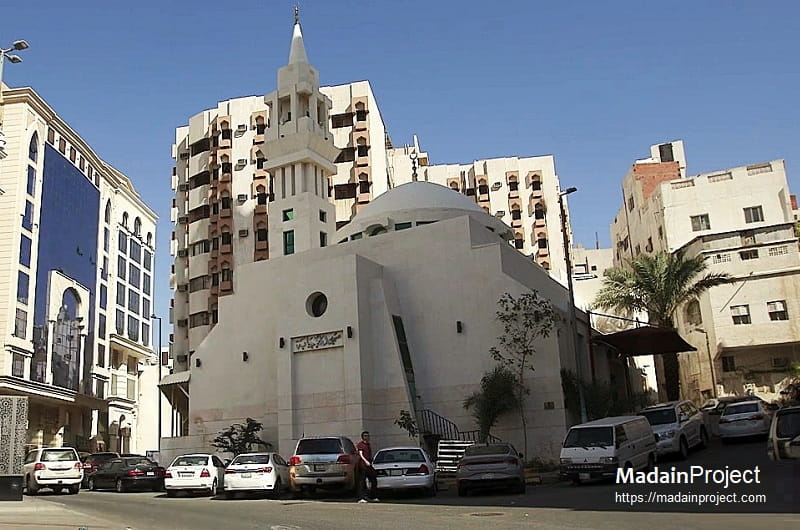
The mosque stands within a historically significant urban context. Nearby is the King Abdulaziz Mosque in the same neighborhood, separated from al-Ijaba Mosque by the road leading to the Grand Mosque. Opposite the mosque lies the King Abdulaziz Palace, where Abdulaziz ibn Saud resided during the early period of the establishment of the modern Saudi state and from which he administered governmental affairs.
On the opposite side of the mosque are the headquarters of the Holy Capital Municipality and the Emirate of the Makkah Region, both located along the same street to the east. As a result, the mosque occupies a corner position between these major administrative buildings. Its central location within the historic neighborhoods of Mecca has contributed to its prominence as a religious landmark and a destination for visitors and pilgrims.
circa 620 CE- Present

The site of the al-Ijaba Mosque is traditionally associated with the place where the Prophet Muhammad is believed to have performed prayer. The area was historically known as Khayf Banī Kinānah or al-Muhassab, terms used in classical Arabic geographical descriptions to refer to a sloping terrain descending from a mountain and rising above a watercourse. This zone extended between al-Hajun and Mina, with the latter being closer to Mina itself.
Archaeological and epigraphic evidence from the mosque includes two foundation inscriptions attached to the qibla wall. One inscription, located to the right of the mihrab, is dated to 1492 CE, while the other, located to the left of the mihrab, is dated to 1712 CE. These inscriptions indicate phases of construction or restoration during the late medieval and early modern periods of Islamic history in Mecca.
During the modern Saudi period, the mosque underwent several restoration and renovation campaigns. The most recent major reconstruction occurred in 2001 CE, when the structure was completely rebuilt. This reconstruction introduced new architectural features and improved facilities while maintaining the mosque’s identity as a historical religious site.
circa 620 CE- Present
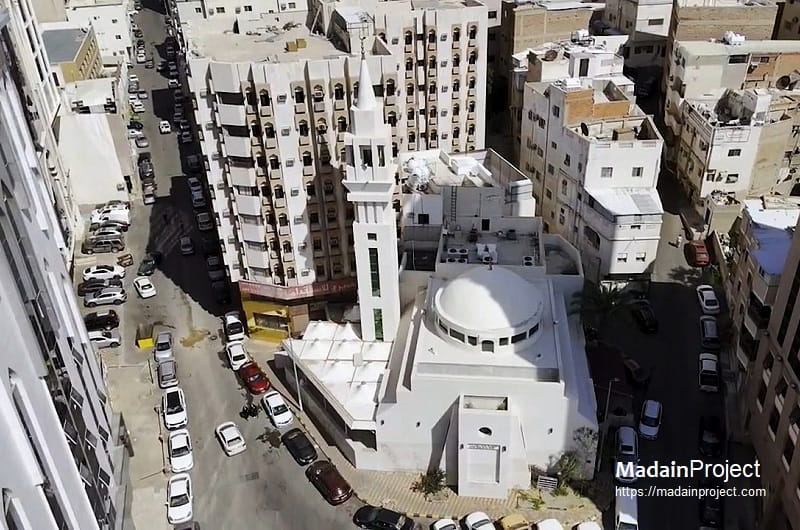
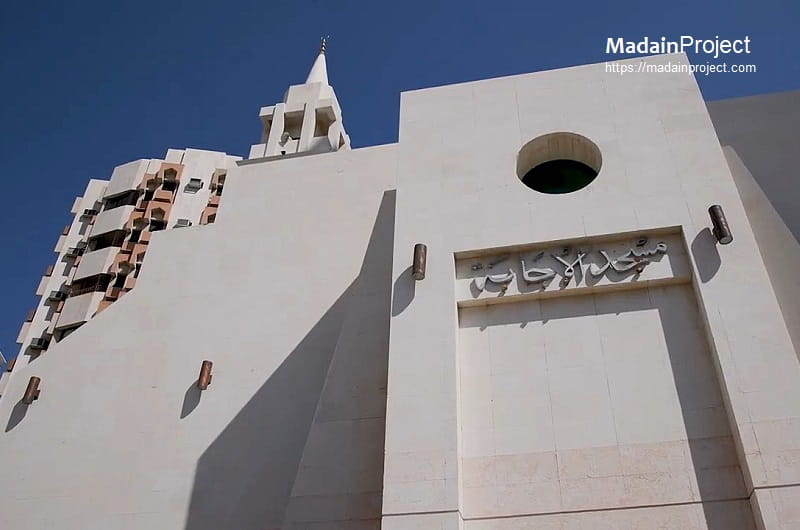
The present structure of the al-Ijaba Mosque reflects the comprehensive reconstruction completed in 2001 CE. The exterior façade is paved with colored marble, giving the mosque a distinctive and polished appearance. A dome and a minaret were added as part of the modern design, while additional facilities—including ablution and restroom areas—were incorporated to accommodate worshippers and visitors.
The mosque is externally recognizable by its predominantly white coloration and marble cladding. Its name is prominently inscribed on the exterior façade in clear script visible from a distance, enabling visitors to identify it easily among the surrounding mosques and buildings in the district.
Access to the mosque is provided through two main entrances positioned on the right and left sides relative to the prayer hall. The qibla orientation of the mosque faces toward the Kaaba within the Grand Mosque and is aligned in such a way that the Abraj al‑Bait Clock Tower is visible in the distance from behind the al-Malawi neighborhood opposite the mosque.
Overall, the architectural form of the al-Ijaba Mosque combines modern reconstruction with the preservation of a historically significant religious site in central Mecca.
Signup for our monthly newsletter / online magazine.
No spam, we promise.

The Madain Project is an online archive of Abrahamic History and Archaeology.
Abrahamic History & Archaeology is the study of history and archaeology with respect to the three Abrahamic Faiths without considering the religious and theological aspects. The goal of Abrahamic History is to understand how and why the religious doctrines and behaviours have evlovled and changed over time. Searching for patterns in the evolution of significant cultural events such as the development of farming, the emergence of cities, or the collapse of major civilizations for clues of why and how these have influenced the three major Abrahamic religions.
Cloud Drive -
About -
Help -
Editorial Policy -
AI Policy -
Privacy Policy -
Contact
Madain Project: Encyclopedia of Abrahamic History & Archaeology.
Copyright MadainProject 2017 - 2026.


