
The tombs in the Isola Sacra Necropolis constitute a structured ensemble of funerary monuments located on the Isola Sacra, the artificial island between the river Tiber and Fiumicino rivers, adjacent to the ancient port of Ostia. This necropolis served as the principal burial ground for the inhabitants of Ostia and its environs from the late first century BCE through the third century CE. The individual tombs at Isola Sacra form part of a recognizable funerary typology, combining house-shaped monuments into a dense, street-based city of the dead.
The Isola Sacra Necropolis constitutes one of the most systematically preserved funerary landscapes of Roman Italy, and the list of its tombs reflects both the density and the social diversity of the community it served. The necropolis developed mainly from the late first century CE through the third century CE, aligned along the Via Severiana and subsidiary roads, following the Roman legal and ritual requirement that burials be located outside the urban boundary. The tombs are arranged in regular rows, creating a coherent funerary district whose organization allows individual monuments to be catalogued with relative precision.
The recorded tombs are predominantly masonry-built chamber tombs, constructed in brick-faced concrete and typically rectangular in plan. Many are two-storied, with an upper commemorative chamber and a lower burial space, and their façades often carry dedicatory inscriptions naming the deceased and, in some cases, their profession or social status. These inscriptions form the basis for identifying and distinguishing individual tombs within the list, allowing modern scholarship to associate specific structures with families, collegia, or freedpersons connected to the port economy of Ostia Antica and Portus.
A defining characteristic of the Isola Sacra tomb list is the prominence of freedmen and their descendants. Epigraphic data consistently indicate that many tombs belonged to former slaves who had achieved economic stability through trade, shipping, or administration connected to the nearby harbors. As a result, the list of tombs functions not merely as an architectural inventory but as a documentary record of social mobility in the Roman Empire.
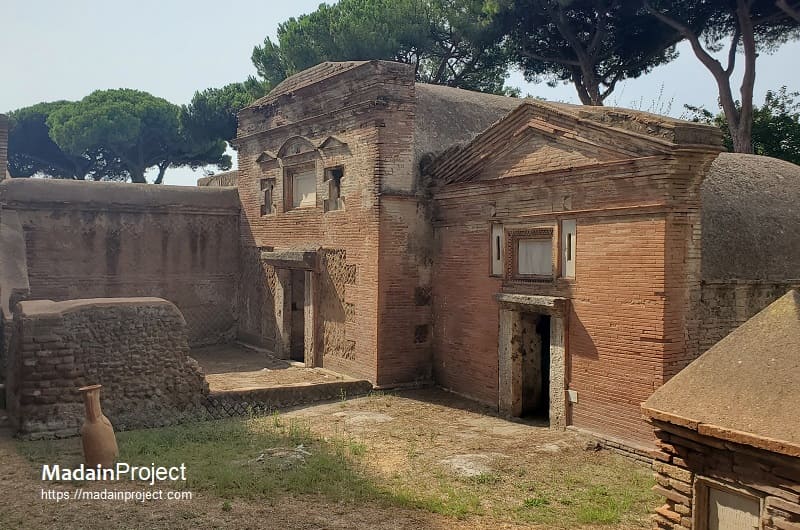
circa
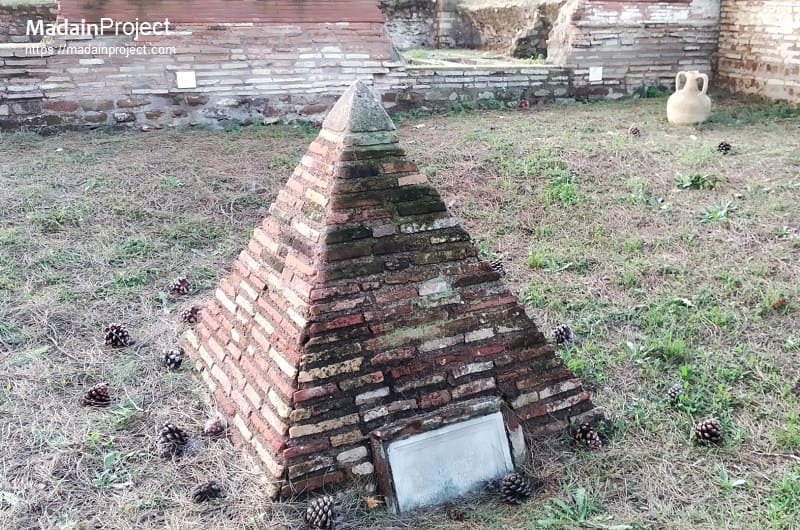
Tomb 1: Caius Annaeus Atticus
Tomb 1 is situated immediately upon entering the excavation area from the south, where the visitor steps onto the remains of the former main thoroughfare, the Via Severiana. This road constituted a significant artery of movement and communication in the Roman period, and, in accordance with Roman funerary custom, was flanked by burial monuments situated outside the inhabited zone. On the left side of the road stands Tomb 1, a detached funerary monument occupying an open space between the Via Severiana and the adjacent tombs conventionally numbered 2, 3, and 4.
The monument takes the form of a small pyramid-shaped structure constructed of brick. Its modest scale and simple geometry are consistent with Roman funerary architecture intended for cremation burials, in which the ashes of the deceased were deposited in an urn placed within the structure. The use of brick reflects common building practices of the Imperial period, particularly in regions where durable and economical materials were favored for commemorative architecture along major roads.
Affixed to the exterior of the monument is a small marble inscription plaque. The inscription records that the tomb was dedicated to Caius Annaeus Atticus, who died at the age of thirty-seven. It further states that he originated from Poitiers, ancient Lemonum, a town in the province of Aquitania in present-day France. This reference provides valuable evidence for individual mobility within the Roman Empire and illustrates the presence of people from the western provinces in this region. The text also indicates that the monument was erected by members of his family, or possibly by individuals belonging to his household, a formulation that leaves open the possibility that freedmen or household slaves were responsible for commemorating him. As such, Tomb 1 offers insight not only into funerary architecture but also into social ties, commemoration practices, and the geographic reach of Roman personal networks.
circa
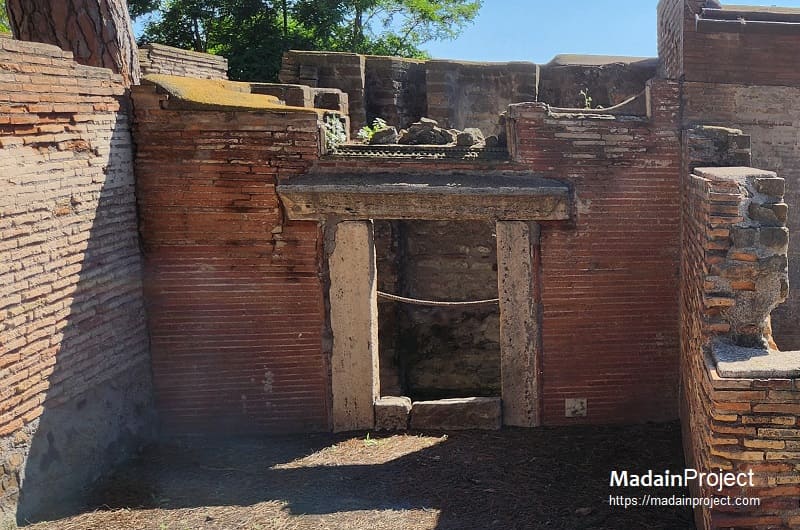
Tomb 10
Tomb 10 is situated at a short distance from the Via Severiana and occupies a constricted position between Tomb 11 and, in part, Tomb 9. Despite this slightly recessed placement, the façade of Tomb 10 is aligned with that of the burial chamber of Tomb 11, and both structures are oriented toward the street. This alignment reflects the continued importance of visual presentation toward the road, even in cases where spatial constraints required the monument to be set back from the main axis of traffic.
Unlike Tomb 11, Tomb 10 was not provided with an enclosing wall or precinct. The absence of such an enclosure suggests a more modest or functionally focused funerary arrangement, or possibly a later insertion into an already densely occupied funerary landscape. The inscription that once surmounted the entrance has been lost, depriving the monument of direct epigraphic evidence concerning the identity or social status of the deceased. Architectural elements of the façade are also fragmentary. Only a portion of the original cornice survives, along with the attachment points indicating the former presence of two relief panels affixed to the wall. These reliefs have not been recovered, and their subject matter therefore remains unknown, though comparable monuments in the necropolis often display portrait busts or symbolic funerary imagery.
Within the burial chamber, the lower sections of the walls are articulated by a double row of arcosolia, above which runs a continuous row of semicircular niches. This internal arrangement indicates a collective or family use of the tomb, accommodating multiple burials over time. The combination of arcosolia and niches corresponds to established funerary layouts in Roman tombs of the High Imperial period, particularly in necropoleis serving urban or suburban populations. No datable finds or inscriptions from the tomb itself provide a secure chronological framework. Consequently, the date of Tomb 10 can only be estimated through architectural comparison with other, better-dated monuments within the same necropolis. On this basis, the most plausible date for its construction and use is around 170 CE, situating it in the later second century and reflecting the continued development and densification of the burial area during this period.
circa
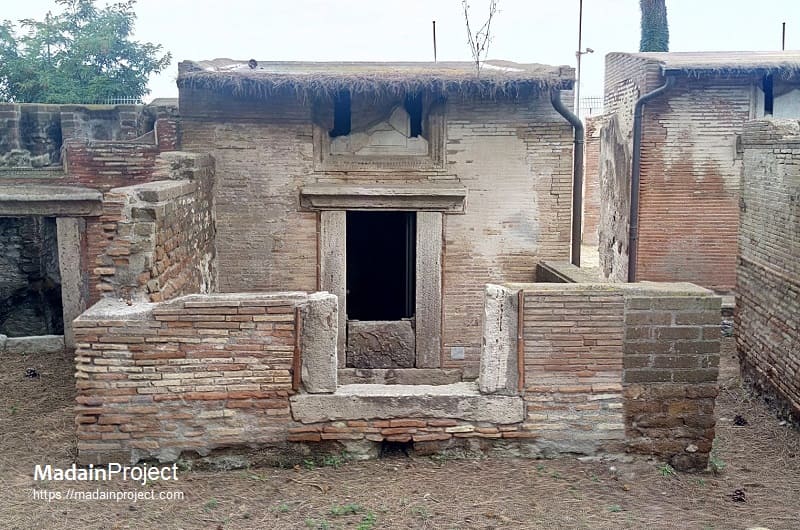
Tomb 11: Terentius Lucifer
Tomb 11 was originally constructed on the same alignment as Tomb 10, with its entrance oriented toward the street. At a subsequent stage, the structure was enclosed within a walled courtyard, altering its original relationship to the surrounding urban space. The floor level of the tomb lies below the contemporary street surface, a feature consistent with several funerary monuments in the necropolis that underwent later architectural modifications. From the outset, the tomb accommodated both inhumation and cremation practices, indicating prolonged use and adaptation to changing funerary customs.
Above the entrance there is a Greek inscription engraved on a marble slab pierced by two small slits. The left side of the inscription is severely damaged, yet the surviving text clearly refers to a family group consisting of a father, a mother, and a daughter, and also records the dimensions of the burial area. Despite its fragmentary state, the inscription provides valuable evidence for the commemorative intent and spatial definition of the tomb at the time of its inscription.
The marble threshold of the entrance belongs to a later phase and stands considerably higher than the original floor level of the tomb, confirming a significant alteration of the internal arrangement. Against the rear wall a sarcophagus was discovered, while the original niches in the left and right walls were later transformed into sarcophagus-like structures, closed at the front with marble slabs. The sarcophagus on the right bears a Latin funerary inscription, which reads:
D(is) M(anibus)
TERENTIVS LVCIFER
ET TERENTEAE KALLOTY
CENI ET FILIS SVIS FE
CIT SI QIT IN AEO SAR
COFAGO INFERET
CORPVS SIBE OSSA
INFERET AERARIO
SATVRNI S(estertium) XXX M(ilia) N(ummum)
This inscription records that the sarcophagus was set up by Terentius Lucifer for himself, his wife Terentea Kallotyche, and their children. It further stipulates a legal prohibition against the interment of any foreign body or bones, under penalty of a fine of 30,000 sesterces payable to the public treasury, reflecting the formal legal framework governing burial rights and the protection of family tombs in the Roman world.
The same Terentius Lucifer can plausibly be identified in at least two other inscriptions from the necropolis. In one, he appears as the benefactor who provided an empty coffin and two sarcophagi for L. Tonneius Celestinus, the husband of Pontia Dativa. In another inscription, he is named as a donor, together with his fellow freedmen and their heirs, of a grave—most likely a burial space—to C. Terentius Felix and his wife Ulpia Chrysopolis. The latter inscription probably originated from Tomb 11 itself, suggesting that this monument functioned as a focal point for a wider network of familial and freedman relationships.
The left sarcophagus was richly decorated with a complex funerary relief. At both ends of the composition stand winged guardian spirits holding inverted torches, traditional symbols of death and the extinguishing of life. At the centre lies the deceased reclining on a couch, holding a cup in his left hand and a floral garland in his right. Behind him is a woman depicted asleep on her stomach, while in front of him, seated on the edge of the couch, another woman offers a drinking vessel. Behind this figure appears a small cupid. Beneath the couch, beside a table laden with bread and what appears to be fried chicken, a dog is shown seated. On the principal, right-hand side of the couch stands an almost completely nude Mercury, extending a purse toward the deceased. On the opposite side is a winged female figure holding a bundle of grain ears in her right hand and a grain measure in her left, generally interpreted as Ceres.
This relief combines realistic domestic imagery with strongly symbolic elements. The guardian spirits simultaneously evoke death and the triumph over it. The presence of a sleeping woman behind the deceased is highly unusual, as wives are typically represented as living participants in such scenes; her posture may indicate that she predeceased her husband. Equally uncommon is the act of offering performed by the seated woman, a role more often assigned to servants. The inclusion of Mercury and the probable figure of Ceres alongside the couch is exceptional and must be understood symbolically. Mercury, as god of commerce and prosperity, points to wealth acquired through trade, while the attributes of the second deity strongly suggest an association with grain. Taken together, these elements support the interpretation that the tomb’s owner was a prosperous grain merchant.
The sarcophagus placed against the rear wall, the only one still preserved in situ, is decorated on its front with strigiles, the characteristic undulating grooves of Roman funerary art. Inside this sarcophagus two skeletons were found, along with a small ring, a gold necklace, and a coin that has not yet been conclusively identified. The tomb itself dates back to the Hadrianic period. Its interior walls were originally divided by a simple moulding into a lower zone with arcosolia and an upper zone with elaborately decorated niches intended for urns. Beneath the black-and-white mosaic floor, two formae were discovered, separated by tuff walls and sealed with tiles, attesting to the continued use of cremation in the earliest phase. In the middle of the second century CE, the tomb was extensively rebuilt to accommodate inhumation. The three sarcophagi described above, dating to approximately 180–190 CE, bear witness to this transformation; two of them are now housed in the Ostia Museum. The construction of the enclosing courtyard also belongs to this later phase.
The burial chamber was further embellished with wall paintings. The decorative scheme includes a pattern of yellow lozenges outlined with dark red lines. In the semicircular central niches of the walls, flanked by small columns, were painted three female figures identified as the Parcae, the goddesses of Fate. On the left wall, set within a yellow field bordered in blue, is Atropos, depicted with reddish hair and her head turned to the left, holding an unrolled scroll. On the wall opposite the entrance was probably Lachesis, wearing a dark red garment, her left hand concealed beneath it, while her right hand holds a balance. In the central niche of the right wall stands Clotho, dressed in blue and carrying a spindle with thread and a bobbin. These figures were accompanied by additional decorative motifs of flowers and stars, completing a program that articulated themes of destiny, mortality, and cosmic order appropriate to a monumental family tomb of the High Imperial period.
circa
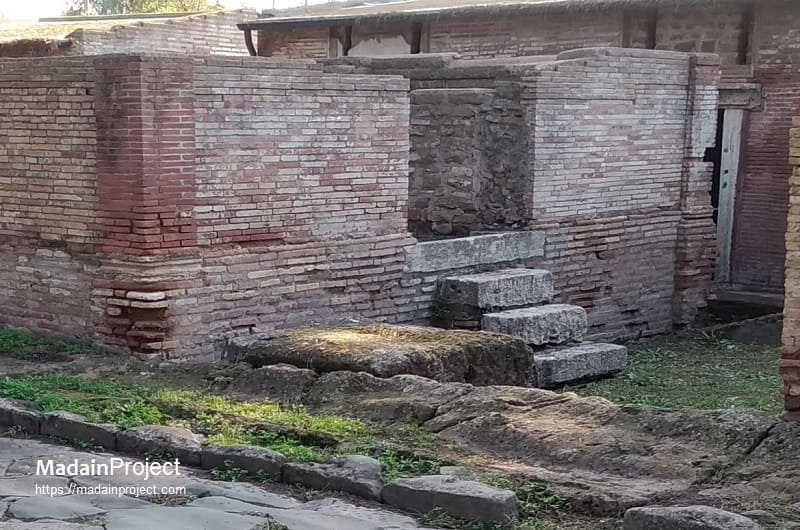
Tomb 12
Tomb 12 belongs to an earlier chronological phase than Tomb 11 and can be dated to the opening decades of the third century CE. Architecturally and topographically, it occupies an open area bounded by Tomb 13, Tomb 14, and the Via Severiana, a major thoroughfare that structured this sector of the necropolis. Unlike many neighboring monuments aligned directly toward the street, Tomb 12 is positioned approximately 0.50 m above the contemporary street level and has its entrance oriented to the north, deliberately facing away from the road. This orientation suggests a conscious deviation from the dominant funerary alignment and may reflect constraints imposed by the surrounding built environment or by pre-existing burial activity in the area.
Access to the tomb is provided by a short flight of three travertine steps leading down into the interior. The monument was designed exclusively for inhumation, a practice that had become increasingly dominant in the Roman world by the late second and early third centuries CE. Along the interior walls are two superimposed rows of arcosolia, indicating a careful vertical organization of burial spaces and an intention to maximize capacity within a relatively compact structure. Beneath the floor, an additional twelve formae were identified, further emphasizing the intensive use of the tomb for multiple interments and pointing to its function as a collective burial place, most likely for a family group or a closely associated community.
Pilot excavations carried out in the open space in front of Tomb 12 revealed that this area had already been used for funerary purposes in earlier periods. Archaeological evidence indicates the presence of several types of small tombs predating the construction of Tomb 12, demonstrating a long-standing funerary use of this zone. The incorporation of Tomb 12 into this earlier burial landscape reflects the cumulative and stratified development of the necropolis, in which new monuments were inserted into spaces already marked by earlier commemorative structures. This continuity underscores the enduring significance of the location within the funerary topography and provides important evidence for the evolving patterns of burial, monumentality, and spatial organization during the Severan period.
circa
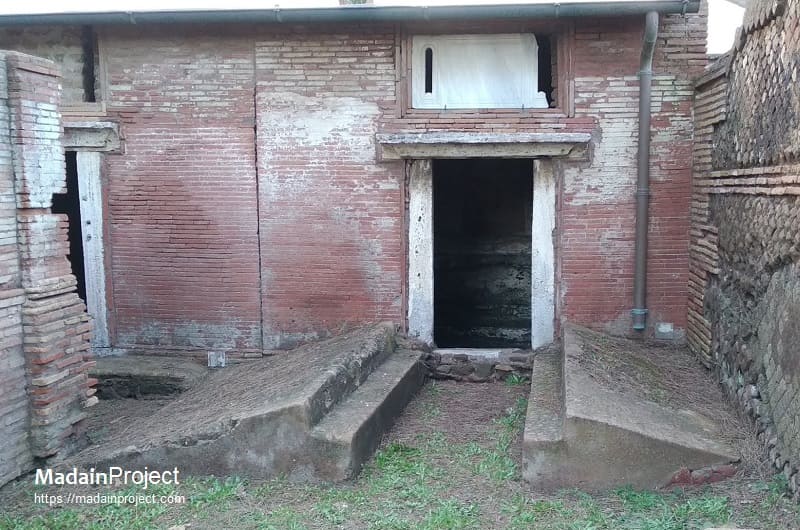
Tomb 15
Tomb 15 is the only monument within the group formed by Tombs 13–15 that still retains its original orientation toward the Via Severiana. In contrast to Tombs 13 and 14, where the associated biclinium has disappeared, this funerary dining installation is preserved at Tomb 15, indicating that commemorative banqueting continued to play a role in the ritual use of the monument. On its right side, the tomb is partly bounded by the enclosure wall of Tomb 16, demonstrating the close spatial interrelationship and progressive infilling characteristic of this sector of the necropolis.
Above the entrance a marble inscription has been affixed which, on the basis of both epigraphic and architectural considerations, almost certainly does not belong to Tomb 15. The personal names recorded in the text recur in the inscriptions of Tomb 29, and the dimensions of the burial area stated in the inscription correspond more closely to the size of that monument than to the relatively smaller interior of Tomb 15. It is therefore highly probable that the inscription was originally associated with Tomb 29 and was secondarily reused or relocated above the entrance of Tomb 15 at a later stage, a practice well attested in the funerary contexts of Ostia.
The inscription records that the monument was constructed by Veria Zosime and was intended for her beloved husband, Lucius Verrius Eucharistus, for herself, for their freedmen and freedwomen, and for their descendants. It further specifies the legal exclusion of external heirs and defines the area of the tomb as measuring ten Roman feet by ten Roman feet. The full text of the inscription reads:
D(is) M(anibus)
VERIA ZOSIME FECIT SIBI ET
L(ucio) VERRIO EVCHARISTO MARITO
SVO BENE MERENTI LIBERTIS
LIBERTABVSQVE SVIS POSTE
RISQVE EORVM
H(oc) M(onumentum) H(eredem) EXTERVM N(on) S(equetur)
IN FRONTE P(edes) X IN AGRO P(edes) X
Chronologically, Tomb 15 belongs to the same phase as Tombs 13 and 14 and was conceived from the outset for a mixed form of burial, accommodating both inhumation and cremation. Internally, the walls are divided into two zones by a simple horizontal moulding. Below this moulding are arcosolia intended for inhumation, while above it are smaller niches designed to hold urns for cremated remains. In the wall containing the entrance there are four such niches, and in each of the side walls there are five. The back wall differs in arrangement, containing only a single central niche surmounted by a triangular tympanum, which provided a focal point within the burial chamber and may have held a particularly important urn or commemorative element.
Beneath the original floor, which is no longer preserved, three formae were discovered, further attesting to the intensive use of the tomb for multiple interments. Tomb 15 was originally furnished with a rich decorative program, particularly in the treatment of the niches. Although time and environmental conditions have caused extensive deterioration, small surviving fragments attest to the former quality and elaboration of this decoration. Together, the architectural features, burial arrangements, and decorative remains of Tomb 15 provide important evidence for the funerary practices, social organization, and commemorative strategies of the community that used this monument along the Via Severiana.
circa
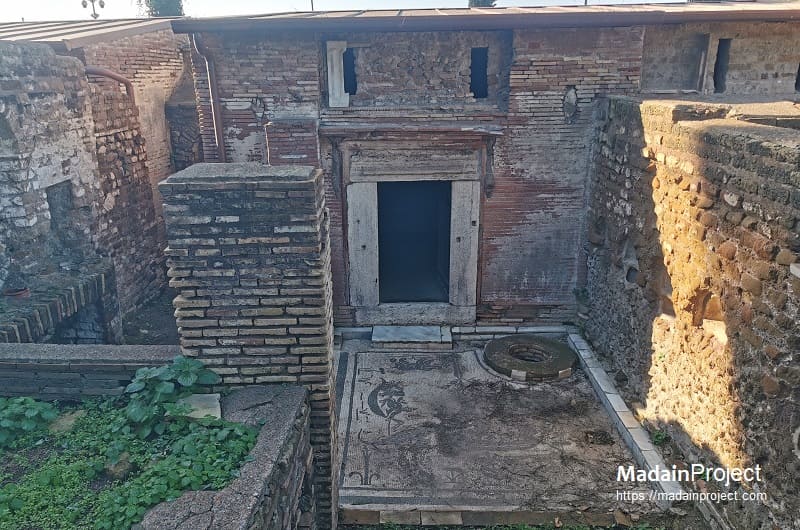
Tomb 16: Terentius Vitalinus
Originally, Tomb 16 consisted solely of a burial chamber oriented toward the Via Severiana, although it was set back at a slight distance from the roadway rather than opening directly onto it. On its left side the monument was likewise detached, and an alley separated it from Tomb 15. This spatial configuration indicates that, at the time of its initial construction, Tomb 16 stood as an independent structure within a relatively open funerary landscape. In a subsequent phase, a courtyard was added, enclosing both the area between Tomb 16 and the Via Severiana and the former alleyway. The entrance to this enclosure was oriented toward the north rather than toward the main road, marking a significant reorganization of access and movement. Part of the enclosure was covered by a roof supported by brick columns, one of which remains standing today in the center of the courtyard and provides valuable evidence for the original architectural articulation of this space.
The floor level of the enclosure lies slightly higher than that of the original burial chamber, indicating a deliberate terracing and a chronological distinction between the two construction phases. Directly in front of the burial chamber a well-preserved black-and-white mosaic is still in situ. This mosaic depicts a Nilotic landscape with the river Nile populated by various animals and a boat manned by pygmies. Such Nilotic scenes were popular in funerary contexts during the Imperial period and functioned as symbolic counterparts to Dionysian imagery, evoking ideas of abundance, regeneration, and the cyclical nature of life. As will be evident from the decoration of the burial chamber itself, Dionysian motifs played a prominent role in the visual program of Tomb 16. Adjacent to the mosaic is a circular well lined with a marble rim, likely used for ritual or practical purposes connected with funerary ceremonies, such as libations or the preparation of commemorative meals.
Above the entrance to the enclosure was a marble inscription that provides detailed information about the ownership and use of the tomb. The text reads:
ET SENTIO D(is) STATIANO M(anibus) ALVMNO SVO
PVBLIVS CORNELIVS FORTVNATVS
TERENTIO BITALINI ET SENTIAE LAIDI
ME DONAVI SARCOFAGA N(umero) XII IN QIBVS TRIA
DEBET FACERE SVIS INPENDIS CVNDISSERO
PARTE DESTRA BIA FLABIA DATA CLABE ET DO
NATA ESSE BOLO QE SVPRA ISCRITA SVN[T]
ET AB EREDE MEV LIBERTI LIBERTABVSQ(ue)
The inscription records that Publius Cornelius Fortunatus donated twelve sarcophagi to Terentius Vitalinus, to Sentia Lais, and to Sentius Statianus, his foster son and heir, as well as to his freedmen and freedwomen and their descendants. Three of these sarcophagi were to be paid for by Terentius Vitalinus after he had received the key of the tomb on the right side of the Via Flavia. Epigraphic analysis shows that the first and eighth lines were added at a later date; due to lack of space, parts of the text were inserted around the letters D and M of Dis Manibus. The reference to the Via Flavia is of particular interest. While it is often stated that the Via Severiana was renamed Via Flavia in the Constantinian period, it remains possible that the road bore the name Via Flavia already from the late first century CE, and that “Via Severiana” represents a later or secondary designation.
On the entrance wall of the burial chamber itself, the attachment point of an earlier inscription is still visible, although the text has not survived. Flanking the doorway are two dolphins carved from tuff, a motif commonly associated with salvation, passage, and the journey of the soul. The burial chamber was designed for a mixed form of burial, combining inhumation and cremation. In the lower parts of the walls are arcosolia intended for inhumation, while the upper zones contain large niches flanked by smaller ones for urns. The floor, now badly damaged, was originally decorated with a mosaic bordered by marble, depicting floral motifs and amphorae, imagery closely connected with funerary banquets and the storage of wine and offerings.
The walls of the burial chamber were plastered and painted to imitate colored marble in shades of red, green, and yellow, a decorative technique widely used in Roman interiors to convey richness and refinement. In the central niche of the back wall, fragments of a painted funerary banquet are preserved. Such scenes belong to a broader Dionysian visual culture, expressing the belief in a blissful afterlife conceived as an eternal banquet. Comparable imagery can be found in the colored floor mosaic of Tomb 88, in a wall painting in Tomb 57, and on the sarcophagus from Tomb 11, indicating a shared symbolic repertoire within the necropolis.
In the rearmost niche of the left wall, a Dionysian scene executed in stucco relief is preserved. It depicts Silenus, the aged tutor and companion of Dionysus, bearded and with a weary expression, seated on a donkey beside a small column and holding a flowering staff. Opposite him stands Pan, identifiable by his goat’s legs and horns, carrying a shepherd’s crook over his shoulder. The ceiling of this niche was adorned with a painted peacock, a symbol often associated with immortality and renewal.
The central niche of the left wall is flanked by two niches containing painted representations of the Fates. In the niche on the left, Clotho is depicted, now preserved in the Ostia Museum. She wears a purple dress and a green mantle and holds a spindle and bobbin with thread. In the niche on the right stands a female figure dressed in purple with a dark yellow cloak. Although the poor state of preservation makes the attributes difficult to identify, she is most likely Atropos or Lachesis. Together, these images articulate the theme of destiny and the inescapable progression of life toward death.
The central niche of the right wall also contained a Dionysian painting, now badly preserved. It shows two male figures carrying shepherd’s hooks over their shoulders. On the ground lies an overturned basket from which a snake has emerged, a potent symbol of renewal and chthonic forces. The composition is completed by a goat rearing on its hind legs. As in the corresponding niche on the opposite wall, a peacock was painted in the upper part. In the flanking niches, two female figures were represented, analogous to those on the left wall. One can be identified as the third Fate, holding a balance. The other figure, whose attributes are no longer clearly visible, may represent Fortuna, who is often depicted in association with the Fates. Only scant remains of this last painting have survived.
The arrangement of the enclosure reflects its complex history of use and adaptation over time. Within its walls were arcosolia for inhumation and smaller niches for urns, many of which were decorated with floral motifs and geometric patterns. In the central niche of the left wall of the enclosure, a painted scene depicted three human figures, two female and one nude male. These figures have been variously interpreted as Heracles and Alcestis or as Hermes and Eurydice, both mythological pairs closely associated with death, rescue from the underworld, and the hope of return.
Between the left wall of the burial chamber and the southern wall of the enclosure a furnace was installed, used for the preparation of funerary meals. Such installations underline the importance of ritual dining and commemoration within the funerary complex. The entire enclosure was paved with a mosaic floor, beneath which space was later created to accommodate additional sarcophagi, demonstrating the continued and evolving use of Tomb 16 over an extended period.
circa
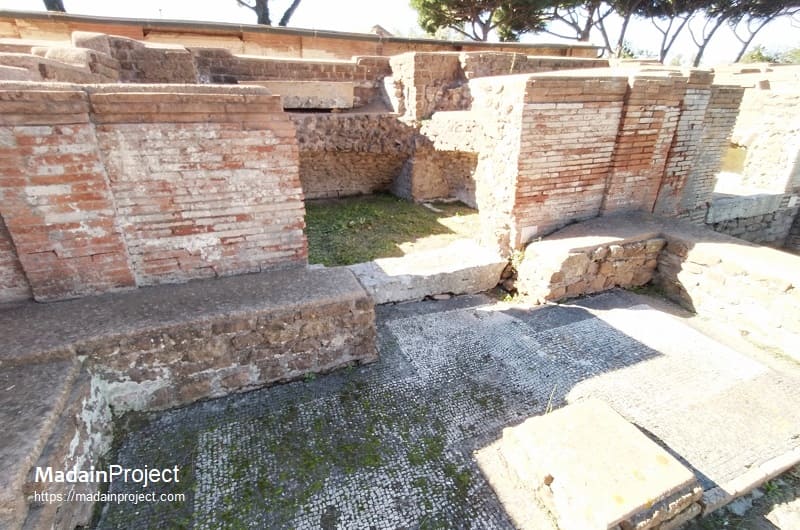
Tomb 23
Tomb 23 occupies a central position within the block formed by Tombs 22, 23, and 24 and is situated approximately 1.30 m farther from the Via Severiana than Tomb 22. This setback from the main road suggests a carefully regulated spatial arrangement within the funerary block, in which the relative placement of individual monuments responded both to available space and to pre-existing architectural alignments. As in other parts of the necropolis, the present appearance of Tomb 23 reflects multiple phases of use and modification rather than a single moment of construction.
During a later phase of use, the area in front of or within the tomb was furnished with stone benches arranged around a central stone table. Such installations are characteristic of funerary dining practices and indicate that the tomb served not only as a place of burial but also as a setting for commemorative gatherings and ritual meals held in honor of the deceased. The space enclosed by the benches was paved with a black-and-white mosaic floor bordered in black, a restrained decorative scheme consistent with early third-century funerary interiors and suitable for an area intended for repeated communal use.
The burial chamber of Tomb 23 was intended exclusively for inhumation, reflecting the dominance of this funerary practice by the beginning of the third century CE. Beneath the floor, multiple formae were identified, arranged both parallel to the façade and diagonally, an unusual configuration that suggests either a prolonged period of use or the adaptation of the tomb to accommodate additional burials beyond its original plan. This subterranean organization underscores the intensive exploitation of burial space typical of the period.
As with several other monuments in this block, the upper part of Tomb 23 has not survived, having been lost to later destruction or spoliation. The absence of this superstructure limits our understanding of the original external appearance of the tomb but is consistent with the general state of preservation in this area of the necropolis. On the basis of architectural features and comparison with the adjacent monuments, Tomb 23 can be dated, like Tombs 22 and 24, to the period between approximately CE 200 and 210, situating it firmly within the Severan phase of funerary development along the Via Severiana.
circa
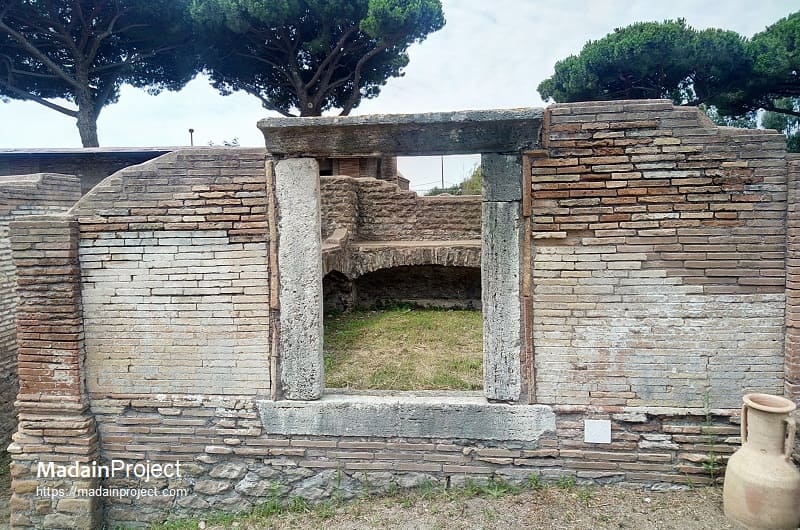
Tomb 25
Tomb 25 forms the first monument in a block of four tombs whose entrances are oriented toward the Via Severiana at a slight angle, rather than being set strictly perpendicular to the road. This oblique alignment reflects a coordinated planning of the group and suggests that the tombs were conceived as a unified architectural ensemble within the necropolis. The façade of Tomb 25 is articulated by a corner column on its left side, while on the right it shares a similar column with the adjacent Tomb 26, creating a visual and structural continuity between the two monuments and reinforcing the impression of a deliberately organized funerary frontage.
The burial chamber of Tomb 25 was designed exclusively for inhumation, in keeping with funerary practices prevalent in the early third century CE. Along the interior walls were two superimposed rows of arcosolia, providing a substantial number of burial spaces within the chamber. Additional interments were accommodated beneath the floor, further increasing the capacity of the tomb and indicating its use by a group rather than a single individual. The upper portions of the walls and the roof have not survived, resulting in the loss of the original vertical articulation and ceiling structure. Nevertheless, enough remains to reconstruct the basic internal organization of the space.
The painted decoration of the niches is preserved only in a fragmentary state. Of particular importance is the painting from the niche in the back wall, which has been detached and is now kept in the Ostia Museum (inventory numbers 10118a, b, and c). This composition depicts two peacocks flanking a handled glass cup filled with flowers and fruit. The iconography of peacocks, often associated with immortality and the afterlife, combined with the vessel overflowing with vegetal abundance, conveys themes of eternal renewal and paradisiacal sustenance. Closely comparable scenes are known from Tombs 34 and 16, indicating the circulation of shared motifs and visual formulas within the necropolis and suggesting a common symbolic language for expressing hopes of posthumous felicity.
On stylistic and architectural grounds, Tomb 25 can be dated to the first decade of the third century CE. Its layout, decorative program, and position within a coordinated block of tombs contribute valuable evidence for the organization of funerary space, the standardization of burial architecture, and the symbolic repertoire employed in the Severan-period necropolis along the Via Severiana.
circa
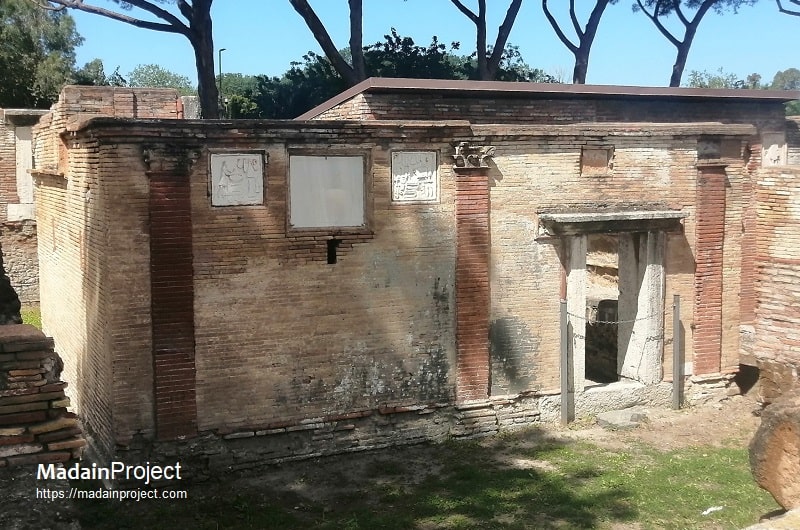
Tomb 29: Verria Zosime
Tomb 29, currently closed to the public, represents one of the most architecturally and artistically significant monuments within the necropolis, notable for its complex layout, rich decoration, detailed reliefs, and informative inscriptions. The original construction comprised a single burial chamber accompanied by a walled courtyard. In a subsequent phase, the courtyard was extended to accommodate a second burial chamber, which included a second floor, likely intended as a solarium or open terrace. Access to this upper level was provided by a staircase, indicating an intention to create a multi-level funerary complex that combined both commemorative and functional spaces. Tomb 29 is detached on three sides, sharing a partial wall on its northern side with Tomb 30. Despite its somewhat remote position relative to the Via Severiana, the entrance of the tomb faces the road, reflecting the fact that the field in front of the monument remained unoccupied, allowing a clear line of orientation and visibility.
The façade of the enclosure is articulated into two sections by three brick half-columns crowned with Corinthian capitals. The entrance is located in the right section. Above this doorway, the site of a now-lost relief is still visible. The left section of the façade contains a marble plaque bearing a dedicatory inscription, flanked by two terracotta reliefs that depict the profession of the tomb’s owner, Verrius Euhelpistus. The inscription reads:
D(is) M(anibus)
VERRIA ZOSIME ET
VERRIVS EVHELPISTVS
FECERVNT SIBI ET
LIBERTIS LIBERTABVSQVE
POSTERISQVE EORUM
This dedicatory text indicates that Verria Zosime and Verrius Euhelpistus established the tomb for themselves, their freed slaves, and their descendants. Beneath the inscription, a small rectangular window is preserved, which would have admitted light to the interior of the enclosure.
The two terracotta reliefs, now represented by copies in situ, illustrate the profession of Verrius Euhelpistus, who appears to have been engaged in the trade or manufacture of iron tools. In the left relief, a man stands on a bench operating a millstone, surrounded above by a collection of tools. This scene closely parallels the decoration of the façade of the original burial chamber, where a similar depiction of a man working at a millstone is evident. The right relief appears to be organized on two levels: on the upper register, a man stands behind the counter of a shop, surrounded by tools including scissors, surgical instruments, scalpels, an anvil, saws, and sickles; on the lower level, a second figure is engaged in work, emphasizing the practical and productive character of the owner’s profession.
The doorway of the enclosure also serves as the entrance to the new burial chamber. Between this doorway and the original burial chamber, the floor is paved with a black-and-white mosaic featuring geometric motifs. The façade of the original burial chamber contains another relief depicting a man working at a millstone, again echoing the themes of labor and professional identity found on the enclosure walls. An inscription, now probably misplaced on Tomb 15, reiterates the dedication of the grave by Veria Zosime for herself, her husband Lucius Verrius Eucharistus, their freed slaves, and their heirs. The burial area measures 10 x 10 Roman feet, corresponding to the dimensions recorded in the inscription (see also Tomb 15).
The original burial chamber was designed for a mixed form of interment. Three arcosolia are preserved in the lower walls for inhumation, while the upper walls, divided from the lower portion by a simple moulding, contain smaller niches for urns. Each wall features a central semicircular niche with a triangular tympanum, flanked by two rectangular niches. The entrance wall also contains small rectangular niches. Traces of the original painted decoration indicate a yellow background with broad red-brown horizontal strokes. The large semicircular niches were crowned with stucco shells and decorated with red flowers or eight-pointed stars. The floor, which retains fragments of a colored mosaic, depicts birds and includes part of an inscription reading:
[Hoc mon? Hoc pav?]IMENTVM CONSECRATVM ES(t)
This likely referred to the consecration of the floor or the tomb itself. Beneath the floor were three additional burial places, and restoration work revealed an older, primarily white mosaic in the corners, indicating earlier phases of use.
The newly constructed enclosure was L-shaped, with two arcosolia in its right wall and additional burial places beneath the floor. A staircase located to the left of the entrance connects the façade of the original burial chamber to the lower level of the second burial chamber via an arch. A second arch, aligned with the façade of the first chamber, divides the new burial chamber into two distinct spaces. Both sections were organized for inhumation with a double row of arcosolia. Supports for a sarcophagus are preserved in the first room, though only the cover survives, bearing the following inscription:
D(is) M(anibus)
BERRIA ZOSIME
FECIT SIBI ET
BERRIO EVHELPISTO
COIVGI SVO
This dedicatory text confirms that Verria Zosime constructed the grave for herself and her husband, Verrius Euhelpistus. The floor of the lower burial chamber was entirely paved with a black-and-white mosaic, establishing a coherent decorative program across the chamber.
The staircase leads to the upper floor, which was divided into two parts. The first section functioned as a solarium, an open space surrounded by a low balustrade with a marble border designed to channel rainwater. Its floor contained a black-and-white mosaic replicating the worktable motif seen on the terracotta reliefs. From the solarium, one could access the upper portion of the second burial chamber, intended exclusively for inhumation. Although little of this upper room has survived, two amphorae depicted in the floor mosaic near the entrance indicate their use for libations, emphasizing the ritual practices associated with the burial and the continued commemoration of the deceased.
Tomb 29 thus exemplifies a complex and multi-phase funerary architecture that integrates commemorative, ritual, and symbolic elements, reflecting both the social identity of the owners and the broader funerary practices of Ostia in the early third century CE.
circa
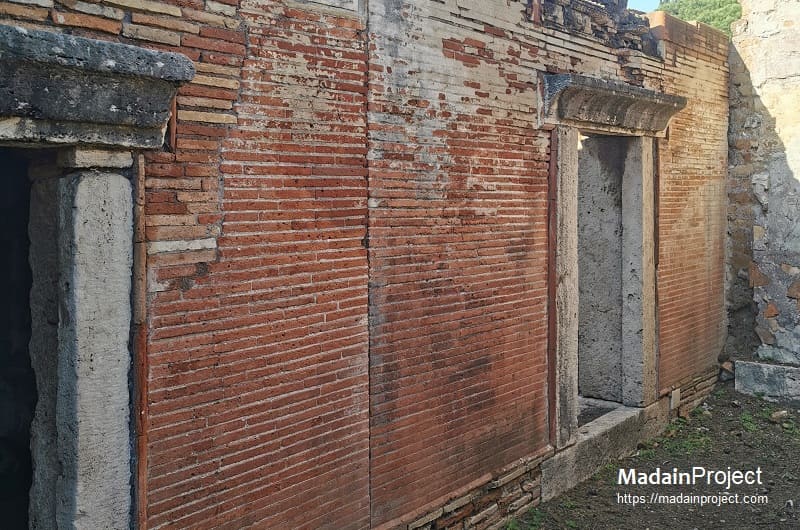
Tomb 31
The façade of Tomb 31 constitutes a deliberate architectural extension of the façades of Tomb 30 and the original burial chamber of Tomb 29, forming a continuous funerary frontage that emphasizes visual cohesion along this section of the necropolis. The back wall of Tomb 31 projects slightly forward relative to the neighboring tombs, reflecting the greater depth of its burial chamber. Originally, the tomb would have been visible from the Via Severiana; however, this line of sight was later obstructed by the construction of Tomb 33. An original passageway connecting Tomb 31 to Tomb 34 was subsequently closed, indicating modifications to the spatial organization of the tomb cluster over time. Tomb 31 also featured a biclinium, a dining or ritual space associated with commemorative funerary practices. Above the entrance, remnants of the cornice that once framed a dedicatory inscription remain, although the inscription itself, as well as the original ceiling, have been lost, leaving only traces of their former presence.
The burial chamber of Tomb 31 exhibits a layout distinct from the neighboring monuments. The walls are fitted with double rows of arcosolia designed for inhumation, while the upper sections, now largely destroyed, contained smaller niches presumably intended for urns or secondary interments. Beneath the floor, which was originally covered with a mosaic, multiple formae have been identified, demonstrating the tomb’s adaptation for intensive use over time. Fragments of the mosaic preserve part of a Greek name, suggesting the incorporation of personal or dedicatory elements in the decorative scheme.
Evidence of painted decoration survives within the arcosolia of both the back wall and the entrance wall, where traces of floral motifs are visible. Additional wall paintings from the arcosolia of the lateral walls, now housed in the Ostia Museum depots, include depictions of two peacocks on one panel and a small column flanked by two birds on another. These decorative elements are consistent with the symbolic language of Roman funerary art in the late second century CE, where peacocks often signified immortality and the promise of eternal life, and vegetal or avian motifs conveyed themes of fertility and renewal.
Tomb 31 can be securely dated to the end of the second century CE, based on stylistic and architectural criteria. Its combination of double arcosolia, upper niches, mosaic flooring, and painted ornamentation exemplifies the funerary conventions of Ostia in this period, reflecting both the practical organization of burial space and the symbolic program intended to honor and perpetuate the memory of the deceased.
circa
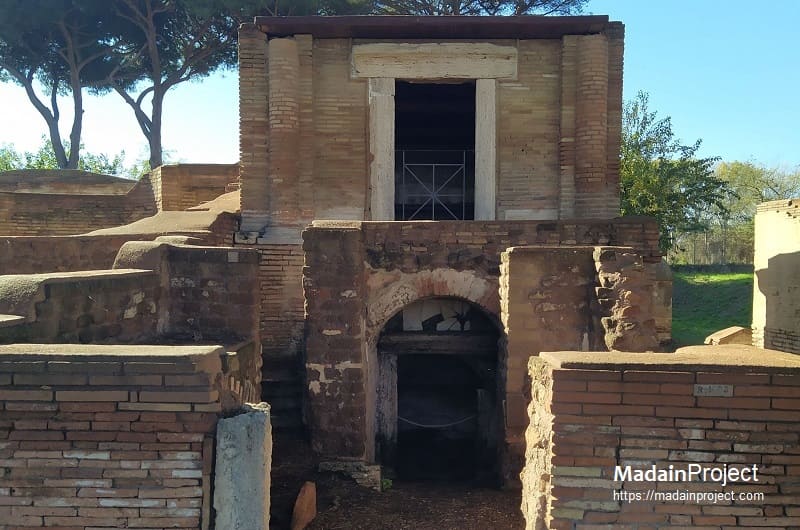
Tomb 41
Tomb 41 is situated directly in front of the older Tomb 42 and appears to occupy the same spatial footprint as the earlier enclosure, indicating a reuse or adaptation of the preceding funerary site. The tomb aligns with Tomb 40 along the necropolis axis and maintains a clear orientation toward the Via Severiana, reflecting the continued importance of visual access to the roadway in the planning of Ostian tombs. The monument was constructed exclusively for inhumation, with burial spaces organized within the side walls, which contain a double row of arcosolia. Within one of the arcosolia on the left wall, a fragment of a terracotta sarcophagus has survived, providing direct evidence of the funerary receptacles employed in the tomb.
Beneath the floor, three formae were installed, each designed to accommodate two bodies, reflecting the Roman practice of maximizing burial space while maintaining a structured organization. Numerous fragments of the original mosaic floor have been recovered from these formae, although the floor itself no longer survives, making reconstruction of the complete decorative program impossible. In the lower niche on the right side of the chamber, a painted decoration has partially endured. This painting is arranged in two registers: the lower level depicts an arrangement of fruit and flowers set against a green background, framed by trees, while the upper level shows a bird rendered against a white field. These motifs are consistent with contemporary funerary iconography, in which floral and avian imagery frequently symbolized life, renewal, and the afterlife.
Due to the advanced state of decay of the tomb, establishing a precise chronological attribution is challenging. Nevertheless, stylistic analysis of the surviving painting situates it in the early third century CE, indicating that the tomb represents a relatively late phase of Roman funerary practice in this section of the necropolis. Tomb 41, therefore, provides important evidence of both the spatial reuse of older tomb enclosures and the persistence of decorative and symbolic motifs in Ostian burial architecture during the first decades of the third century CE.
circa
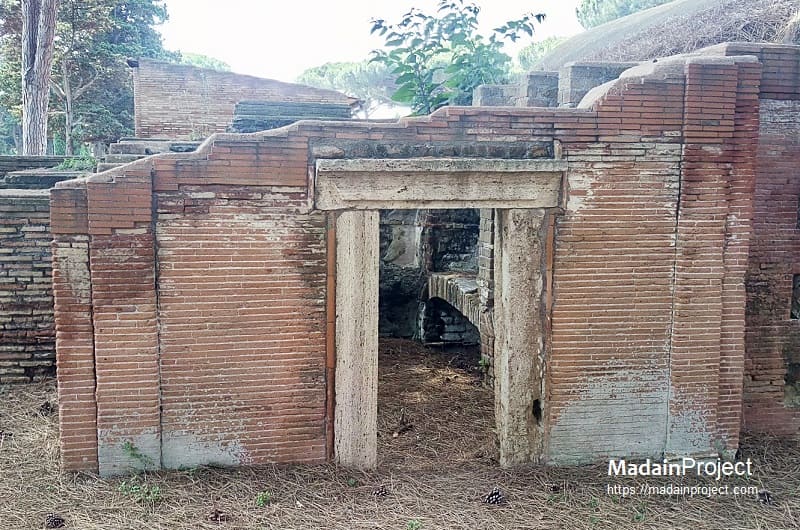
Tomb 45
Tomb 45 is situated immediately behind Tomb 44 and shares its left wall, demonstrating a close spatial relationship and continuity within this sector of the necropolis. The entrance to the tomb is oriented toward the north, positioned transverse to the Via Severiana, while the right wall of the burial chamber adjoins Tomb 46. This alignment reflects the dense arrangement of funerary architecture in Ostia, where tombs were often integrated or abutted adjacent structures while maintaining individual access and visibility.
The burial chamber of Tomb 45 was arranged for a mixed form of interment, combining inhumation with urn deposition. The lower portion of the walls contains two rows of arcosolia, specifically designed for inhumation burials. The right wall retains traces of semicircular and smaller rectangular niches, which were likely intended for urns, indicating a planned accommodation for cremated remains alongside full-body interments. The ceiling and roof of the tomb have not survived, leaving the chamber exposed to subsequent decay. Beneath the floor, six formae were installed, each capable of holding two bodies, illustrating the Roman practice of efficiently structuring burial space while maintaining clear organization within the tomb. Fragments of stone recovered from these formae suggest that the original floor was constructed as a mosaic, although no evidence of painted decoration has been preserved.
Based on architectural and structural characteristics, Tomb 45 can be dated to the middle of the second century CE. The combination of arcosolia, urn niches, and formae reflects typical funerary arrangements of the period in Ostia, demonstrating both practical concerns for space and the coexistence of multiple burial practices within a single chamber.
circa
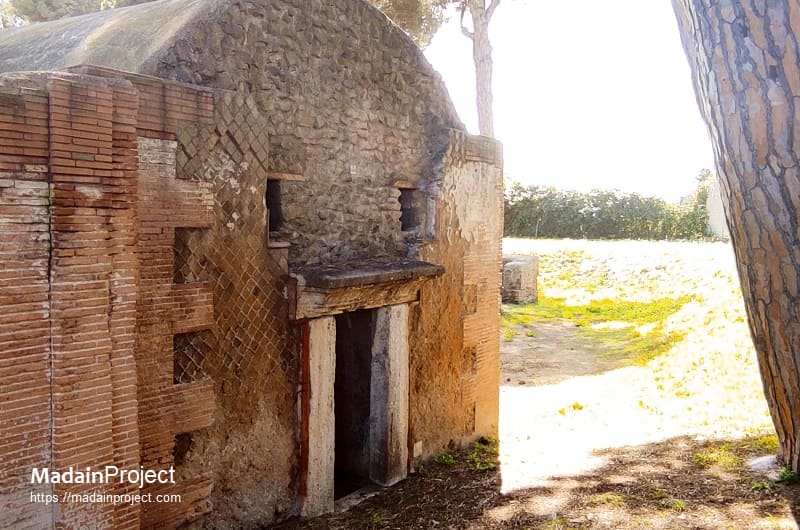
Tomb 46
Tomb 46 is constructed using small square blocks of tuff in opus reticulatum and red brick, reflecting typical Roman building techniques of the early Imperial period. Like Tomb 45, the entrance is oriented to the north, consistent with local funerary conventions that allowed for structured access while aligning tombs relative to the Via Severiana. Above the entrance, a small fragment of the cornice remains, which originally framed a marble plate with an inscription that has not survived, leaving only traces of its former presence.
The walls of the burial chamber have been preserved up to the level of the original, now-lost ceiling. The chamber was initially designed for cremation burials, with all walls featuring large central niches flanked by smaller niches, a common arrangement for urn interment in Roman tombs of this period. Evidence within the walls indicates a later reorganization of the grave, particularly the large central niche of the back wall, which was subsequently modified with two brick arches to support a sarcophagus. Small windows in the back wall suggest the intention to admit light into the chamber, a feature found in select Ostian tombs designed to enhance the visibility of funerary offerings or decorations.
Fragments of painted decoration attest to the original aesthetic richness of the tomb, indicating that the walls were likely covered with vibrant imagery or motifs, although only isolated pieces remain. Beneath the now-lost mosaic floor, twelve formae were installed, each accommodating three bodies, demonstrating the tomb’s capacity for multiple interments and the Roman practice of structuring burial space efficiently.
Architectural and material evidence indicates that Tomb 46 was constructed at the beginning of the second century CE, predating surrounding tombs and suggesting that it remained a detached monument for an extended period. Archaeological indicators show that the tomb was later reused, but this secondary phase of activity likely did not occur later than the beginning of the third century, reflecting both continuity and adaptation in the funerary practices of Ostia.
circa
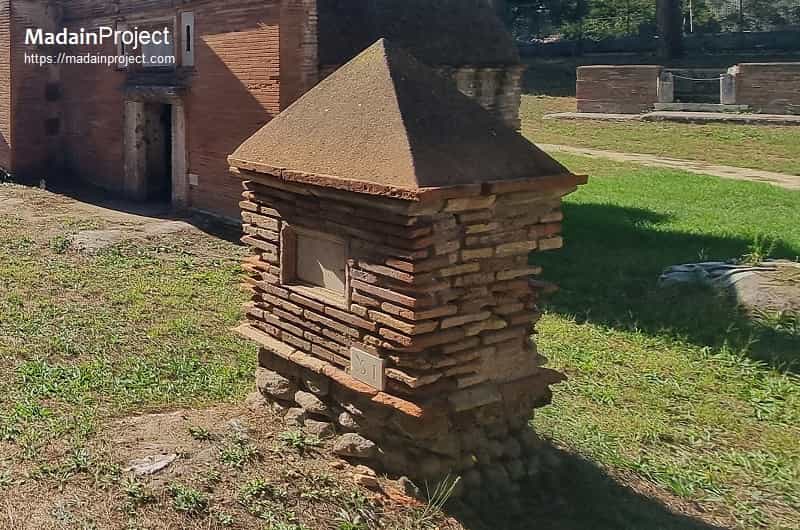
Tomb 51
Tomb 51 is a small funerary monument constructed entirely of brick, distinguished by its pointed roof. The tomb is square in plan, with sides measuring 82 cm and a height of 120 cm, making it a compact example of modest Ostian burial architecture. Originally, the tomb was oriented to face the Via Severiana, providing visibility to passersby; however, this aspect of its placement was later obscured by the construction of Tomb 42, which now blocks the original line of sight.
On the tomb is a marble inscription slab measuring 20 × 22 cm, which reads:
D(is) M(anibus)
BASSO FECIT
MYRON FRATER
BENE MERENTI
PIENTISSIMO
This inscription indicates that the tomb was commissioned by Myron on behalf of Bassus, whom he commemorates as his “very obliging and pious brother” (bene merenti pientissimo). The absence of family names in the text demonstrates that both Myron and Bassus were freedmen or slaves, reflecting the common practice in Ostia for servile individuals to erect modest funerary monuments honoring familial bonds or close personal relationships. Despite its small size, Tomb 51 provides a clear example of personal commemoration within the funerary landscape of Ostia, particularly among non-elite members of society.
circa
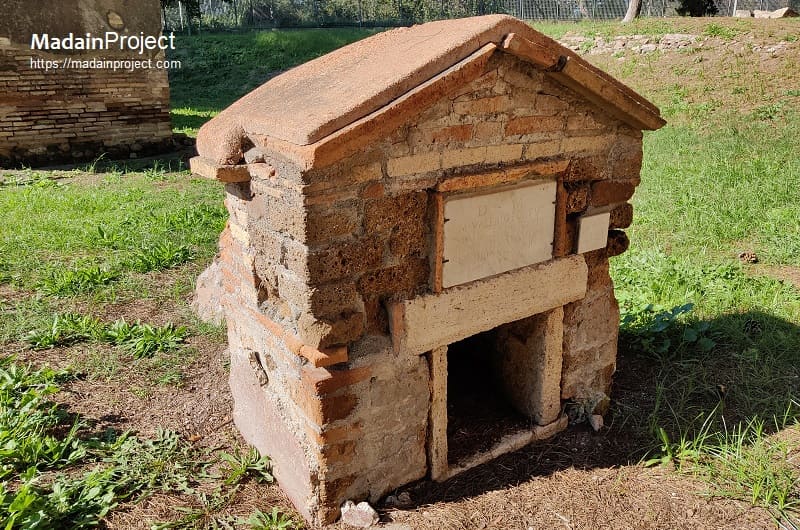
Tomb 53
Tomb 53 is an example of a tomb a cassone, a type of small Roman funerary monument resembling a chest. Unlike simpler cassone tombs, this grave is distinguished by a brick façade that culminates in a triangular pediment above the front wall. A modest entrance is located in the center of this wall, above which a marble slab bearing an inscription has been affixed. The text reads:
D(is) M(anibus)
M(arco) VALERIO FORTV
NATO SER(---) IANVARIA
MATER FIL(io) PIE(ntissimo) SVO FE
CIT SIBI S(uis) VIX(it) ANNIS III
MES(ibus) VIII D(iebus) XXV IN F(ronte) P(edes) X (in) A(gro) P(edes) X
According to this inscription, the tomb was commissioned by Sergia Ianuaria for her devout son, Marcus Valerius Fortunatus, who died at the age of three years, eight months, and twenty-five days. The text further indicates that the tomb was intended to serve not only as a memorial for the child but also for the mother and her descendants, reflecting the Roman practice of including family members within a single funerary monument. The dimensions of the tomb’s area are recorded as ten Roman feet by ten Roman feet.
Architectural and epigraphic evidence places Tomb 53 in the early to mid-second century CE, during the reigns of Hadrian or Antoninus Pius. Its design and inscription provide a clear illustration of funerary practices for children in Ostia, demonstrating both the personalization of monuments by family members and the use of compact yet carefully measured structures for commemoration.
circa
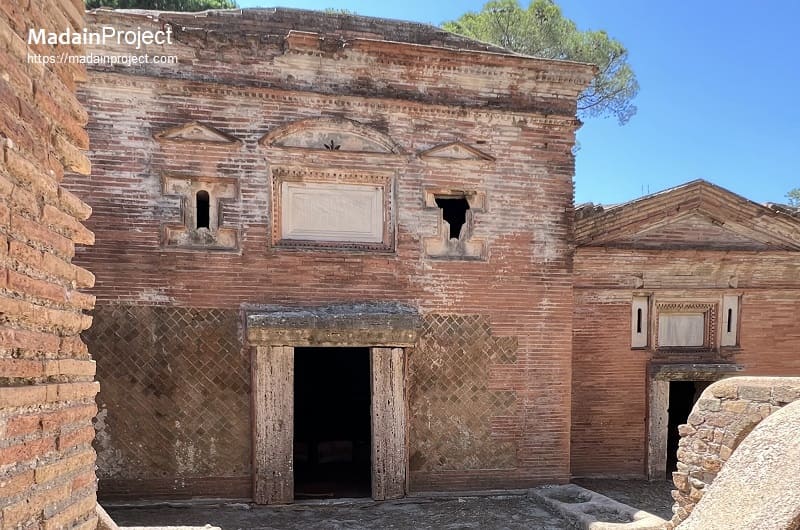
Tomb 54
Tomb 54 consists of a burial chamber preceded by an external enclosure, both of which have entrances oriented toward the Via Severiana. The enclosure was primarily occupied by a biclinium that flanked the entrance to the burial chamber, providing a space for ritual feasting associated with funerary commemoration. On its southern side, Tomb 54 abuts Tomb 75, and the façades of the two graves are aligned. Subsequently, Tomb 72 was constructed against both Tomb 54 and Tomb 72 itself; nevertheless, the entrances to Tomb 54 remained accessible. The later erection of Tomb 38, however, obstructed both the view onto the main street and the direct access from the Via Severiana.
Above the entrance of the burial chamber, a marble inscription has been preserved, reading:
D(is) M(anibus)
ATTIA PSYCHE ET
C(aius) ATTIVS ALEXANDER LIB(erti?)
FECERVNT SIBI ET SVIS LIBERTIS
LIBERTABVSQVE POSTERISQVE EORUM
H(oc) M(onumentum) H(eredes) N(on) S(equetur) VENDENDI CAVSA
FIDEIQVE EORUM COMMISSAE
NEQVE FIDVCIARIVS INTROIT(um) HAB(eat)
IN FRONT(e) P(edes) XVIII IN AGR(o) P(edes) XXXVIII
This text indicates that the tomb was erected by the freed individuals Attia Psyche and Caius Attius Alexander for themselves, for their joint freed slaves, and for their descendants. The inscription explicitly forbids any use of the monument by persons outside the family, including purchasers or fiduciaries. The area of the tomb measures eighteen Roman feet in front and thirty-eight feet in depth.
The walls of the enclosure were originally utilized to accommodate urns containing cremated remains. The biclinia, which once flanked the entrance, are no longer visible. The façade of the burial chamber is constructed from small tufa blocks up to the height of the doorway, while opus reticulatum brickwork was employed above this point, a feature unique within the necropolis. The inscription is flanked by two small, framed windows, and both the inscription and windows are topped by brick decorative elements.
The interior of the burial chamber was designed for a mixed form of burial. The walls contain a large central niche flanked by smaller rectangular niches on both sides. The left wall, however, exhibits a layout that diverges significantly from the other walls, suggesting modifications during a later reuse. The original painted decoration of the tomb has largely disappeared. The floor, like the pathway between the biclinia in the enclosure, was originally paved with a black-and-white mosaic. A notable feature of the floor is a mosaic inscription in front of the right wall reading:
T(ito) IVLIO ARGIO
This likely commemorates the individual who claimed this “place of no fear.” Stamped bricks discovered in the walls of the tomb provide a precise chronological marker, allowing the construction of Tomb 54 to be dated to 123 CE.
circa
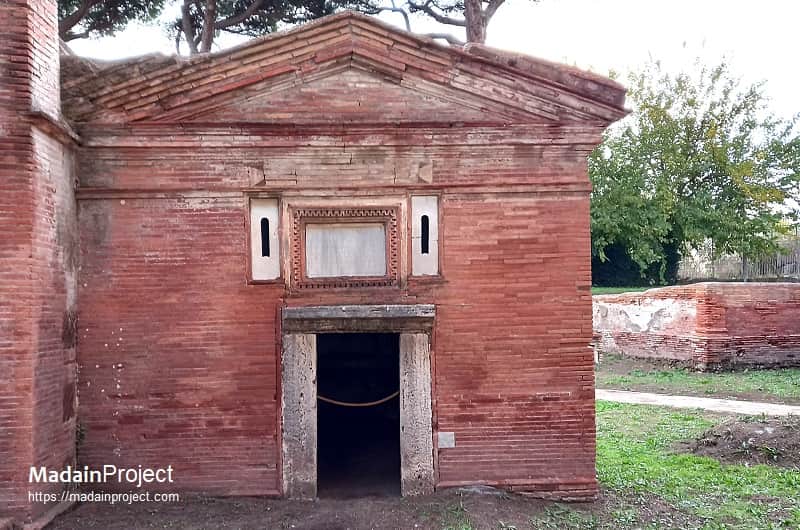
Tomb 55
Tomb 55 occupies the northernmost position within the row of graves extending from Tomb 55 to Tomb 81. It borders the area historically referred to as the "Field of the Poor" and belongs to the second period of use of the necropolis, specifically dating to the reign of Antoninus Pius (c. 138–161 AD). The entrance of the tomb was originally flanked by a biclinium, providing a space for commemorative feasting, ritual offerings, and social gatherings associated with funerary practice. In front of this biclinium, a square pedestal is preserved, which likely supported a table top in antiquity.
The façade of Tomb 55 is particularly notable for its architectural refinement, featuring a tympanum above the doorway. The entrance is flanked by two small windows, and above it is a marble slab bearing the following inscription:
D(is) M(anibus)
SCANTIA SALVINA
SCANTIAE SABINAE FILIAE
PIENTISSIMAE ET M(arcus) SVLPI
CIVS FORTVNATVS FECER(unt)
SIBI ET LIBERIS ET LIBERTIS
LIBERTAB(usque) POSTERISQ(ue) EORVM
H(oc) M(onumentum) H(eredem) N(on) S(equetur)
This inscription indicates that the tomb was commissioned by Scantia Salvina for her pious daughter, Scantia Sabina, and by Scantia Salvina together with Marcus Sulpicius Fortunatus for themselves, their children, and their freed slaves, including the descendants of both groups. The text explicitly forbids inheritance of the monument by those outside the family, ensuring that the grave remained within the immediate familial line.
The burial chamber itself is well preserved and was designed for a mixed form of interment. Three arcosolia for inhumation are arranged along the walls, surrounded by smaller niches intended for the placement of urns containing cremated remains. The barrel-vaulted ceiling was originally painted a gold-yellow color and decorated with a rich program of iconography. Among the motifs were four medallions depicting heads representing the four seasons, while two additional medallions contained satyrs. At the center of the vault, within an octagonal frame, is the depiction of a winged figure, likely representing Psyche. The decorative scheme was completed with garlands and cupids, forming a coherent funerary iconography reflecting both the cycles of life and the promise of the afterlife.
The walls of the burial chamber were also elaborately painted in a polychrome style, contrasting with the geometric black-and-white mosaic floor. The central octagonal motif of the vault was repeated in the floor mosaic, emphasizing the visual unity of the tomb’s decoration. Most of the paintings and the floor mosaic have been removed and are currently conserved in the storage facilities of the Museum of Ostia.
Tomb 55, therefore, provides a well-documented example of mid-2nd century CE funerary architecture and decoration in Ostia, combining commemorative, familial, and ritual functions within a visually sophisticated tomb complex, dating approximately to 140 CE.
circa

Tomb 56
Tomb 56 presents the appearance of a small altar with a recessed niche and represents a distinctive example of funerary sculpture in miniature form. The tomb has been relocated from its original position along the right wall of Tomb 55 to the back wall of the same tomb, suggesting adaptive reuse of the funerary space over time. The niche itself rests upon a brick base and is articulated by two tufa columns, each surmounted by capitals that support a triangular tympanum, creating a classical architectural frame for the sculptural representation within.
Within the niche, a low-relief depiction shows a double door, slightly ajar, through which a figure—undoubtedly representing the deceased—is entering. The figure is shown from behind, and although the head is no longer preserved, the scene clearly conveys the symbolic passage from the earthly realm to eternity. This iconography, featuring the departed crossing a threshold, is a motif with deep roots in Roman funerary art, reflecting the belief in an afterlife and the transition from mortal existence to the eternal.
The tomb bears the following inscription:
D(is) M(anibus)
SABINO
TAVRIO FILIO
PIENTISSIMO
FECIT
The inscription indicates that the tomb was erected by Taurius for his son Sabinus, described as “pientissimus,” or most dutiful and pious, emphasizing the filial devotion central to Roman funerary culture. The combination of the sculptural niche and the epigraph reflects both commemorative and didactic functions: it memorializes the deceased while visually reinforcing the ritual passage from life to death in accordance with Roman funerary traditions.
circa
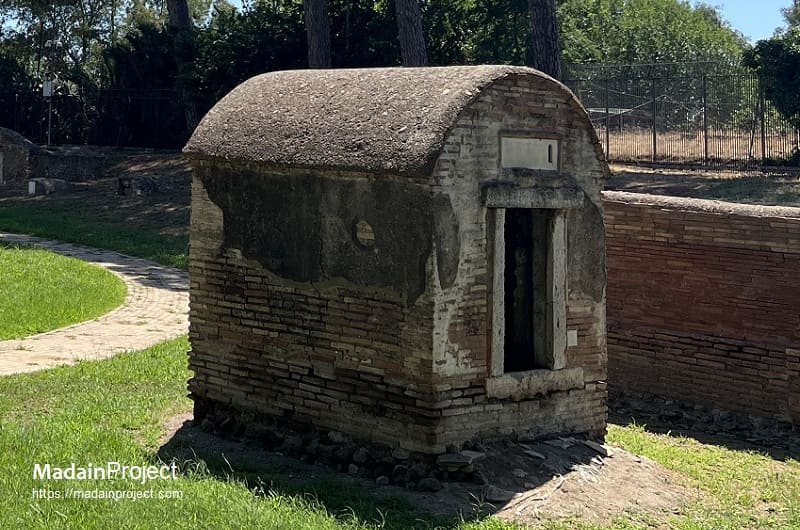
Tomb 57
Tomb 57, like its neighbor Tomb 58, is oriented toward the main street, indicating the presence of a secondary road running in front of both monuments. These two detached tombs occupy a relatively isolated position within the necropolis, separated from the denser clusters of graves. Originally, Tomb 57 functioned exclusively as a columbarium, designed to house urns containing cremated remains. However, as with many tombs in the necropolis, it underwent later reorganization and adaptation, reflecting evolving funerary practices and the continued use of the space over time.
Above the entrance of the tomb, a marble slab bears the following inscription:
D(is) M(anibus)
SEPTIMIAE TYCHENI
P(ublius) AEMILIVS TYRANNVS CONIVGI
CARISSIME ET LECANIVS
ZOSIMVS SORORI PIAENTISSIME
FECERVNT ET SVIS OMNIBVS
The inscription indicates that the tomb was dedicated to Septimia Tyche by Publius Aemilius Tyrannus, for his beloved wife, and by Lecanius Zosimus, for his very pious sister, and extended for the use of all other members of the family. This formulation emphasizes familial devotion and the integration of freedmen or non-immediate kin in Roman funerary commemorations, a common feature in Ostian tombs of the period.
The burial chamber of Tomb 57 is well preserved, though the upper portions of the walls, including niches, are no longer extant. Both the niches and remaining wall surfaces were originally decorated with elaborate paintings, which have been removed and are now preserved in the storage facilities of the Museo Ostiense. The central niche of the back wall likely contained a depiction of the tomb owner herself. Flanking this niche, two winged figures offer a crown of victory to the female deceased, a motif symbolizing her triumph over mortality and her elevation to the afterlife. On one of the side walls, the deceased was represented in a banquet scene, emphasizing the continuation of social and ritual practices beyond death. On the opposite side wall, decorative imagery included bread, fruit, and garlands, reinforcing associations with abundance, ritual offering, and the immortality of the soul.
The barrel-vaulted ceiling of the burial chamber was painted in a complex iconographic program. A nude youth was depicted at the center of the vault, while the four corners contained representations of the seasons. At the time of excavation, three of the four seasonal figures remained: Spring, depicted with a garland in her hair; Summer, shown with ears of grain; and Winter, with a veiled head. Calza noted that, despite the overall crude execution of the painting, the three surviving heads of the seasons conveyed remarkable expressiveness, demonstrating the attention to individual characterization in funerary art.
Tomb 57 can be dated to the mid-second century CE, situating it within the Antonine period and reflecting the broader trends of Roman funerary architecture and painted decoration in Ostia during this era.
circa
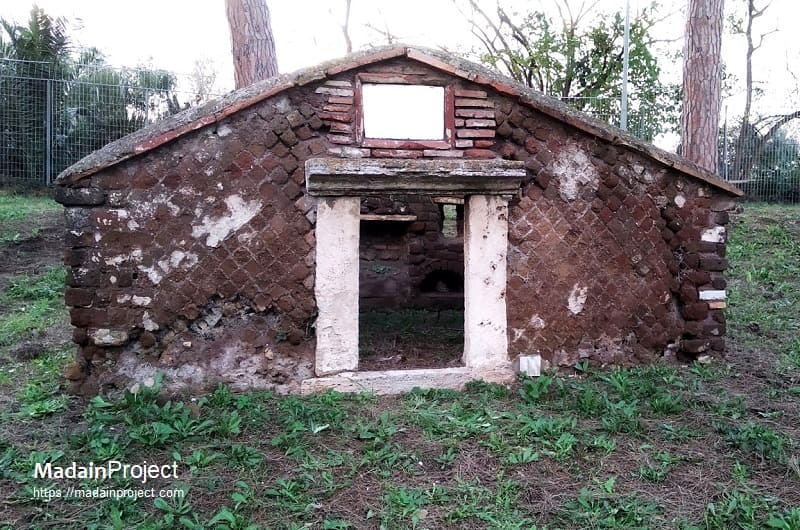
Tomb 63
Tomb 63 was originally constructed using opus reticulatum, a technique characterized by small square tufa blocks arranged in a regular check pattern. The tomb is oriented toward the Via Severiana and features an inscription above the entrance, set within a small section of the façade built in brick. This brickwork represents a later phase of the tomb’s use, indicating modifications or restorations after its initial construction. The primary inscription reads:
D(is) M(anibus)
ALFIAE M(arci) F(iliae) PROCILLAE
ET CLAVDIAE HYGIAE
CONIVGIB(us) KARISSIM(is) FECIT
P(ublius) SEXTILIVS PANNYCHIANVS
ET SIBI POSTERISQVE SVORVM
According to this dedication, Publius Sextilius Pannychianus erected the tomb for his two beloved wives, Alfia Procilla, daughter of Marcus, and Claudia Hygia, as well as for himself and his heirs. The inscription implies that the husband remarried, reflecting common Roman domestic and funerary practices where remarriage often resulted in multiple interments within a single family tomb. Based on stylistic and epigraphic analysis, Tomb 63 can be dated to the Trajanic period, approximately 125 CE.
The burial chamber was initially designed for cremation burials only, with walls preserved to a height of 2.10 metres, though the vaulted ceiling has entirely disappeared. In a later phase, when the tomb was adapted for inhumation, four niches on the right wall were removed to accommodate new burial practices, illustrating the evolving use of funerary spaces in Ostia.
Excavations revealed several niches still covered by marble slabs, with two inscriptions preserved in situ. The first reads:
D(is) M(anibus)
CONSIDIAE SATVRNINAE
M(arcus) LICINIVS HERMES
CONVIGI BENEMERENTI
ET SIBI
This dedication indicates that Marcus Licinius Hermes constructed the grave for his beloved wife Considia Saturnina and for himself. The second inscription reads:
D(is) M(anibus)
D(ecimo) SERGIO FELICI ET
PETRONIAE AVXESI
LIBERTIS LIBERTAB(usque) POSTERISQ(ue)
EORVM
This commemorates Decimus Sergius Felix and Petronia Auxesis, their freed slaves, and their descendants. These secondary inscriptions suggest that Tomb 63 functioned as a shared familial and collegial burial space, accommodating both free citizens and their liberti, consistent with Roman funerary customs in the early second century CE.
circa
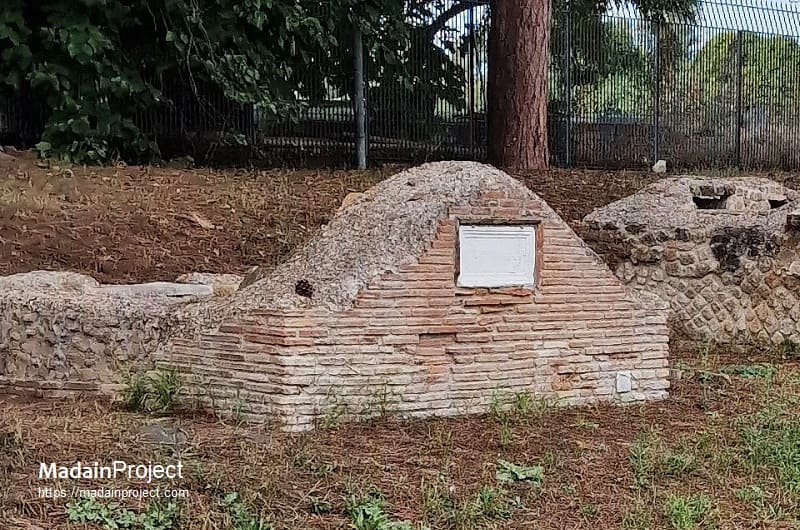
Tomb 64
Tomb 64, measuring approximately 1.30 metres in height, is notable within this necropolis for its unique orientation, with the entrance directed toward the sea rather than the Via Severiana. Despite this unusual orientation, the funerary inscription clearly references the main street, indicating the importance of maintaining symbolic connection to the urban axis. The dedication, attached to the back wall of the tomb, reads:
D(is) M(anibus)
P(ublio) BETILIENO SYNEGDEMO
BETILIENA ANTIOCHIS
CONIVGI BENE MERENTI
LIBERTIS LIBERTABVS POSTERISQVE
EORVM FECIT
According to this text, the tomb was commissioned by Betiliena Antiochis for her husband, Publius Betilienus Synegdemus, described as bene merenti, and for their freed slaves (libertis), as well as for their descendants. The inscription underscores the dual function of the tomb as both a familial and manumissional commemorative space, consistent with Roman funerary practices of the early second century CE.
The tomb was specifically used for urn interments. No evidence has been found, either beneath the floor or along the walls, for inhumation burials, confirming its exclusive use for cremation. Among the funerary artifacts recovered was a marble urn bearing both the names of the original dedicatees and the donor:
D(is) M(anibus) P(ubli) BETILIENI
SYNEGDEMI ET
BETILIENAE ANTIOCHIDI
CVRA
M(arci) COSCONI HYGINI
The inscription indicates that the urn contained the ashes of Publius Betilienus Synegdemus and Betiliena Antiochis, while the monument itself was commissioned by Marcus Cosconius Hyginus.
Additional evidence for dating comes from several stamped bricks found within the tomb, including one inscribed:
SAL(arese) EX PR(aediis) COR(neli) SEVE(ri)
This stamp identifies production during the consulship of Cornelius Severus, situating the construction of Tomb 64 within the Trajanic or Hadrianic period. The combination of epigraphic, architectural, and material evidence thus firmly places Tomb 64 in the early second century CE, exemplifying both the social networks and commemorative practices of Ostian freedmen and their families.
circa
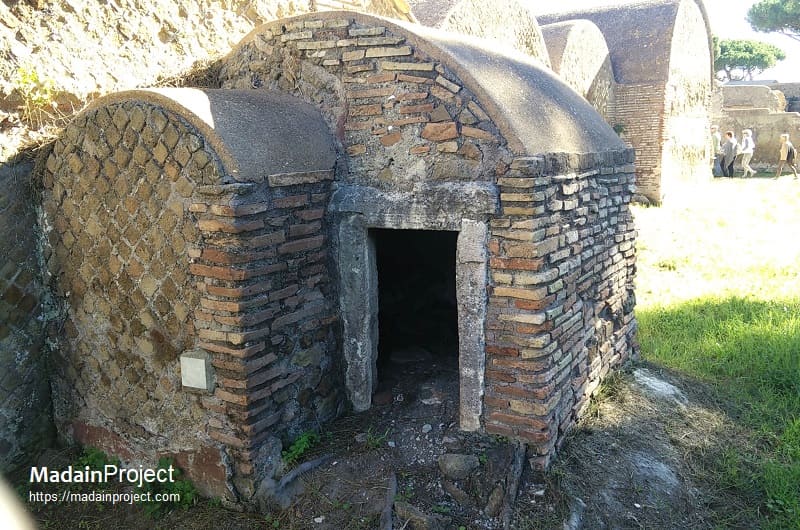
Tomb 67
Tomb 67 was originally constructed as a very small grave around 120 CE, intended solely for the interment of urns. The tomb was built against the back wall of tomb 76 and was oriented towards the south, reflecting a modest, functional design typical of early second-century funerary architecture for non-elite or freed persons. Around the middle of the second century CE, the tomb underwent a significant expansion, becoming part of a larger funerary structure. Evidence for this enlargement is provided by the inscription on the southern wall, which indicates that the tomb was adapted to accommodate the burial needs of Didia Helpis, her freed slaves, and their heirs:
D(is) M(anibus)
DIDIAE
HELPIDIS
ET LIBERTIS LIBERTAB(usque) POSTERISQ(ue)
EORUM
Originally, the entrance was positioned below this inscription; however, with the tomb’s reorganization, the entrance was relocated to the north side, suggesting an adaptation to new spatial or social requirements. Within the enlarged burial chamber, a designated area for inhumation was created along the right wall, indicating a shift from exclusive cremation to a mixed funerary practice, consistent with trends in mid-second-century Roman necropolises.
Calza noted the tomb’s particular interest due to the presence of two layers of plaster. The second layer featured a relatively crude decorative scheme comprising geometric motifs with white and yellow areas set against a red background. In the vault, a circular medallion originally contained a depiction of the head of Medusa, although this central image is no longer preserved. The architectural and decorative modifications of tomb 67 are therefore firmly dated to the middle of the second century CE, reflecting both functional adaptation and evolving aesthetic preferences in funerary contexts.
circa
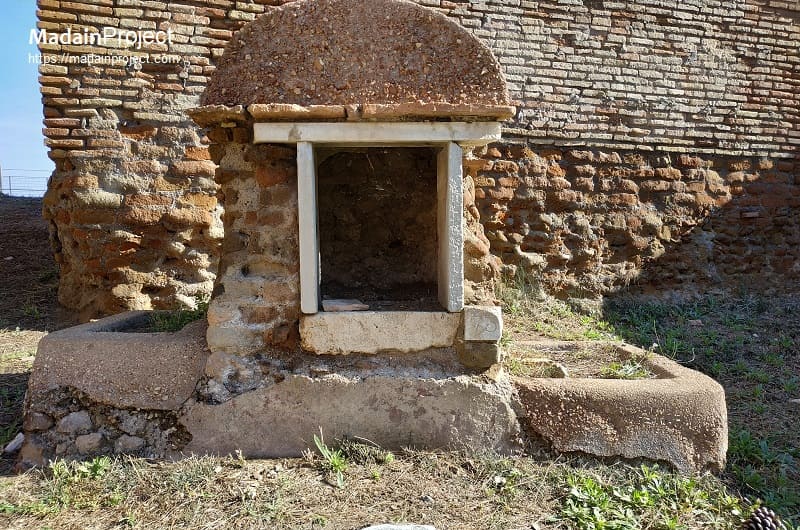
Tomb 73
Tomb 73 is an almost square funerary monument of the type known as a cassone, measuring approximately 1.05 by 0.95 metres. The entrance is oriented to the west, facing the Via Severiana, in keeping with the prevailing orientation of tombs along this street. In front of the tomb, a stone base survives, which likely supported a table used for funerary offerings or commemorative rites.
The tomb bears an inscription on a marble slab measuring 30 by 39 centimetres, positioned on the back side of the monument, which reads:
D(is) M(anibus)
L(ucio) MINDIO DIOGAE
IVLIA ZOE CONIVGI
B(ene) M(erenti) F(aciendum) C(uravit) ET SIBI
ET SVIS POSTERIS Q(ue) EORUM
According to this text, the grave was commissioned by Iulia Zoe for her devoted husband, Lucius Mindius Dioga, and was intended also for herself, her family, and their descendants. The phrasing emphasizes both marital devotion and familial continuity, a common theme in second-century Roman funerary inscriptions.
The architectural and epigraphic features, as well as stylistic parallels with other tombs in the necropolis, allow for a chronological placement of tomb 73 in the period of Antoninus Pius, reflecting the funerary practices and commemorative customs of the mid-second century CE.
circa
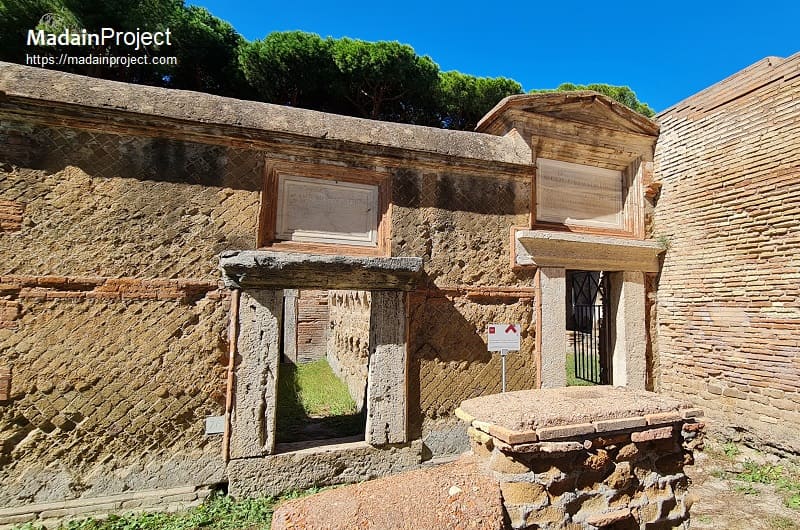
Tombs 75 and 76
Tombs 75 and 76 originated as a single, detached funerary complex, originally visible from the Via Severiana. The original structure consisted of a large, covered courtyard with a central burial chamber aligned against the midpoint of the back wall. Flanking the central chamber were two subsidiary rooms; the right room survives largely in its original form, while the left room was later converted into the burial chamber of what is now designated as tomb 76. The original entrance to the courtyard was aligned with the entrance to the central burial chamber, maintaining a coherent axial plan.
According to the epigraphic evidence, the original tomb was commissioned by Marcus Cocceius Daphnus for himself, his family, and his freed slaves, as well as for the heirs Marcus Antonius Agathias and Marcus Ulpius Domitus, along with their respective families, freedmen, and descendants. A marble slab measuring 54 by 101 centimetres above the entrance of the original courtyard preserves the inscription:
D(is) M(anibus)
M(arcus) COCCEIVS DAPHNVS
FECIT SIBI ET SVIS ET LIBERTIS LIBERTABVSQVE
POSTERISQVE EORVM ET
M(arco) ANTONIO AGATHIAE ET SVIS
ET LIBERTIS LIBERTABVSQVE POSTERISQVE EORVM ET
M(arco) VLPIO DOMITO ET SVIS
ET LIBERTIS LIBERTABVSQVE POSTERISQVE EORVM
PER FRONTE PEDES XL IN AGRO PEDES XL
This text establishes the original tomb as a multi-generational funerary complex covering an area of forty feet square. The courtyard walls were lined with numerous niches for urns, indicating its primary use as a columbarium. In front of the burial chamber of tomb 75, a round well is preserved, likely serving ritual or commemorative purposes. Along the left wall of the courtyard, a series of small tuffstone graves survives, one of which bears a marble slab of 46.5 by 25 centimetres with the inscription:
D(is) M(anibus)
COCCEIAE DORIDI M(arcus)
ANTONIVS M(arci) F(ilius) CALLISTIANVS
AVIE PIENTISSIMAE FECIT
IPSE QVI VIX(it) AN(nis) XXI M(ensibus) II
This commemorates Cocceia Doris, a grandmother honored by her grandson Marcus Antonius Callistianus, who himself lived twenty-one years and two months.
Adjacent to the right wall of tomb 75, a small grave is covered with a mosaic depicting Venus and a pigeon. This grave originally contained two bodies, and inscriptions indicate it was commissioned by Sextus Iulius Armenius for his wife, Iulia Paullina. A later interment, possibly of Armenius himself, was made by his female friend, Cocceia Tyche:
D(is) M(anibus) IVLIAE PAVLLINAE
CONIVGI BEN(e) MER(enti) FECIT
Sextus IVLIVS ARMENIVS
D(is) M(anibus) COCCEIA TY
SEXTO IVLIO ARMENIO AMICO B(ene) M(erenti) FECIT
Several other marble grave covers provide insight into the age and familial relationships of those commemorated in this tomb complex. One such slab (22 x 32 cm) records the early death of a girl, Urbica, the companion of Olympus, a slave of Matidia, daughter of Augustus Traianus, who erected the monument:
D(is) M(anibus)
VRBICAE SVAE FECIT
OLYMPVS MATIDIAE AUG(ustae) F(iliae) SER(vus)
CVM QVA VIX(it) ANNO I M(ensibus) VIII D(iebus) XXII H(oris) III
QVAE DECESSIT ANN(orum) XIIII M(ensium) XI
Another marble slab (25 x 34 cm) commemorates a slave girl, Sabina, aged six years and nine months, for whom Aelia Salviana arranged the burial:
D(is) M(anibus)
SABINAE QVAE VIXIT ANN(is) VI M(ensibus) VIIII D(iebus) XX
AELIA SALVIANE VERNAE B(ene) M(erenti) FECIT
An additional inscription, 16 x 33 cm, records the burial of Maria Semproniana, daughter of Marcus, arranged by her father, Marcus Marius Iulianus:
MARIAE M(arci) FIL(iae)
SEMPRONIANE
M(arcus) MARIVS IVLIANVS PATER FECIT
Guido Calza notes the presence of a sarcophagus cover in the open room adjacent to the burial chamber of tomb 75, originally located on the Via Severiana, featuring a relief of a priest of Cybele; two additional reliefs of the same figure were also recovered. The burial chamber of tomb 75 retains parts of a black-and-white mosaic floor with geometric motifs, which continue into the adjacent room where a triton is depicted at the center. The courtyard contains multiple burial places both above and below the floor, reflecting its original function as a columbarium. Following the subdivision of the original tomb, inhumation became increasingly common, and tomb 76 was equipped with arcosolia accordingly.
Above the entrance of the enclosure of tomb 76, a marble slab measuring 39 by 67 cm records the formal division of the original tomb:
D(is) M(anibus)
M(arcus) ANTONIVS AGATHIAS
AEDICVLAM PVRAM EX SEPVLCHRO
M(arci) COCCEI DAPHNI CVIVS HERES EST
FACTA DIVISIONE INTER SE ET COHER(e)DES SVOS
ADIECTO DE SVO PARIETE MEDIO ET OSTIO LIBERO
FACTO FECIT SIBI ET
(blank space)
LIBERTIS LIBERTABVSQVE POSTERISQVE EORVM
This inscription indicates that Marcus Antonius Agathias, as heir of Marcus Cocceius Daphnus, partitioned the original tomb, erecting a new wall and creating an independent entrance for use by himself, his freed slaves, and his descendants.
D(is) M(anibus)
M(arcus) ANTONIVS PIVS AEMILIAE
MAIORICE ET COMINIO SILVA
NO CONCESSV IN TRANTIB(us) PARTE DEXT(ra)
LIB(ertis) LIBER(tabusque) POS(terisque) EOR(um)
The combined evidence from architecture, inscriptions, mosaics, and decorative elements demonstrates the complex evolution of these tombs from a single monumental courtyard columbarium into two distinct funerary units, reflecting changes in inheritance, burial practices, and the growing integration of inhumation in the second century CE.
circa
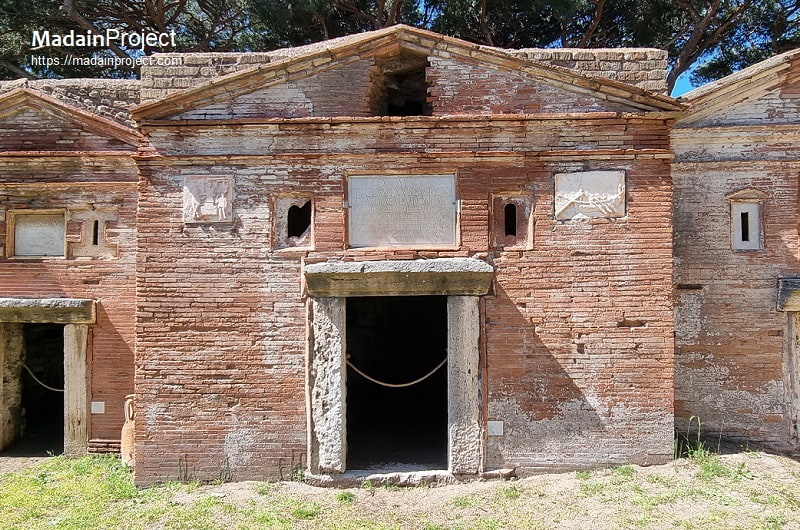
Tomb 78
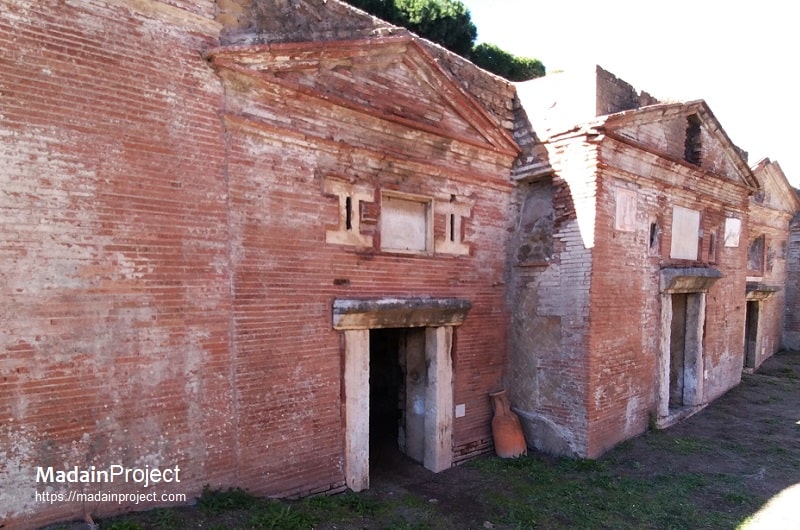
Tomb 78 forms part of the cluster of tombs numbered 77 to 80 and represents the earliest construction within this group. Unlike many other funerary complexes in the necropolis, these tombs lack enclosing walls; however, each is flanked by biclinia at the entrance, suggesting a designated area for commemorative rituals or funerary banquets. The facades of these tombs are distinguished by triangular tympanums, characteristic of early second-century funerary architecture in Ostia.
Above the entrance of tomb 78, a marble slab preserves the following inscription:
D(is) M(anibus)
TI(berius) CLAVDIVS EVTYCHUS
CLAVDIAE MEMNONIDI
CONIVGI BENE MERENTI ET SIBI
LIBERISQVE SVIS FECIT LIBERTIS
LIBERTABVSQVE POSTERISQVE
EORVM ITV AMBITVM H(oc) M(onumentum) H(eredem) N(on) S(equetur)
IN FRONTE P(edes) XV IN AGRO P(edes) XV
According to the inscription, the tomb was commissioned by Tiberius Claudius Eutychus for his well-deserving wife, Claudia Memnonis, for himself, their children, their freed slaves, and the descendants. The monument was legally restricted from inheritance, as indicated by Heredem non sequitur. The funerary area measured fifteen Roman feet both in width and depth, reflecting a modest but well-defined plot.
Adjacent to the inscription are two terracotta reliefs, offering a glimpse into the symbolic and practical motifs associated with the tomb. The right relief depicts a boat with a sternman at the helm, propelled by three seated oarsmen, suggesting a maritime or navigational theme. The left relief shows a horse operating a grain mill, guided by a servant, indicating agricultural or domestic labor and possibly alluding to the deceased’s wealth or social role.
Tomb 78 functioned primarily as a columbarium. While the back wall shows no surviving traces of painting, Guido Calza records the presence of painted niches on the side walls. In one niche, Hercules was depicted holding a club in his left hand and, likely, an apple in his right. The opposite niche contained a representation of Neptune; only the legs, the left hand holding a trident, and the right hand pointing toward a dolphin were discernible at the time of discovery.
During a later phase, formae were installed beneath the original black-and-white mosaic floor. A small section of polychrome mosaic covered a tomb a cappuccino, while in the left corner a tomb a cassone, constructed from four marble slabs, was also present. These additions reflect evolving burial practices, including the incorporation of inhumation alongside earlier cremation burials.
Architectural and decorative evidence situates tomb 78 firmly in the Trajanic period, around the early second century CE, making it one of the earlier monuments within this necropolis cluster.
circa
Tomb 79
Tomb 79 is marked by a marble inscription placed above its entrance, measuring 37 x 52 cm, which provides essential information regarding the tomb’s dedication, familial affiliations, and legal status. The inscription reads:
D(is) M(anibus)
Q(uintus) APPIVS Q(uinti) F(ilius) SATVRNI
NVS FECIT SIBI ET ANNI
AE DONATAE COIVGI SVAE
BENE MERENTI ET LIBERIS
LIBERTIS LIBERTABVSQVE
POSTERISQVE EORVM HOC
MONIMENTVM HEREDEM NON
SEQVETVR NEQVE HIS QVIBVS RELIQVI
VENDERE DONANDI IN EO IVS HABERE LICEAT
IN FRONT(e) P(edes) X IN AGRO P(edes) XII
According to this text, the tomb was erected by Quintus Appius Saturninus, son of Quintus, for himself, his wife Annia Donata, described as bene merenti, their children, freed slaves, and descendants. The legal formula explicitly forbids inheritance or sale by individuals outside the family, reflecting a common practice in Ostian funerary law aimed at preserving family control over the monument. The tomb occupied an area of ten Roman feet in width and twelve in depth, indicating a modest but carefully structured funerary space.
In front of the entrance, a biclinium was constructed, providing space for ritual meals or commemorative gatherings. Originally designed as a columbarium for cremation burials, tomb 79 was later adapted to accommodate inhumation, illustrating the evolving mortuary practices of the period. Below the niches of the burial chamber, marble nameplates once recorded the identities of the interred, a feature typical of Ostian tombs later associated with funerary collegia or guilds; similar practices can be observed in tombs 60, 63, 77, 85, 87, and 94.
The architecture of the burial chamber features a series of niches, each surmounted by a triangular tympanum, reflecting standard decorative conventions. The niche on the left wall originally contained a depiction of Neptune on a white-yellow background, clearly showing the trident in his left hand, while the niche on the right wall displayed Hercules wielding a club in his right hand. These paintings, now preserved in the storage rooms of the Ostia museum, indicate the incorporation of mythological iconography into funerary contexts.
The ceiling, plastered in white, was adorned with numerous painted circles, some of which preserved images of male and female heads, likely representing the four seasons, alongside stylized floral motifs. The majority of these paintings have been carefully removed and stored for preservation. Architectural evidence, including brick stamps recovered from the site, dates the construction of tomb 79 to approximately 123 CE, situating it within the Hadrianic period of Ostian funerary development.
circa
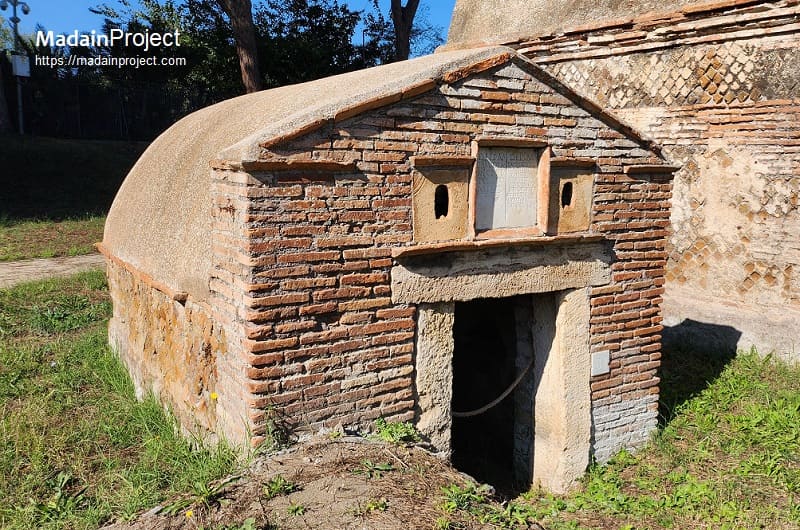
Tomb 81
Tomb 81 is a small, originally detached funerary monument, notable for its integration of ritual and commemorative features. Like many tombs in this necropolis, it originally included a biclinium in front of the entrance, intended for funerary banquets. The base of the table associated with this biclinium remains extant, providing clear evidence of the layout and use of the space. On the left bench of the biclinium, a tomb a cassone was constructed at a later stage, indicating successive use and adaptation of the site over time.
Above the entrance, a marble slab measuring 37 x 36 cm bears two inscriptions placed adjacently, each reflecting distinct commemorative actions within the same monument:
DIIS M(anibus)
CLAVDIA NICE SIBI
ET CLAVDIO LVPERCO
FILIO FECIT
DIIS M(anibus)
EX CONCESSIONE CLAVDI LVPERCI
PVRUM
C(aius) NVNNIDIVS FORTVNATVS
SIBI LIBERIS
LIBERTIS
LIBERTABVSQVE
POSTERISQVE EORVM
The left inscription indicates that Claudia Nice commissioned the tomb for herself and her son, Claudius Lupercus. The right inscription records that, with the permission (ex concessione) of Claudius Lupercus, Caius Nunnidius Fortunatus utilized a portion of the tomb for himself, his children, freed slaves, and their descendants. These inscriptions illustrate the practice of shared or partitioned tombs, a common feature in Ostian funerary architecture, where legal authorization was required to incorporate additional individuals into a preexisting monument.
At a later stage, the passageway between tombs 81 and 80 was closed through the construction of a funerary oven, reflecting the evolving functional and spatial organization of the necropolis. Tomb 80 itself is smaller and lower than adjacent tombs and was exclusively designed for the interment of urns. Its walls were painted in red, following standard decorative conventions for columbaria of the early second century CE. Architectural and epigraphic evidence suggests that tomb 80 dates to the Trajanic period.
Somewhat to the west of tomb 81, the remains of a tomb a cassone, identified as tomb 81A, are still visible. This monument is now entirely covered, and no further information regarding its decoration, inscriptions, or occupants is available. The association of tomb 81 with later modifications, including the a cassone and partitioned use, underscores the dynamic nature of funerary practices in Ostia, where monuments frequently evolved to accommodate additional burials over successive generations.
circa
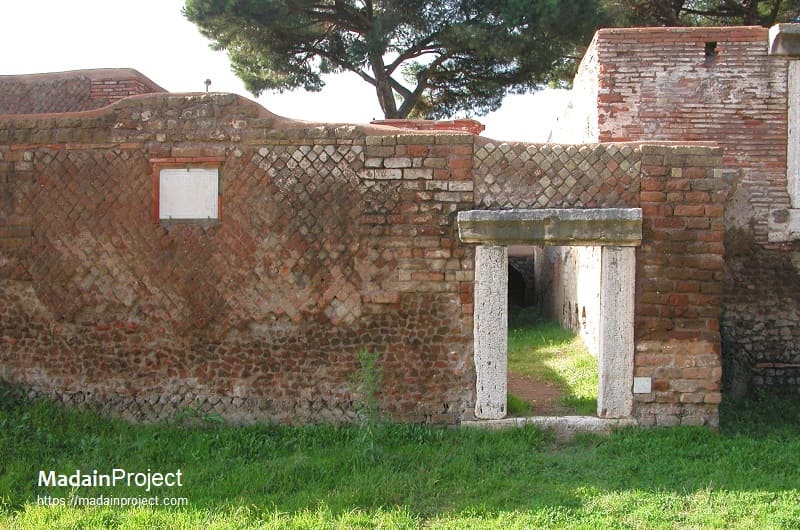
Tomb 85
Tomb 65 is the earliest of a small group of seven tombs separated from the main necropolis by a modest open area. Within this group, some monuments retain biclinia while others possess enclosed courtyards. Tomb 65 itself is among the oldest and originally lacked an enclosure; this feature was added at a later stage, reflecting successive adaptations to changing funerary practices. Above the entrance to the burial chamber, a triangular tympanum is supported by two columns, although the original inscription has not survived. The burial chamber was constructed as a columbarium, comprising aediculae flanked by series of small semicircular niches. Beneath these niches, blank marble plates were installed to receive the names of the deceased, demonstrating the chamber’s original function as a site for commemorating multiple individuals. Traces of green and red wall decoration survive within the niches and adjacent to the windows, suggesting a decorative program consistent with other early second-century columbaria. Shortly after the burial chamber was completed, additional burial places were excavated beneath the mosaic floor. These subterranean interments included terracotta sarcophagi and tombs alla cappuccina, which partially damaged the original mosaic flooring. The construction of the burial chamber is dated to approximately 120–130 CE.
The original entrance to the tomb’s enclosure was located in the southern, left wall. Around 150 CE, with the construction of the adjacent tomb 86, this original access was closed, and a new entrance was created in the wall facing the Via Severiana. The enclosure itself was initially employed as a space for funerary banquets, featuring benches along the full length of the side walls, making it one of the rare examples of a designated banquet area within an Ostian tomb, comparable only to tomb 54. Over time, the enclosure underwent significant reorganization. It was first converted into a columbarium and subsequently adapted for inhumation, both above and below the floor. Evidence indicates that probably in the third century CE, the walls of the enclosure were reconstructed in opus vittatum, combining tuff blocks and bricks, and the second entrance was closed and replaced by a slightly elevated doorway. Access to the tomb during this later phase likely involved a wooden staircase, which has since disappeared. The successive architectural modifications of tomb 65 thus reflect both evolving funerary practices in Ostia and the continued reuse of the monument over several generations.
circa
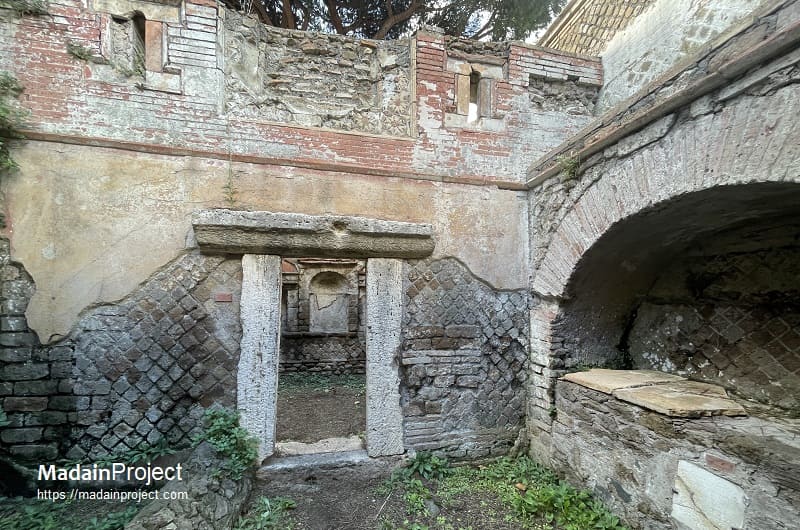
Tomb 92
Tomb 92 consists of a burial chamber originally constructed for urn interments, with an enclosure added at a later period. Unlike most tombs in the necropolis, the masonry of the enclosure differs from that of the burial chamber: the façade is executed primarily in opus reticulatum, using small tuff blocks. Tomb 92 shares its side walls with tombs 90 and 93, reflecting a dense pattern of spatial organization characteristic of later phases of the Ostian necropolis. The original inscription above the burial chamber has not survived, yet the cornice remains partially intact, revealing elements of refined architectural decoration. Adjacent to the cornice, two small windows were incorporated to illuminate the interior of the burial chamber.
The burial chamber was originally organized exclusively for the placement of urns. Along the walls are numerous small semicircular niches, as well as larger rectangular niches surmounted by triangular tympana, intended for commemorative purposes. All stucco and painted decorations have been lost, though traces of the original floor survive, revealing a black-and-white mosaic pattern. During a later reuse of the chamber, formae for inhumation were excavated beneath the floor, and platforms were added to support sarcophagi. At the same time, a new mosaic floor featuring geometric designs was installed; this floor is now preserved in the Ostian Museum. The original construction of the burial chamber is dated to the reign of Hadrian.
The façade of the enclosure aligns with the burial chamber of tomb 93. Above the entrance, a marble slab measuring 38 × 53 cm bears an inscription framed by a decorated cornice:
D(is) M(anibus)
FVLCINIAE CALLISTES
P(ublius) FVLCINIVS ABASCANTVS CVM
FVLCINIO HERMIPPO LIB(erto) P(ro) P(arte) D(imidia) FECIT SIBIQ(ue) ET
FVLCINIAE BASSILLAE FILIAE ET
FVLCINIAE DAPHNIDI VXORI ET LIB(ertis) LIBERTAB(usque)
POST(eris)Q(ue) EORVM H(oc) M(onumentum) H(eredem) F(amiliae) EX(terum) NON S(equetur)
The text records that Publius Fulcinius Abascantus, together with Fulcinius Hermippus, a freedman who contributed half of the expenses, erected the monument for himself, for his wife Fulcinia Daphnis, and for his daughter Fulcinia Bassilla, along with their freed slaves and descendants. The monument explicitly could not be inherited by persons outside the family, as indicated by the clause Heredem familiae externum non sequetur.
Despite this restriction, a later phase of use within the enclosure included an arcosolium on the right wall for unrelated individuals, demonstrating the adaptation of the space for additional burials. The associated inscription reads:
D(is) M(anibus)
IVNIAE CHELI
DONI CONIVGI
B(ene) M(erenti) ET IVNIO
CRESCENTI FI
LIO EIVS FECIT
C(aius) IVLIVS IVLIA
NVS
This commemorates Caius Iulius Iulianus, who dedicated the tomb to his well-deserving wife, Iunia Chelido, and to their son, Iunius Crescens.
The enclosure was initially designed for cremation. Above the entrance on the interior wall, a now-fragmentary painting survives; the right-hand portion, preserved in the Ostian depot, depicts two bears and two male figures, likely representing a scene from the amphitheatre. Such imagery, akin to hunting scenes, symbolized triumph over death. During subsequent reuse, additional spaces for inhumation were created along the walls and beneath the floor. Externally, the enclosure is flanked by two benches of a biclinium, with a brick base for a table, indicating that commemorative meals may have been performed in connection with the funerary cult. Tomb 92 thus demonstrates the evolution of funerary architecture in Ostia from an early cremation-focused columbarium to a multifunctional monument accommodating both urns and inhumation burials.
circa
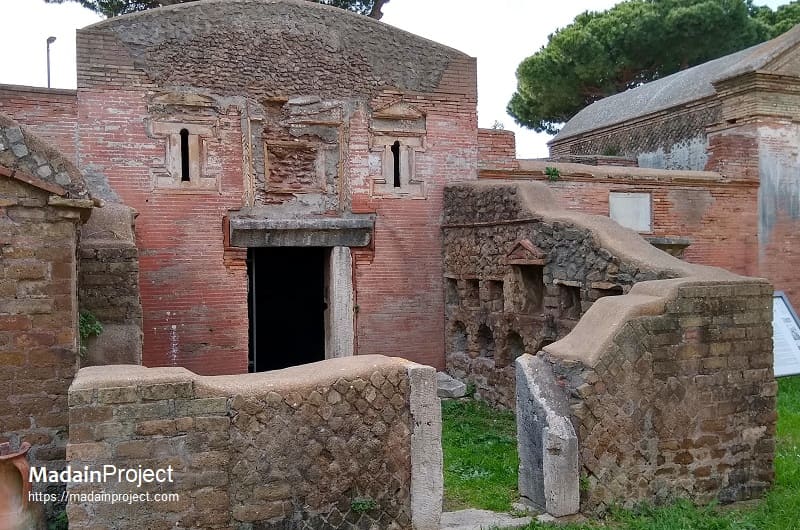
Tomb 93
Tomb 93 features an enclosure that was clearly constructed as a secondary addition to the original burial chamber. The façade and the back wall of the chamber align precisely with the corresponding elements of tomb 92, reflecting a deliberate spatial planning within this sector of the necropolis. While the original inscription above the entrance has not survived, the frame of a finely crafted cornice remains. The façade was elaborately decorated, not only with the cornice but also with floral motifs and garlands, attesting to the high level of architectural ornamentation typical of early second-century Ostian funerary monuments.
The burial chamber itself was designed exclusively for the interment of urns. The decorative program included stucco work and painted motifs, though unfortunately only fragments have survived. The back wall contains a large semicircular niche, flanked by two substantial rectangular niches, each surmounted by a triangular tympanum. Within the tympana, shell motifs are depicted, consistent with marine symbolism frequently found in Ostian funerary art. The wall containing the entrance is punctuated by two additional rectangular niches, which originally featured Dionysian paintings, reflecting the association of the god with death, regeneration, and the afterlife.
The floor of the chamber was laid in polychrome mosaic, demonstrating the continuation of Ostian traditions of geometric and colored pavement in funerary architecture. Adjacent to the back wall, a substantial brick bench was installed, likely used for ritual banquets or commemorative gatherings associated with the funerary cult. The tomb is generally dated to approximately 130 CE, situating its original construction in the Antonine period.
In a later phase of reuse, the large semicircular niche in the back wall was removed to make space for a supporting pillar. Upon this pillar, a new inscription was set, reflecting a secondary dedication:
D(is) M(anibus)
ARRIAE
MOSCHIDIS
C(aius) ARRIVS
IHERAX
PATRONAE
OPTIMAE
BEN(e) MER(enti)
FEC(it)
This text records that Caius Arrius Iherax erected the monument for Arria Moschis, his distinguished and well-deserving patroness. The reuse of the tomb for additional commemorations illustrates both the adaptability of Ostian columbaria over time and the continuing social importance of patronage relationships in funerary practices. Tomb 93, therefore, represents a combination of original Antonine funerary architecture, sophisticated decorative elements, and subsequent adaptations reflecting evolving ritual needs.
circa
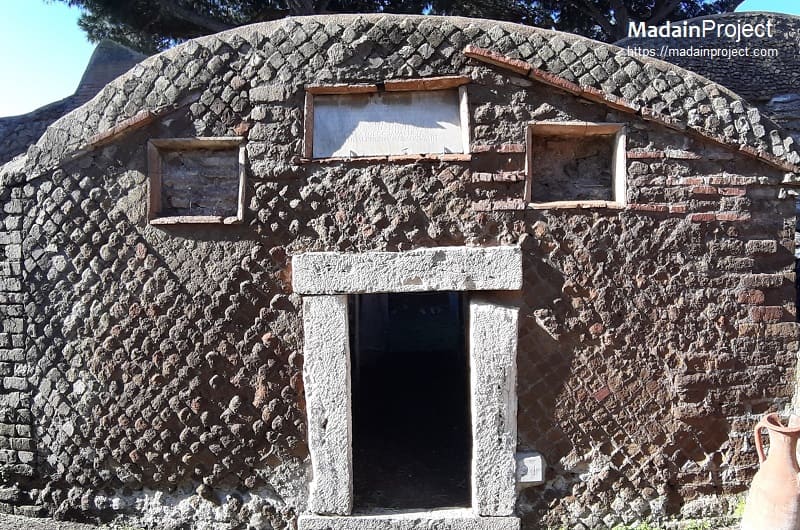
Tomb 94
Tomb 94 comprises a burial chamber and a later-built enclosure. The enclosure postdates both the original burial chamber and the adjacent tombs 93 and 95, utilizing portions of their side walls for structural support. While the original inscription above the entrance of the burial chamber is lost, a triangular tympanum remains, flanked by two small windows that once illuminated the interior. The burial chamber itself also incorporates the lateral walls of tombs 93 and 95. Its internal organization includes a central aedicula on each wall, each surmounted by a tympanum and surrounded by a series of small niches. Two arcosolia occupy the lower portions of each wall, demonstrating that the tomb was designed for a combination of cremation and inhumation practices. Beneath the smaller niches, blank marble name plates are preserved, intended for the inscriptions of the deceased, although the tomb appears to have been only partially utilized.
The decorative program of the burial chamber, though largely lost, was evidently of considerable artistic importance. Guido Calza, during the excavation, noted that the composition of the aediculae, niches, and columns along the right wall evoked stylistic parallels with Pompeian funerary architecture. Based on architectural and decorative evidence, the original burial chamber is dated to approximately 140–145 CE.
The enclosure was likely constructed around 150 CE and was used exclusively for the interment of urns. Its design includes four columbaria connected by a corridor leading to the street. Above the entrance, a marble slab measuring 35 × 78 cm once bore an inscription flanked by reliefs, which are now lost:
DIS MANIBVS
TROPHIMVS CAES(aris) N(ostri) SER(vus) ET CLAVDIA
TYCHE SIBI ET CLAVDIAE SATVRNINAE
FILIAE PIENTISSIMAE QVAE VIXIT ANN(is)
XV MENSIBVS VI DIEB(us) XIII ET LIBERTIS
LIBERTABVS POSTERISQVE EORVM
COMPARATO LOCO A VALERIA
TROPHIME P(ro) P(arte) IIII HVIVS MONVMENT(i)
This inscription indicates that the monument was erected by Trophimus, a slave of the Emperor, and by Claudia Tyche for themselves, their most pious daughter Claudia Saturnina—who lived fifteen years, six months, and thirteen days—their freed slaves, and the descendants. A fourth portion of the monument, likely corresponding to part of the enclosure, was purchased from Valeria Trophime.
The enclosure contains four columbaria and a corridor leading from the burial chamber to the street. A secondary inscription on the right side documents a subdivision of the tomb by one of the descendants of the original builders. On a marble slab measuring 30 × 35 cm, the text reads:
D(is) M(anibus)
C(aius) GALGESTIVS HELIVS LOCO PVRO
EMPTO A VALERIA TROPHIME
FECIT SIBI ET SVIS AEDICVLAM
IVNCTAM PARIETI INTRAN
TIBVS PARTE DEXTRA IN QVA
SVNT OLLAE N(umero) XIIII PRAETER
EAM OLLAM QVAM DONAVIT
TROPHIME GALGESTIO VITALI
EX QVIB(us) OL(lis) I POMPON(iae) CHRYSOPOLI D(ono) D(ed)I(t)
This indicates that Caius Galgestius Helius, after purchasing a vacant portion from Valeria Trophime, constructed an aedicula along the right-hand wall of the entrance, containing fourteen urns. One of these urns was given to Galgestius Vitalis by Trophime, and another was donated to Pomponius Chrysopolis.
A third inscription, likely originating from a second room on the right side of the enclosure (now in the Ostian depot), reads:
D(is) M(anibus)
EVHODVS CAES(aris) N(ostri) SER(vus)
ET VENNONIA APPHIS LOCO
EMPTO A VALERIA TROPHIME
FECERVNT SIBI ET LIBERTIS
LIBERTABVSQVE EIVS POSTERIS
QVE EORVM
This text records that Euhodus, a slave of the Emperor, and Vennonia Apphis, after acquiring rights from Valeria Trophime, erected this portion of the tomb for themselves, their freed slaves, and the descendants.
Tomb 94 thus exemplifies the layered development of Ostian funerary architecture: an early second-century burial chamber with substantial decorative ambitions, later enclosed and subdivided for multiple users, including imperial slaves and their descendants, reflecting both private family devotion and broader social networks within the necropolis.
circa
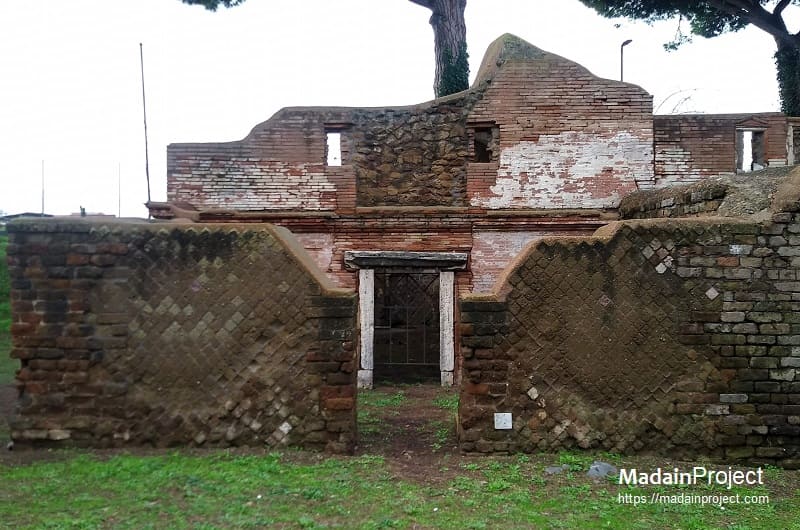
Tomb 95
Tomb 95 predates Tomb 94 and was originally a completely detached structure prior to the construction of the latter. Architecturally, the tomb was designed exclusively for cremation and exhibits a classical layout with low, central aediculae flanked by small semicircular niches along the walls. On the left exterior wall, where the enclosure of Tomb 94 abuts the burial chamber of Tomb 95, a brick column is preserved, surmounted by a rosette of flowers carved in pumice, demonstrating the decorative attention paid even to structural junctions with later constructions. The tomb’s interior decoration extended from the walls onto the ceiling, emphasizing an integrated ornamental program. Based on stylistic and architectural features, the tomb is dated to approximately 120 CE.
During a subsequent reuse of the tomb under the reign of Antoninus Pius, the burial chamber underwent significant restoration, including the application of fresh plaster and yellow paint, traces of which remain visible on the lower portions of the back wall. The ceiling originally featured twelve panels depicting the Labours of Hercules, of which six panels along the right side have survived. These panels, although fragmentary and in poor condition, are currently preserved in the Ostian depots. The surviving labours include the capturing of Cerberus, guardian of Hades; the stealing of the apples of the Hesperides; the obtaining of the girdle of Hippolyte, queen of the Amazons; the seizing of the Cows of Geryon; the capture of the Cretan Bull; and the theft of the Mares of Diomedes. These mythological subjects reflect the tomb’s symbolic engagement with themes of heroism and the victory over death.
Thylander attributes an inscription found near Tomb 95 to this monument, which emphasizes both the dedication of the builders and the strict regulations governing inheritance and use. The inscription reads:
D(is) M(anibus)
M(arcus) ANTONIVS VITALIS ET
M(arcus) ANTONIVS M(arci) FILIVS VERVS FECERVNT SIB(i)
ET SVIS LIBERTIS LIBERTABVSQVE POSTERISQVAE
EORVM
QVOD SI QVIS IN HOC MVNIMENTVM VEL INTRA MACERIAM
QVAM EIVS POST EXCESSVM M(arci) ANTONI VITALIS VENDERE VEL
DONARE ALIOVE QVO GENERE ABALIENARE VOLET AUT CORPVS
OSSVAVE ALIENIGERI NOMINIS QVAM TITVLO S(upra) S(cripto) CONTINETVR
INTVLERIT TVNC POENAE NOM[in]E IN SINGVLA CORPORA
CVLTORIBVS LARVM PORTVS [augu]STI (sestertium) III M(ilia) N(ummum)
H(oc) M(onumentum) H(eredem) E(xterum) [N(on)] S(equetur)
The text confirms that Marcus Antonius Vitalis and Marcus Antonius Verus, son of Marcus, constructed the monument for themselves, their freed slaves, and their descendants. It also stipulates a severe penalty for any unauthorized use or alienation of the tomb: should any person, following the death of Marcus Antonius Vitalis, attempt to sell, donate, or otherwise transfer the monument, or deposit the body or bones of an unrelated individual within the tomb or its walls, they were to pay a fine of three thousand sesterces to those responsible for the Lares of Portus Augusti. The inscription concludes by emphasizing that the monument could not be inherited by persons outside the family, reflecting both the legal and ritual protection of family burial spaces in Ostian funerary practice.
Tomb 95 thus exemplifies the early second-century approach to cremation burials in Ostia, combining carefully structured architecture, elaborate mythological decoration, and formalized legal inscriptions to regulate the use and continuity of family monuments.
circa
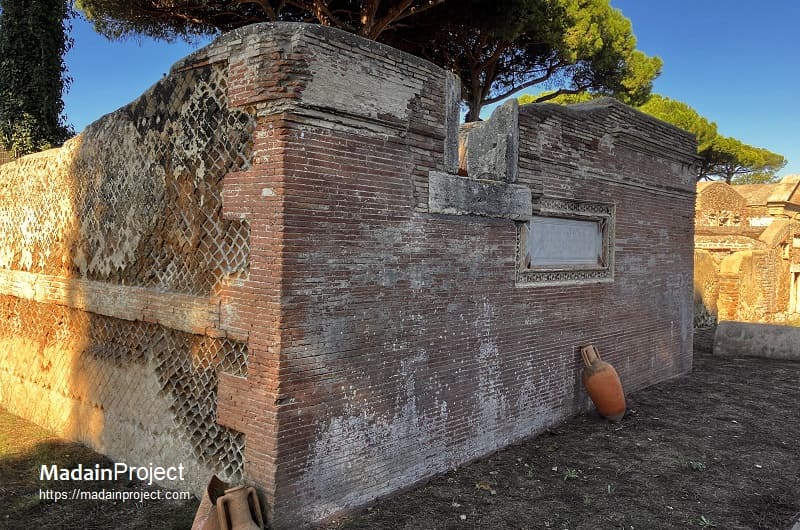
Tomb 97
Tomb 97 is a fully detached structure, standing independently on all sides within the necropolis. The original entrance is positioned on the north side, slightly left of the central axis of the façade. On the eastern portion of the façade, a marble tabula ansata is preserved, framed by an elaborately carved cornice. The inscription on this slab reads:
DIIS MANIBVS
IVLIAE L(uci) F(iliae) APOLLONIAE MATRI PIISSIMAE
C(aius) ANNIVS PROCVLVS ET C(aius) NYMPHIDIVS OGVLNIANVS
FECERVNT ET SIBI LIBERTIS LIBERTABVS POSTERISQVE EORVM
IN FRONTE P(edes) XXV IN AGRO P(edes) XXV
The inscription records that the monument was erected by Caius Annius Proculus and Caius Nymphidius Ogulnianus in honor of their mother, Iulia Apollonia, daughter of Lucius, described as matri piissimae, or “most pious mother.” The dedication further extends to themselves, their freed slaves, and their descendants. The area of the tomb measures twenty-five Roman feet in both width and depth.
No inscription survives above the original entrance of the tomb, although a visible mark on the wall indicates that one was likely once affixed. The façade and lateral walls were originally adorned with continuous mouldings, fragments of which remain on the eastern wall. Tomb 97 is architecturally unique within the necropolis. Upon entering through the north door, one is immediately in a roofed portico that extends along the western and northern sides of the tomb, supported by three columns with two barrel vaults in between. This portico opens onto a central courtyard featuring a marble altar set upon a brick base.
The tomb was initially intended exclusively for cremation. Traces of decorative motifs—primarily floral patterns and geometric designs—are visible on the walls of the niches and on the ceiling. In a subsequent phase of reuse, likely during the third century CE, a new entrance was constructed adjacent to the inscription on the eastern façade. This entrance is positioned at a considerably higher level than the original and was probably accessed via a wooden staircase. During the same period, formae for inhumation were excavated throughout the floor of the portico, indicating a functional transition from cremation to inhumation.
The altar itself appears to have been part of the original design of the tomb. It is richly decorated with grooved columns topped by capitals adorned with cornucopia motifs. Between the columns, a frieze depicts a bush, a lion, a panther, and two griffins. In the tympanum of the altar, the deceased is represented with a hairstyle characteristic of the Trajanic period, confirming the construction of Tomb 97 as one of the earliest graves in this necropolis. The secondary phase of use, involving inhumation and architectural modifications, dates to the third century CE.
The inscription on the altar reiterates the familial dedication:
D(is) M(anibus)
IVLIAE L(uci) F(iliae)
APOLLONIAE
MATRI PIENTISSIMAE
C(aius) ANNIVS PROCVLVS
ET C(aius) NYMPHIDIVS
OGVLNIANVS
It confirms that Caius Annius Proculus and Caius Nymphidius Ogulnianus erected the altar in honor of their mother, Iulia Apollonia, emphasizing her exceptional piety and highlighting the familial and ritual continuity within the tomb. Tomb 97 thus exemplifies early second-century funerary architecture in Ostia, combining cremation practice, monumental dedication, and rich decorative program with later adaptive reuse for inhumation.
circa
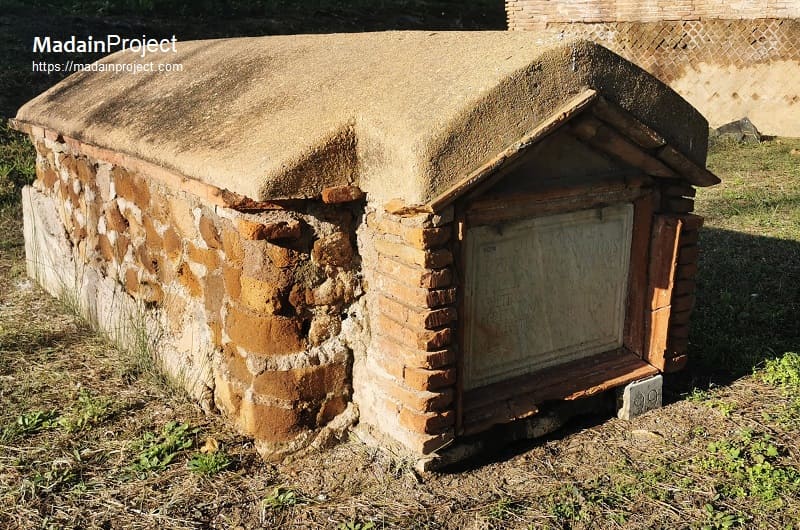
Tomb 99
Tomb 99, situated between Tomb 97 and Tomb 100, is a small funerary monument of the type known as a cassone. The tomb is characterized by a single aedicula oriented toward the street, which serves as its principal architectural feature. Within this aedicula, a marble slab measuring 34 by 37 centimeters preserves a dedicatory inscription:
DIIS MANIB(us)
PETRONIAE STOLIDIS
FIL[[L]]IAE PIISSIMAE
C(aius) PETRONIVS ANDRONICVS
ET PETRONIA MARITIMA
PARENTES FECERVNT
VIXIT ANN(is) XX D(iebus) XXII H(oris) IIII
The inscription records that the monument was commissioned by Caius Petronius Andronicus and Petronia Maritima in honor of their daughter, Petronia Stolis, described as filia piissima, “most pious daughter.” It provides her precise age at death: twenty years, twenty-two days, and four hours, illustrating the Roman preoccupation with exact chronological reckoning in funerary commemoration.
In front of the tomb, a brick or stone base for a funerary table is preserved, indicating that ritual meals or offerings were performed in association with the grave, consistent with the a cassone typology, which typically accommodated both commemorative display and small-scale funerary rites.
Tomb 99 dates to the Antonine period, specifically the reign of Antoninus Pius, situating it chronologically in the mid-second century CE. Its modest dimensions and architectural features are typical of family-oriented, private tombs of this period in Ostia, reflecting the combination of personal commemoration, filial devotion, and ritual practice within the urban necropolis.
circa
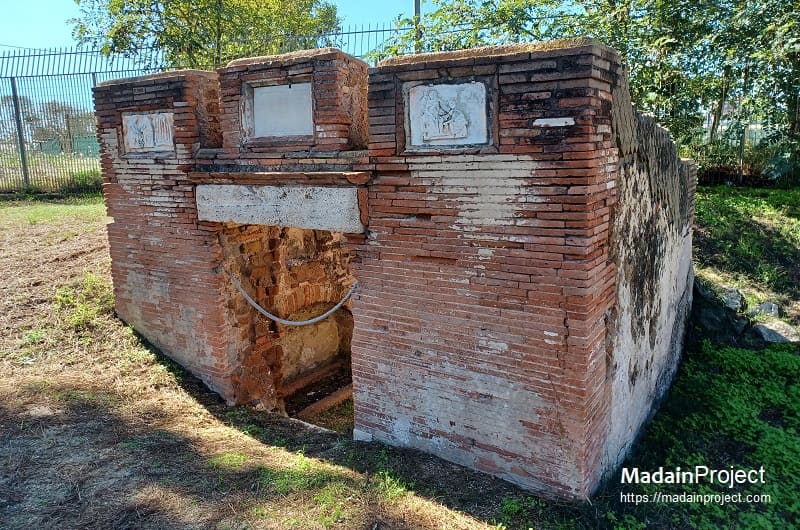
Tomb 100
Tomb 100 is a relatively small, completely detached funerary monument, notable for the absence of an enclosure. The tomb does not align with adjacent structures and is set at a lower level than the surrounding graves, a condition likely caused by localized subsidence of the terrain. The entrance of the burial chamber faces the Via Severiana and preserves a marble slab measuring 35 by 42 centimeters, which bears the following inscription:
H(uic) M(onumento) D(olus) M(alus) A(besto)
D(is) M(anibus)
SCRIBONIA ATTICE
FECIT SIBI ET M(arco) VLPIO AMERIMNO
CONIVGI ET SCRIBONIAE CALLI
TYCHE MATRI ET DIOCLI ET SVIS
ET LIBERTIS LIBERTABVSQVE POSTE
RISQVE EORUM PRAETER PANARATUM ET PROSDOCIA
H(oc) M(onumentum) H(eredem) E(exterum) N(on) S(equetur)
The inscription opens with a protective invocation, H(uic) M(onumento) D(olus) M(alus) A(besto), “May this monument be protected against intentional evil,” emphasizing the Roman concern with both spiritual safeguarding and familial legacy. The dedicators, Scribonia Attice and her husband Marcus Ulpius Amerimnus, constructed the monument for themselves, for Scribonia Callityche, her mother, for Diocles, for their family, and for their freed slaves, as well as their descendants, explicitly excluding Panaratus and Prosdocia. The text concludes with a declaration that the monument could not be inherited by outsiders, reflecting common Roman funerary legal practices designed to preserve familial rights and control over sepulchral property.
Flanking the inscription are two terracotta reliefs, which appear to reflect the professional identities of the monument’s dedicators. The left relief depicts a seated surgeon attending to a patient whose leg rests on a high chair, surrounded by an array of surgical instruments, suggesting the medical profession of Marcus Ulpius Amerimnus. The right relief shows a midwife assisting an expectant mother, supported by a third woman, with the midwife seated on a low stool in front of the patient, likely representing the profession of Scribonia Attice. Such iconography is rare in Ostian funerary art and demonstrates a deliberate celebration of personal vocation within the commemorative context.
The interior of the burial chamber was originally designed for the interment of urns. In a later period, formae for inhumation were introduced beneath the floor, covered with marble slabs, indicating a secondary adaptation of the space to accommodate changing funerary practices. In front of the tomb, two benches associated with a biclinium were once present, providing a designated area for funerary banquets, although they are no longer extant. Tomb 100 is dated to approximately 140 CE, situating it within the mid-second century Antonine period, and exemplifies both the architectural and social customs of private family commemoration in Ostia.
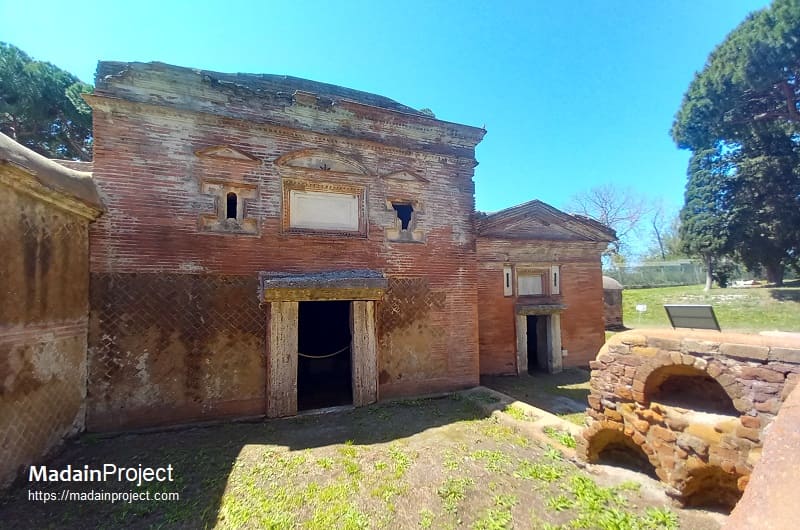
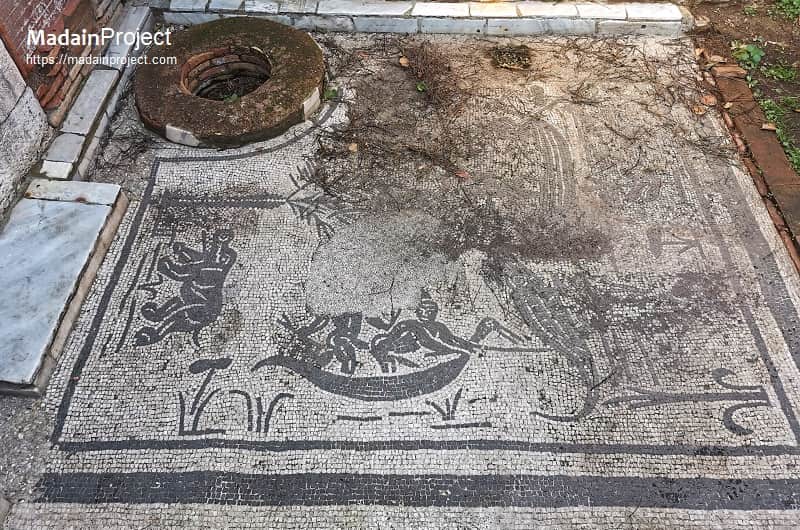
Signup for our monthly newsletter / online magazine.
No spam, we promise.

The Madain Project is an online archive of Abrahamic History and Archaeology.
Abrahamic History & Archaeology is the study of history and archaeology with respect to the three Abrahamic Faiths without considering the religious and theological aspects. The goal of Abrahamic History is to understand how and why the religious doctrines and behaviours have evlovled and changed over time. Searching for patterns in the evolution of significant cultural events such as the development of farming, the emergence of cities, or the collapse of major civilizations for clues of why and how these have influenced the three major Abrahamic religions.
Cloud Drive -
About -
Help -
Editorial Policy -
AI Policy -
Privacy Policy -
Contact
Madain Project: Encyclopedia of Abrahamic History & Archaeology.
Copyright MadainProject 2017 - 2026.


