
A Temple of Apollo refers to any sacred structure or architectural complex dedicated to the Greco-Roman god Apollo, who was associated with prophecy, music, healing, archery, and the sun. These temples served as central cultic institutions for the worship and veneration of Apollo across the Greek world and beyond, functioning both as religious centers and as political and cultural landmarks. They often housed oracular sanctuaries, featured monumental altars, and attracted regional and pan-Hellenic pilgrimages.
The Temple of Apollo or the institution of Apollo's temple transcended any single geographic location, existing as a widespread and culturally influential network of sacred spaces throughout the ancient Mediterranean. Each temple varied in design, function, and prominence depending on local traditions and political dynamics. Yet all maintained a unifying purpose: to act as a locus of divine presence, a medium for communication with the god, and a stage for rituals that affirmed communal identity. From the Delphic oracle in mainland Greece to temple complexes in Anatolia, North Africa, and Magna Graecia, these temples illustrate the adaptability of Apollo’s cult to different sociopolitical environments while preserving key theological motifs.
circa 1500 BCE- 500 CE

The earliest cults of Apollo likely emerged in the Late Bronze Age, with evidence of Apollo’s worship found in Linear B inscriptions from Mycenaean contexts (circa 14th–13th century BCE). During the Archaic period (circa 8th–6th century BCE), his cult expanded rapidly, becoming state-sponsored in many poleis. The 6th and 5th centuries BCE witnessed the monumentalization of Apollo’s temples, particularly at Delphi, Didyma, and Delos, establishing architectural norms and theological authority. Under Hellenistic patronage, many temples were rebuilt or expanded, and Apollo’s attributes were adapted to new political ideologies, including ruler cults and cosmic philosophy. In the Roman period, imperial interest in Apollo—especially under Augustus—reinvigorated several temples as centers of imperial theology. By the 4th century CE, with the Christianization of the Roman Empire, many temples were abandoned, repurposed, or systematically dismantled.
circa 1500 BCE- 500 CE
Though regional diversity shaped the construction of individual temples, a number of formal characteristics were widely shared. Most temples of Apollo followed the peripteral or dipteral plan—rectangular layouts encircled by colonnades, typically in the Doric or Ionic order. The naos (inner sanctuary) often contained a cult statue, and a pronaos (forehall) provided access. High visibility and axial symmetry were key features, reflecting Apollo’s association with clarity, order, and illumination. Innovations were also prominent—e.g., the hypaethral (open-roofed) cella at Didyma, or the intricate orientation of the temple at Delphi to align with specific solar and ritual phenomena. Temples were often integrated with oracular and healing infrastructure, including tholos shrines, sacred springs, omphalos stones, and treasuries.
circa 1500 BCE- 500 CE
Apollo’s temples were sites and hubs of multifaceted ritual and social life. Central were sacrificial rites, including holocausts and hecatombs, performed on large external altars. Apollo was also honored with choral hymns, lyric contests, and pæans, reflecting his patronage of the arts. Many temples, particularly Delphi and Didyma, served as oracular centers, where prophetesses or priestly interpreters conveyed divine insight, often after purification and incubation rituals. Healing cults, such as at Claros, involved dream incubation (ἐγκοίμησις) and sacred bathing. Annual festivals—like the Delphinia, Thargelia, and Carneia—drew pilgrims for athletic games, theatrical competitions, and ritual processions. Political consultations, treaty ratifications, and dedications of war spoils further cemented these temples as civic and interstate nodes.
circa 800 BCE– 390 CE

Delphi (mainland Greece)
The sanctuary of Apollo at Delphi was the most prominent pan-Hellenic religious center of the ancient Greek world. Situated on the slopes of Mount Parnassus, it housed the famous Delphic Oracle and the Temple of Apollo, where the Pythia, a female prophetess, delivered cryptic responses believed to be divinely inspired. Delphi also featured treasuries, a theater, and athletic facilities used during the Pythian Games, which were second only to the Olympics. The site gained prominence in the 8th century BCE and remained active until late antiquity, with its influence peaking between the 6th and 4th centuries BCE. It was formally closed during the anti-pagan persecutions of the later Roman Empire.
circa 700 BCE– 100 CE

Delos (Cyclades)
The sanctuary of Apollo, also known as the Temple of the Delians, on Delos was a major religious and commercial hub in the Aegean, mythologized as Apollo's birthplace. The sacred precinct, or Temenos, contained multiple temples to Apollo, as well as shrines to Artemis, Leto, and Dionysos, forming an extensive cultic complex. The site reached its peak in the Classical and Hellenistic periods, especially under the patronage of the Delian League and later the Ptolemies. Apollo’s temples here were focal points during festivals like the Delia, which featured athletic, musical, and processional rites. Roman intervention and a shift in trade routes led to its gradual decline by the 1st century CE.
circa 625 BCE– 150 BCE

Thermon (Aetolia)
The temple of Apollo Thermios is one of the earliest monumental Doric temples known. Located within a broader sanctuary complex, it was a political and religious center of the Aetolian League. Its original form utilized wooden columns and mudbrick walls, later replaced with stone, and featured painted terracotta metopes—a rare decorative survival from early temple architecture. The sanctuary remained active through the Hellenistic period but declined with the Roman conquest of Greece in the 2nd century BCE.
circa 600 BCE– 300 CE

Cyrene (Libya)
The sanctuary of Apollo at Cyrene was the oldest and most extensive religious complex in the city, founded by Greek colonists from Thera. The site included an archaic temple, rebuilt in the 5th century BCE, a sacred spring, a gymnasium, and numerous votive niches. Apollo was honored here as a healing deity and city founder. The sanctuary received Roman patronage under Augustus and later emperors, incorporating imperial statuary and monumental gateways, before gradually declining in the 3rd century CE due to earthquakes and shifting religious policies.
circa 600 BCE– 100 CE

Aegina (Sarconia)
The temple of Apollo on Aegina, often referred to as the Temple of Apollo Aphaia, stood on a prominent rise overlooking the sea, serving both religious and navigational functions. Although Aphaia was the dominant local deity, Apollo was worshipped in connection with regional trade and Delphic cultic authority. The temple is a classic example of early Doric architecture, featuring slender proportions and limestone construction with stucco surfacing. It was part of a sanctuary complex that included altars, treasuries, and a possible oracle, active well into the Roman period before its decline. The site reflects the fusion of local cults with pan-Hellenic deities during the Archaic period.
circa 580 BCE– 400 CE

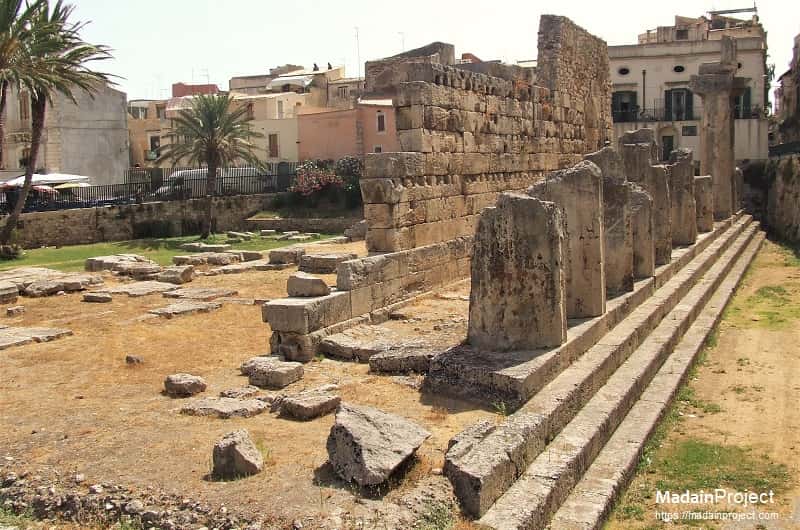
Syracuse (Sicily)
The temple of Apollo at Syracuse is the earliest extant Doric temple in the western Greek world. Built in the early 6th century BCE, it was marked by massive proportions and a robust style suited to the limestone of Sicily. Located in the city’s agora, it also reflects civic-religious integration. The structure underwent multiple transformations, serving as a Byzantine church, a mosque under Arab rule, and again a church under the Normans. Despite these conversions, many original elements remain, testifying to the temple’s continuous sacred use over nearly a millennium.
circa 550 BCE– 79 CE

Pompeii (Italy)
The temple of Apollo at Pompeii was central to the religious and civic life of the pre-Roman and Roman city. Originally constructed by Oscan or Etruscan settlers, it was later remodeled in a Roman style with Corinthian capitals and a large altar in the forum. The temple shows evidence of syncretism between Apollo and Sol, reflecting the Italic reinterpretation of Greek divinities. It remained in use until the catastrophic eruption of Mount Vesuvius in 79 CE, which preserved much of the site under volcanic ash.
circa 550 BCE– 250 CE

Claros (Ionia)
The temple of Apollo at Claros functioned primarily as an oracular center, serving nearby cities such as Colophon and Ephesus. The sanctuary, accessed by a processional road, contained a subterranean adyton where priests or interpreters—rather than a prophetess—issued oracles in hexameter verse. The temple, rebuilt during the Hellenistic period, was embedded within a sacred grove and featured a central spring. Claros retained its significance into the Roman era, though its prominence was never as pan-Hellenic as that of Delphi or Didyma.
circa 550 BCE– 300 CE

Cumae (Campania)
The sanctuary of Apollo at Cumae is most famously associated with the Cumaean Sibyl, whose oracular cave lies adjacent to the temple area. One of the earliest Greek colonies in Italy, Cumae served as a conduit for the transmission of Greek religion and language to the Italic peoples. The original temple may have been built in the 6th century BCE, with substantial Roman renovation under Augustus, who strongly patronized Apollo's cult. The Sibylline Books, attributed to this oracle, became central to Roman religious and political life. The sanctuary continued functioning until the Christianization of Campania in late antiquity.
circa 550 BCE– 300 CE

Didyma (Asia Minor)
The temple of Apollo at Didyma, near Miletus, was renowned for its oracular function and unique architectural form. Originally established by the Branchidae priestly family, the sanctuary was destroyed by the Persians in 494 BCE and rebuilt under Hellenistic patronage in a grander Ionic form. This hypaethral (open-roofed) temple was never fully completed, but its colossal columns and monumental naiskos housed a sacred spring and cult statue. The oracle at Didyma continued into the Roman period, though its influence diminished by the 3rd century CE.
circa 540 BCE– 400 CE

Corinth (Korinthos)
Temple of Apollo of Korinthos in Corinth is one of the earliest large-scale stone temples in mainland Greece, marked by its austere Doric columns and early experimentation with monumental form. Strategically located on the Acrocorinth, the temple was central to Corinth’s religious identity and political legitimacy. While no oracle function is attested, Apollo’s cult was linked to civic rituals, musical festivals, and regional diplomacy. The structure was repeatedly restored during Roman rule, reflecting both religious continuity and adaptation to new imperial aesthetics. Active for nearly a millennium, it served as a landmark of both local devotion and Greco-Roman syncretism.
circa 530 BCE
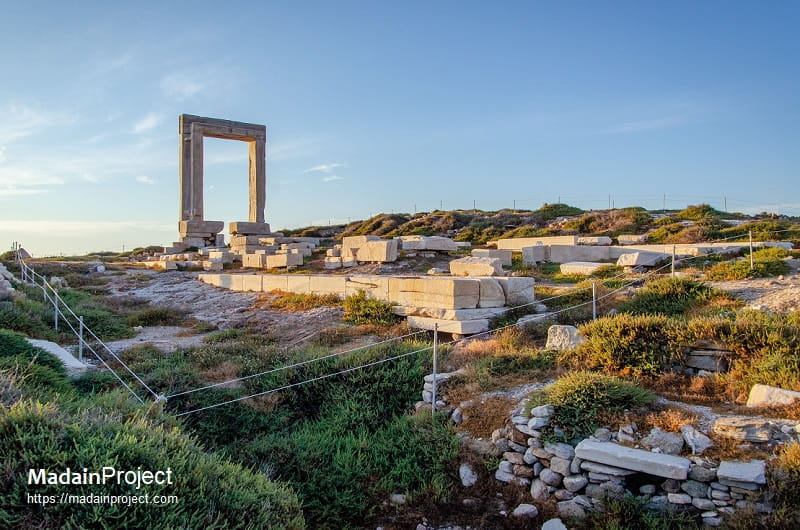
Temple of Apollo (Naxos)
The temple of Apollo at the Naxos island, famously represented by its colossal marble gateway known as the Portara, stands as a monumental testament to the island's Archaic period / Archaic Greek grandeur and the unfulfilled ambitions of the tyrant Lygdamis. Construction began around 530 BCE on the islet of Palatia, intended to be a massive peripteral dipteral temple that would rival the greatest sanctuaries of Samos and Ephesus. Built entirely of high-quality Naxian marble, the temple was designed in the Ionic order, but work abruptly ceased when Lygdamis was overthrown in 506 BCE, leaving the structure unfinished. Today, while the main body of the temple was largely scavenged for building materials during the Venetian period, the 6-metre-tall Portara remains standing as an iconic silhouette against the Aegean horizon, its massive lintels weighing over 20 tons each and perfectly aligned with the sacred island of Delos.
circa 450 BCE– 150 CE

Bassae (Arcadia)
The temple of Apollo Epikourios at Bassae was situated in a remote mountainous area and is exceptional for its architectural hybridity. Built by Iktinos, the architect of the Parthenon, it combines Doric, Ionic, and the earliest known Corinthian column in its interior. The cult epithet Epikourios ("the Helper") refers to Apollo’s perceived intervention during a plague. Though relatively isolated, the temple’s innovative design made it a reference point for later architectural theory. The structure was in ritual use into the Imperial period before being abandoned.
circa 150 BCE– 400 CE

Side (Pamphylia)
The temple of Apollo at Side was part of a seaside sanctuary complex constructed during the late Hellenistic or early Roman period. Its Corinthian colonnade and seafront position made it architecturally dramatic and symbolically resonant. Inscriptions suggest the presence of twin cults to Apollo and Athena. The temple and surrounding structures remained in use well into late antiquity and were repurposed or dismantled during the Christianization of the region in the 5th century CE.
circa 150 BCE– 400 CE
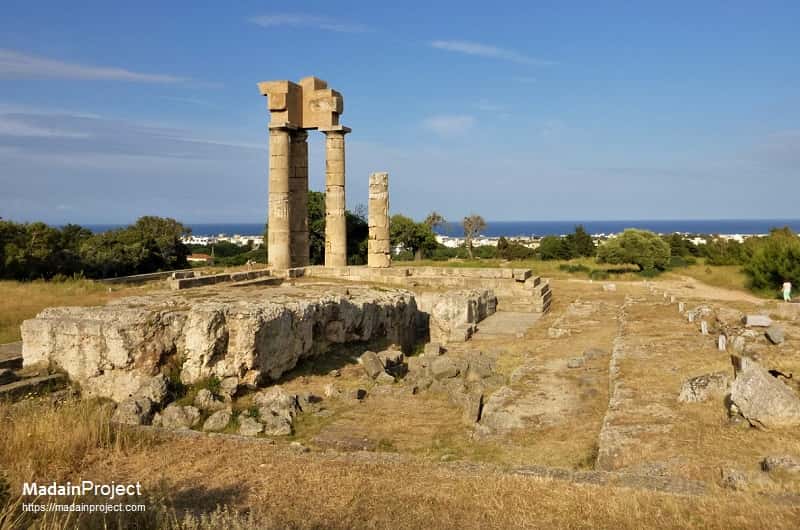
Acropolis of Rhodes (Dodecanese)
The sanctuary of Apollo Pythios on the Acropolis of Rhodes was a major Hellenistic complex integrated into a larger urban and defensive framework. Apollo was worshipped here as Apollo Pythios, a title suggesting Delphic connections, and his temple stood near other civic structures like the nymphaeum, gymnasium, and stadium. Built on a stepped terrace with commanding views of the harbor and sea routes, the sanctuary reinforced the island’s identity as both culturally Greek and politically autonomous. The temple underwent Roman enhancements, including sculptural additions and architectural refinements, and remained in use through the 4th century CE.
circa 28 BCE– 400 CE

Palatine Hill (Rome)
The temple of Apollo Palatinus, was constructed by Emperor Augustus on the Palatine Hill following his victory at Actium, symbolizing his divine favor and ideological alignment with Apollo. Inaugurated in 28 BCE, the temple was flanked by a library and featured cult statues by Greek masters such as Scopas. It became an emblem of imperial theology, linking Apollo with Roman order, harmony, and victory. Literary events, senatorial readings, and public rites were held at the site, reinforcing its civic role. The temple remained a visible symbol of Augustan rule and was referenced extensively in Latin literature before falling into disuse during the Christian ascendancy.

Signup for our monthly newsletter / online magazine.
No spam, we promise.

The Madain Project is an online archive of Abrahamic History and Archaeology.
Abrahamic History & Archaeology is the study of history and archaeology with respect to the three Abrahamic Faiths without considering the religious and theological aspects. The goal of Abrahamic History is to understand how and why the religious doctrines and behaviours have evlovled and changed over time. Searching for patterns in the evolution of significant cultural events such as the development of farming, the emergence of cities, or the collapse of major civilizations for clues of why and how these have influenced the three major Abrahamic religions.
Cloud Drive -
About -
Help -
Editorial Policy -
AI Policy -
Privacy Policy -
Contact
Madain Project: Encyclopedia of Abrahamic History & Archaeology.
Copyright MadainProject 2017 - 2026.


