
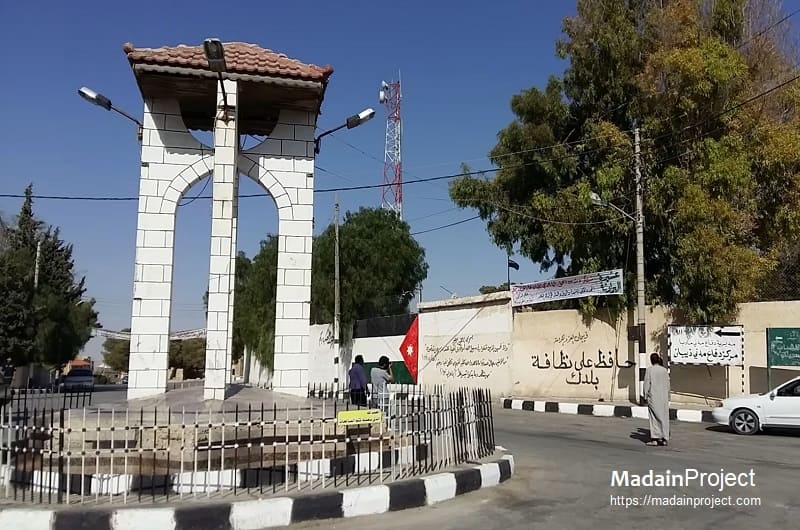
Dhiban, Jordan is a contemporary urban and municipal entity in the Hashemite Kingdom of Jordan, situated in Madaba Governorate, whose name preserves that of the ancient settlement of Dibon, a historically significant site in the Transjordan region. The modern town’s identity is deeply intertwined with the archaeological tell immediately adjacent to it, reflecting millennia of human occupation and evolving cultural landscapes in central Jordan.
Dhiban lies approximately seventy kilometres south of the Jordanian capital Amman and east of the Dead Sea, occupying a strategic position along the route historically known as the King’s Highway. This location has shaped its long-term habitation, connecting it to wider networks of trade, empire, and cultural exchange in the southern Levant. The contemporary community is predominantly composed of inhabitants who settled permanently in the mid-20th century CE, many of whom trace their roots to traditionally nomadic Bedouin groups and participate in local agriculture, service in national institutions, and other civilian vocations.
Officially called the Muhafizah Dhiban (Dhiban Protectorate) region accounts for both its present-day socio-economic characteristics and its embeddedness within broader national frameworks. As a municipality, Dhiban functions under Jordan’s administrative structures and contributes to the cultural life of Madaba Governorate. Its population, numbering in the low tens of thousands, has educational connections with universities in nearby urban centers, and the town serves as a local hub for its hinterland. At the same time, the presence of the ancient site exerts a significant influence on regional identity, drawing scholarly interest and heritage initiatives that engage both local residents and international academic institutions.

The history of Dhiban extends across several millennia and encompasses diverse political, cultural, and material developments anchored in the nearby archaeological site of ancient Dhiban. Archaeological and textual evidence indicates that the earliest known occupation at the site dates to the Early Bronze Age, in the third millennium BCE. This earliest phase is identified through limited material remains, but the continuity of settlement becomes clearer with later Iron Age strata. The site gained particular prominence in the first millennium BCE as the capital of the kingdom of Moab under King Mesha in the ninth century BCE. The importance of this period is underscored by the discovery of the Mesha Stele (Moabite Stone) in 1868 CE, a basalt inscription in the Moabite language that recounts Mesha’s military campaigns, including conflicts with the kingdom of Israel, and provides one of the most crucial epigraphic sources for Iron Age Transjordan.
Following the Iron Age, Dhiban experienced successive phases of occupation that reflect wider regional dynamics. During the Hellenistic period and Nabataean period, the site appears to have maintained a degree of habitation, though the archaeological signature is comparatively less extensive. Under Roman and subsequently Byzantine rule, the settlement expanded, evidenced by architectural remains including residential structures, public buildings, and religious edifices such as churches. By the early Islamic period, Dhiban was reestablished as a community, with material culture and settlement patterns attesting to its integration into Umayyad and Abbasid spheres. In the later medieval era, particularly under the Mamluk Sultanate, the site formed part of regional socio-economic networks, with documentary and architectural evidence indicating its function within the iqṭāʿ system and as a locus of agricultural production.
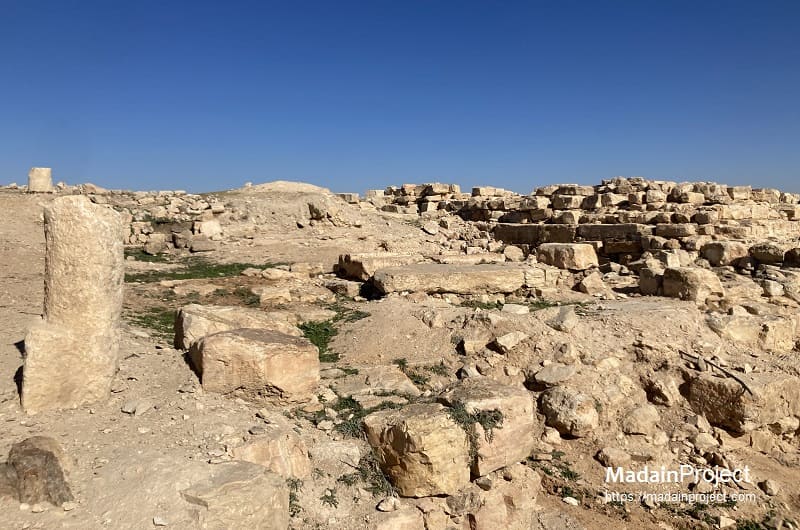
Tell Dhiban
Tall Dhiban archaeological site refers specifically to the ancient mound that dominates the landscape adjacent (west) to the modern town and encapsulates the accrued deposits of human habitation over several millennia. This artificial mound, covering over twelve hectares and rising conspicuously above the surrounding plains, has been the focus of archaeological inquiry since the early 20th century CE. Initial investigations by Duncan Mackenzie in 1910 laid the groundwork for systematic excavations, followed by extensive fieldwork in the mid-20th century under the aegis of the American Schools of Oriental Research. These campaigns uncovered substantial evidence of Iron Age architecture, fortifications, and burial practices, situating Dhiban within the political milieu of Iron Age Moab.
In the early 21st century CE, the Dhiban Excavation and Development Project—a collaborative and multidisciplinary initiative led by the University of Liverpool in partnership with American and Jordanian institutions—has advanced understanding of the site’s longue durée significance. This project integrates archaeological research with community engagement, focusing on Iron Age political systems, water management infrastructure, Byzantine and early Islamic occupation phases, and the interplay of local and imperial influences. Excavations continue to yield materials that elucidate daily life, economic strategies, and environmental adaptations across periods, reinforcing Tall Dhiban as one of Jordan’s most informative archaeological landscapes.
Signup for our monthly newsletter / online magazine.
No spam, we promise.

The Madain Project is an online archive of Abrahamic History and Archaeology.
Abrahamic History & Archaeology is the study of history and archaeology with respect to the three Abrahamic Faiths without considering the religious and theological aspects. The goal of Abrahamic History is to understand how and why the religious doctrines and behaviours have evlovled and changed over time. Searching for patterns in the evolution of significant cultural events such as the development of farming, the emergence of cities, or the collapse of major civilizations for clues of why and how these have influenced the three major Abrahamic religions.
Cloud Drive -
About -
Help -
Editorial Policy -
AI Policy -
Privacy Policy -
Contact
Madain Project: Encyclopedia of Abrahamic History & Archaeology.
Copyright MadainProject 2017 - 2026.


