
The so-called Corridor of Processions at the Palace of Knossos in Crete is a formally articulated ceremonial passage within the Neopalatial Minoan palace (circa 1700–1450 BCE), defined by its longitudinal architectural alignment and the extensive wall paintings that once depicted figures in ritualized procession, through which participants moved from the external ceremonial West Court toward the palace’s inner sacred precincts.
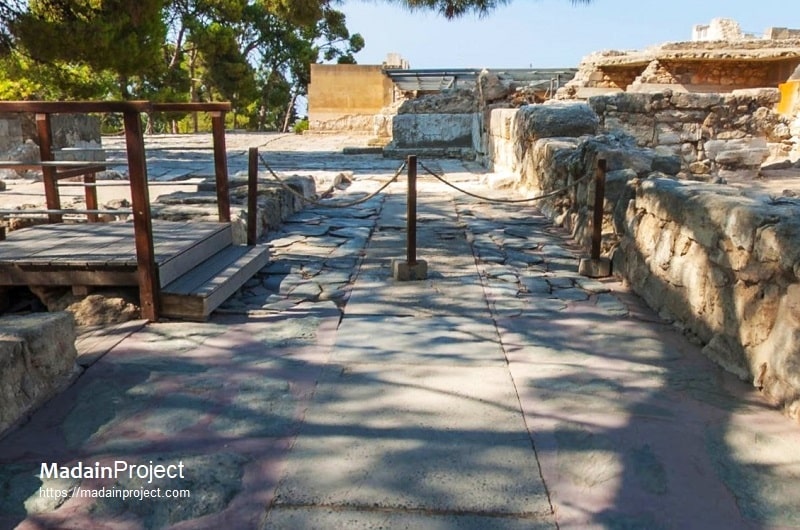
The Corridor of Processions constitutes one of the principal processional pathways of the Minoan palace complex at ancient Knossos, positioned to the south of the West Court and projecting toward the South Propylaeum and Central Court. Its alignment and construction reflect deliberate architectural planning: a paved gypsum and schist floor edged by plastered walls that once bore a continuous fresco cycle showing near life‑size male and female figures bearing offerings, musical instruments, and ritual paraphernalia.
The decorative program visually transformed the act of movement through the corridor into a performative narrative, merging the physical route with ideological expression. Scholars interpret the fresco subjects and corridor articulation as reinforcing ceremonial prestige and hierarchical relationships within Minoan society, underscoring how spatial and pictorial design operated together to sacralize movement into the palace’s most significant spaces.
circa 1700–1450 BCE

The Corridor of Processions emerges from the broader archaeological and historical context of the Neopalatial phase of the Palace of Knossos, when the settlement became the political and ritual center of the Minoan civilization on the Island of Crete. Excavated and brought to scholarly attention in the early twentieth century by British archaeologist Sir Arthur Evans (1851–1941 CE), Knossos was systematically uncovered beginning in 1900 CE, revealing the West Court, West Porch, and adjoining ceremonial passages including the corridor later named for its fresco imagery. Evans’s identification of the corridor was based on the substantial painted stucco fragments preserved in underlying fills and adherent to surviving wall sections; he reconstructed a long narrow passage with murals representing stately processions that paralleled ceremonial routes taken during festivals and formal audiences. Though some of Evans’s interpretative and restoration choices have been reassessed by subsequent scholars, the central significance of the Corridor of Processions as a designated ritual route within the palace’s spatial hierarchy has remained foundational in Minoan studies.
Archaeological evidence suggests that the corridor’s decorative and functional integration belongs to the apex of Knossos’s development in the Neopalatial era, following earlier architectural phases disrupted by seismic and other destructive events in the Protopalatial period. Its construction reflects an advanced understanding of how built space could regulate social and religious movement, directing participants from the open, communal West Court—an arena for public display and ritual—through increasingly enclosed and symbolically charged thresholds toward the sanctuary‑like heart of the palace complex.
circa 1700–1450 BCE
The route defined by the Corridor of Processions begins immediately south of the West Court, which functioned as an open ceremonial plaza bounded by altars and causeways. The corridor originates at the West Porch, a porticoed entrance flanked by a monumental column that opened onto the palace interior, and extends southward. The paved gypsum slabs of its floor, edged with green schist, continued from the porch into the enclosed corridor. Though erosion and later loss have truncated the southernmost sections, archaeological plans and surviving foundations indicate the corridor continued beyond the preserved stretch, making a right‑angled turn eastward and then northward at the South Propylaeum, which acted as a monumental gateway into more central palace precincts. The pathway thus formed a controlled, articulated axis that connected the outer ceremonial space of the West Court with the palace’s central ceremonial heart, channeling formal movement in a sequence of spatial thresholds reinforced by the iconographic program of the frescoes that lined its walls.
Signup for our monthly newsletter / online magazine.
No spam, we promise.

The Madain Project is an online archive of Abrahamic History and Archaeology.
Abrahamic History & Archaeology is the study of history and archaeology with respect to the three Abrahamic Faiths without considering the religious and theological aspects. The goal of Abrahamic History is to understand how and why the religious doctrines and behaviours have evlovled and changed over time. Searching for patterns in the evolution of significant cultural events such as the development of farming, the emergence of cities, or the collapse of major civilizations for clues of why and how these have influenced the three major Abrahamic religions.
Cloud Drive -
About -
Help -
Editorial Policy -
AI Policy -
Privacy Policy -
Contact
Madain Project: Encyclopedia of Abrahamic History & Archaeology.
Copyright MadainProject 2017 - 2026.


