
Known to Muslims as al-Haram al-Ibrahimi (الحرم الإبراهيمي), after the prophet Ibrahim or Cave of Patriarchs or Cave of Machpelah (the cave of the tombs) in Jewish tradition, is a series of caves located in the heart of the Old City of Hebron. According to the Abrahamic religions, the cave and adjoining field were purchased by Abraham as a burial plot. According to the tradition this is the place where Jewish Patriarchs and Muslim prophets Abraham (Ibrahim) Isaac (Ishaq) and Jacob (Yaqoob) are believed to be buried along their wives Sara (Sarah), Rebekah (Rifaqah) and Leah (Leah) respectively.
Nearly the entire building itself was built by King Herod and it remains the only Herodian building surviving today virtually intact. Situated beneath a Saladin-era mosque converted from a large rectangular Herodian-era structure built by Herod the Great to commmorate the site for his Jewish subjects, the series of subterranean chambers is located in the heart of the old city of Hebron (al-Khalil) in the Hebron Hills.
The date of 10 BCE mentioned in this article refers to the plausible date of the structure's construction.

circa 10 BCE

The Arabic name of the complex (الحرم الإبراهيمي) reflects the prominence given to Abraham in Islam. Outside biblical and Quranic sources there are a number of legends and traditions associated with the cave. The site is considered by Jews to be the second holiest place in the world, after the Temple Mount.
circa 10 BCE

The Herodian edifice of the Cave of the Patriarchs (Machpelah) is a monumental rectangular enclosure constructed in the late 1st century BCE, traditionally attributed to the building program of Herod the Great, and represents one of the best-preserved examples of Herodian ashlar architecture. The structure consists of massive limestone walls, approximately 6–7 m thick and rising to about 12 m in height, built of large, finely dressed ashlars characterized by the distinctive Herodian technique of smooth drafted margins surrounding a slightly raised central boss. The blocks are laid in regular horizontal courses without mortar, relying on precise stone cutting and weight for stability. The plan forms an enclosed temenos measuring roughly 34 by 59 m, with projecting corner elements that give the exterior a fortress-like appearance, though lacking true defensive features such as parapets or arrow slits.
Original entrances were limited and carefully controlled, emphasizing monumentality and enclosure rather than accessibility. The interior space was initially an open courtyard above the rock-cut burial caves, with no evidence for a freestanding superstructure from the Herodian phase; later roofing, partitions, mihrabs, and chapels reflect successive Byzantine, Islamic, Crusader, and Mamluk interventions. Architecturally, the building aligns closely with other Herodian monumental works, such as the Temple Mount enclosure in Jerusalem, underscoring its role as a dynastic and commemorative monument rather than a conventional temple.
The large Herodian edifice stands over an ancient series of caves (illustration) believed to contain the burials of patriarchs and matriarchs. Later in its history, Byzantine Christians took it over and built a Basilica which after the Muslim conquest was converted into the Ibrahimi Mosque. Crusaders took over the site in the 12th century, but it was taken back by Saladin 1188 and reconverted into a mosque. Under Israeli control the the structure has been divided in to two parts, a mosque and a synagogue.
circa 10 BCE

Cenotaph of Prophet Abraham
"Tomb of Abraham," cenotaph above the cave traditionally considered to be the burial place of Abraham and Sarah in the Haram al-Ibrahimi (Cave of the Patriarchs). The burials lie well beneath the Herodian structure, to which only two entrances are known to exist. The passage to the caves was sealed at some time after Saladin had recaptured the area, though the roof of the circular room was pierced, and a decorative grate was placed over it.
circa 10 BCE

Cenotaph of Rebekah
The cenotaph of Rebekah (ريبيكا) wife of prophet Isaac, in the southeastern section, which functions primarily as a mosque, contains two cenotaphs, symmetrically placed, near the center, with other being dedicated to Isaac. Between the two cenotaphs, in the southeastern wall, is a mihrab. The cenotaphs have a distinctive red and white horizontal striped pattern to their stonework but are usually covered by decorative cloth.
circa 10 BCE

Cenotaph of Isaac
The memorial cenotaph of Isaac (prophet Ishaq) in located in the mosque section of the Haram al-Ibrahimi. To the left (south-east) is the mehrab and the minbar of Salah al-Din Ayyubi.
circa 10 BCE
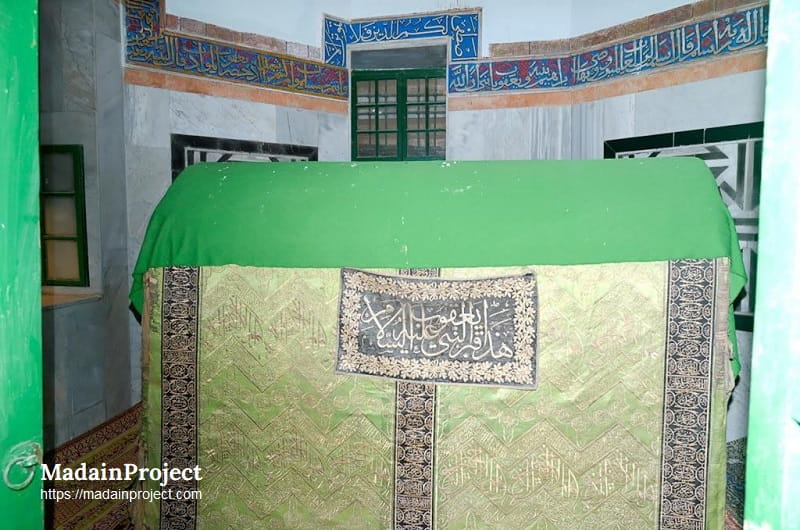
Cenotaph of Jacob
According to Genesis, Jacob was buried in the Cave of Machpelah alongside other members of the patriarchal family. The site is revered by Jews, Christians, and Muslims as the traditional burial place of Abraham, Sarah, Isaac, Rebekah, Jacob, and Leah. The present enclosure surrounding the cave is a monumental structure dating largely to the Herodian period in the late first century BCE, although the sacred association of the location predates the construction of the enclosure. Within the complex are cenotaphs traditionally identified with the patriarchs and matriarchs, including Jacob, though these monuments are commemorative rather than archaeologically verified grave markers. Owing to the site's continuous religious significance and restricted archaeological investigation of the cave itself, the biblical burial traditions cannot be independently confirmed. Nevertheless, the Cave of the Patriarchs remains one of the most important sacred sites associated with Jacob and has served as a major centre of pilgrimage and veneration for more than two millennia.
Although The existing monumental enclosure of the complex is primarily of Herodian date (late first century BCE), though the cenotaph itself reflects later architectural and devotional developments associated with the sustained veneration of the site. Archaeologically, there is no evidence confirming that the cenotaph marks an actual burial of Jacob, and the cave beneath the structure remains largely inaccessible for systematic excavation. The cenotaph therefore functions as a material expression of long-standing religious memory rather than as a verifiable funerary installation attributable to the Middle Bronze Age or any historically attested burial context.
circa 10 BCE

Along the north-eastern wall of the mosque section, an access shaft is located. This shaft is blocked with a decorative grate (inspect) and adorned with a dome. This grate allows visitors to look down into the 40-foot shaft leading to the ground level of the cave where Ibrahim and Sarah are believed to be buried. The other entrance is located to the southeast, near the mihrab, and is sealed by a large stone, and usually covered by prayer mats.
The waqf have historically prevented access to the actual tombs out of respect for the dead. When the enclosure was controlled by crusaders, access was occasionally possible. The cenotaph of Ibrahim is directly opposite of this domed structure, on the other side of the wall, in the Jewish section.
circa 10 BCE

One account, by Rabbi Benjamin of Tudela dating from 1163 CE, states that after passing through an iron door, and descending, the caves would be encountered. According to Benjamin of Tudela, there was a sequence of three caves, the first two of which were empty; in the third cave were six tombs, arranged to be opposite to one another.


Signup for our monthly newsletter / online magazine.
No spam, we promise.

The Madain Project is an online archive of Abrahamic History and Archaeology.
Abrahamic History & Archaeology is the study of history and archaeology with respect to the three Abrahamic Faiths without considering the religious and theological aspects. The goal of Abrahamic History is to understand how and why the religious doctrines and behaviours have evlovled and changed over time. Searching for patterns in the evolution of significant cultural events such as the development of farming, the emergence of cities, or the collapse of major civilizations for clues of why and how these have influenced the three major Abrahamic religions.
Cloud Drive -
About -
Help -
Editorial Policy -
AI Policy -
Privacy Policy -
Contact
Madain Project: Encyclopedia of Abrahamic History & Archaeology.
Copyright MadainProject 2017 - 2026.


