
Jacob, also known as Yaqub, Yakov, and later as Israel, is a central patriarchal figure in the Abrahamic religions. He appears prominently in the Hebrew Bible, the Christian Old Testament, and the Qur'an. According to biblical tradition, he was the son of Isaac and Rebekah and the grandson of Abraham. Jacob is particularly significant as the progenitor of the twelve tribes of Israel through his twelve sons. Although he occupies a foundational position in Jewish, Christian, and Islamic religious history, no contemporary historical or archaeological evidence has been identified that independently confirms his existence. Consequently, scholarly discussions distinguish between Jacob as a literary and religious figure and the question of his historical identity.
The principal narratives concerning Jacob are contained in Genesis 25–50 of the Hebrew Bible. These accounts describe his birth as the younger twin brother of Esau, his acquisition of the birthright and paternal blessing, his residence with relatives in northern Mesopotamia, his marriages and children, and his eventual return to Canaan. A pivotal episode recounts his struggle with a mysterious being at the ford of the Jabbok, after which he receives the name Israel. The biblical narrative presents him as the ancestor of the Israelites through his descendants.
Modern scholarship generally regards the Jacob traditions as products of a long process of oral transmission and literary development. The narratives reached their present form during the composition and editing of the Pentateuch, likely during the first millennium BCE. As a result, the stories are typically studied as expressions of ancient Israelite identity, memory, and theology rather than as straightforward historical records.
_67326.jpg)
circa 2000-1550 BCE

According to the biblical account, Jacob was born to Isaac and Rebekah after a period of infertility. His twin brother Esau emerged first, while Jacob followed grasping Esau's heel, an episode reflected in the traditional explanation of his name. The narratives place his family within the patriarchal lineage descending from Abraham.
Genesis describes Jacob acquiring Esau's birthright in exchange for food during a moment of need. Subsequently, with the assistance of his mother Rebekah, he obtained Isaac's blessing that had been intended for Esau. These events created hostility between the brothers and prompted Jacob's departure from his parental household.
Jacob travelled to the household of his maternal relatives in Paddan-Aram, generally associated with the region of Upper Mesopotamia. There he entered the service of his uncle Laban. The biblical narrative recounts his marriages to Leah and Rachel, as well as his relationships with Bilhah and Zilpah. Through these women he became the father of twelve sons and at least one daughter, Dinah. The twelve sons later became identified with the tribes of Israel.
One of the most significant episodes in Jacob's life occurs during his return journey to Canaan. Near the Jabbok River he wrestled through the night with a mysterious figure. Following this encounter he received the name Israel, commonly understood within the narrative as signifying a transformation in status and destiny. The location was subsequently named Peniel.
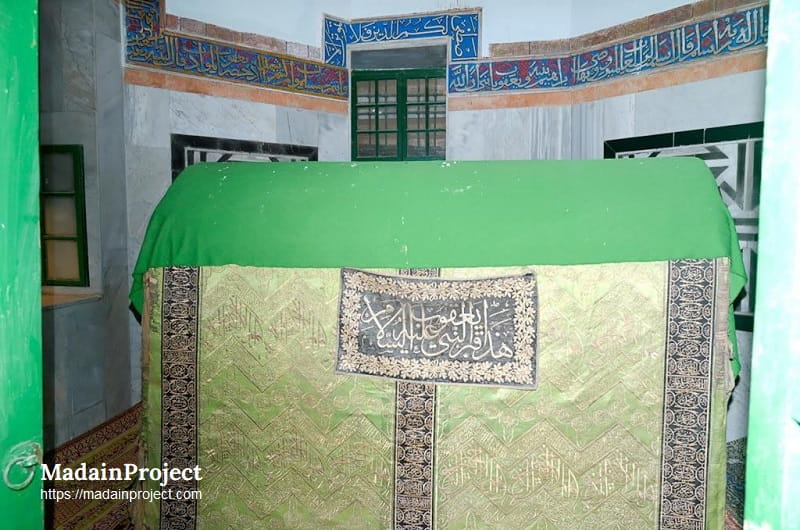
Later narratives describe Jacob's settlement in Canaan and the events surrounding his son Joseph. During a famine, Jacob and his family migrated to Egypt, where Joseph had risen to a position of authority. Jacob spent his final years there and died in Egypt. According to Genesis, his body was transported to Canaan and interred in the Cave of Machpelah near Hebron, a burial site associated with the patriarchs and matriarchs.
circa 2000-1550 BCE
_436276.jpg)
Judaism
In Judaism, Jacob is one of the three patriarchs, alongside Abraham and Isaac. He occupies a central place in Jewish religious memory as the father of the twelve tribes of Israel and the bearer of the name Israel. Biblical and rabbinic traditions present him as a key recipient of divine promises concerning land, descendants, and covenantal continuity. His experiences, journeys, and encounters with God became important themes in Jewish interpretation and liturgy.
Rabbinic literature greatly expanded the biblical portrait of Jacob, emphasizing his righteousness, devotion, and role in preserving the covenantal heritage of Abraham and Isaac. Jewish tradition frequently regards him as a foundational ancestor of the Jewish people.
circa 2000-1550 BCE
Christianity
Christianity inherited the figure of Jacob through the Hebrew Scriptures. The New Testament refers to him in genealogical, theological, and historical contexts. Christian interpretation commonly views the patriarchal narratives as part of the unfolding history of salvation that culminates in the life and ministry of Jesus.
The episode of Jacob's ladder became especially influential in Christian theology and symbolism. Church Fathers and later theologians often interpreted aspects of Jacob's life typologically, viewing events in the patriarch's story as foreshadowing themes developed in the New Testament. Jacob therefore occupies an important position within the broader biblical narrative shared by Christians.
circa 2000-1550 BCE
_427487.jpg)
Islam
In Islam, Jacob is known as Yaqub and is recognized as a prophet. He is mentioned numerous times in the Qur'an and is presented as a faithful servant of God who upheld the monotheistic tradition inherited from Abraham and Isaac. The Qur'an identifies him as the father of Yusuf (Joseph) and portrays him as an exemplar of patience, trust in God, and steadfast belief.
Islamic tradition regards Yaqub as one of the patriarchs through whom divine guidance was transmitted. Qur'anic narratives place particular emphasis on his grief over the apparent loss of Yusuf and his enduring confidence in God's mercy and wisdom. As in Judaism and Christianity, he is viewed as a significant link in the chain of prophetic succession descending from Abraham.
circa 2000-1550 BCE
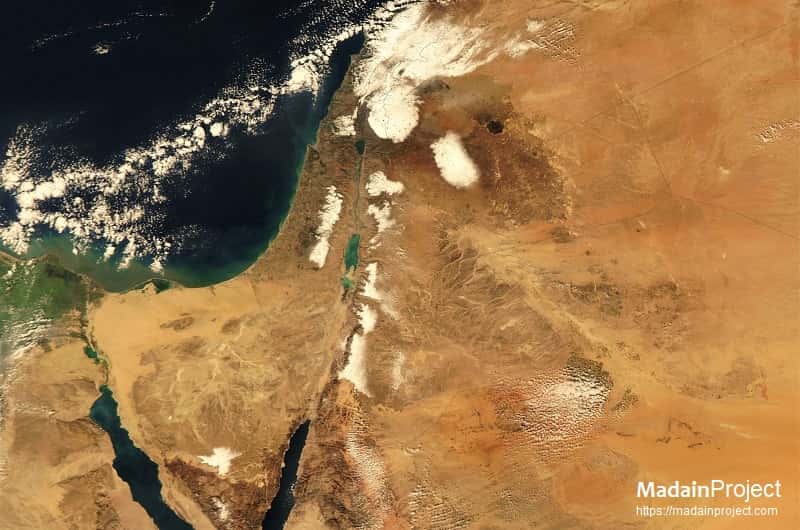
No archaeological evidence has been discovered that can be directly and unequivocally attributed to Jacob as an individual. Consequently, archaeological investigation focuses on places, landscapes, settlement patterns, and cultural contexts associated with the patriarchal narratives rather than on the historical verification of the person himself.
Several locations associated with the Jacob traditions have long attracted scholarly attention. Hebron, one of the oldest continuously occupied urban centres in the southern Levant, is associated in biblical tradition with the patriarchal family. The Cave of Machpelah, traditionally identified as the burial place of Abraham, Isaac, Jacob, and their families, became an important pilgrimage site in Jewish, Christian, and Islamic traditions. While the site's religious significance is ancient, archaeology cannot confirm the patriarchal burials described in Genesis.
Bethel occupies a prominent place in Jacob's story as the location of his dream of a ladder reaching heaven during his departure from Canaan. Archaeologists have investigated sites identified with ancient Bethel, particularly in the central hill country of the southern Levant. Excavations reveal occupation during various periods of Bronze Age and Iron Age history, although no evidence directly links the site to Jacob himself.
The narrative setting of Jacob's sojourn with Laban the Aramean is commonly associated with Upper Mesopotamia, particularly the region around Harran. Harran was an important urban and commercial centre during the second and first millennia BCE. Archaeological research has documented its long history and strategic role within regional trade networks. Although the city appears in patriarchal traditions, no material evidence connects Jacob personally to the site.
Jacob's return journey to Canaan is associated with the Jabbok River, generally identified with the modern Zarqa River in present-day Jordan. The river forms the setting for the episode at Peniel, where Jacob is said to have encountered a mysterious being and received the name Israel. Archaeological investigations in the Zarqa river valley have documented settlement and human activity from the Neolithic period onward, including substantial occupation during the Bronze and Iron Ages. Scholars study the geography of the region to understand the landscape within which the biblical narrative was constructed, but the specific events described remain archaeologically unattested.
Following his return to Canaan, Shechem emerges as an important location associated with Jacob and his descendants. Situated in the central highlands of Canaan, the city was a major political and religious centre during the Bronze and Iron Ages. Excavations at Tell Balata, widely identified with ancient Shechem, have uncovered fortifications, temples, and domestic structures that illuminate the urban environment reflected in biblical traditions.
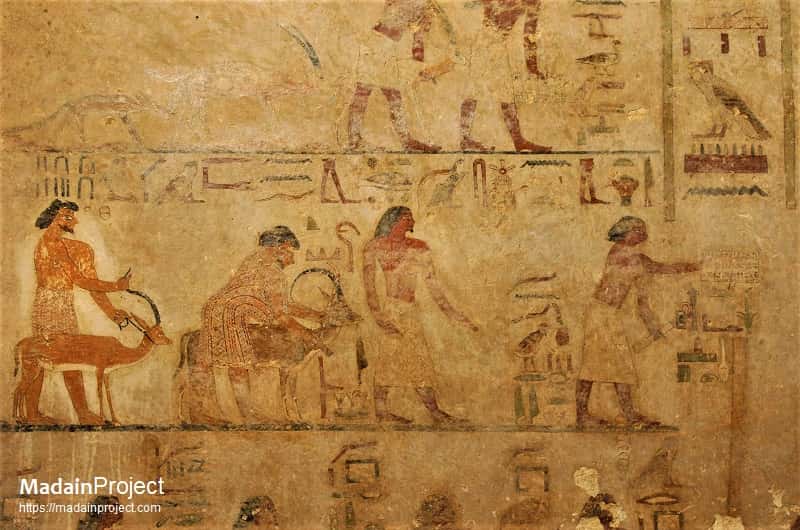
Ancient Egypt features prominently in the final chapters of Genesis. Archaeological and textual evidence demonstrates extensive contacts between Egypt and the Levant throughout the Bronze and Iron Ages. Evidence for contacts between Egypt and populations from the Levant is also reflected in the well-known tomb BH3 painting of the Twelfth Dynasty official Khnumhotep II at Beni Hasan, which depicts a group of West Asiatic visitors, often identified as people from the Levant, entering Egypt during the early second millennium BCE. These interactions provide a plausible background for traditions involving migration and residence in Egypt, though no evidence specifically identifies Jacob or his family within the Egyptian archaeological record. According to the Genesis narrative, Jacob and his family settled in the land of Goshen (perhaps at or near Avaris) in the eastern Nile Delta, a region traditionally associated with the Israelites' residence in Egypt, although its precise location remains a subject of scholarly debate.
The broader cultural setting of the Jacob narratives has been examined through evidence from Bronze and Iron Age societies of the Levant and Mesopotamia. Archaeological discoveries relating to pastoralism, kinship structures, settlement systems, and regional mobility provide comparative contexts for understanding the patriarchal traditions. Such evidence helps scholars reconstruct aspects of the ancient Near Eastern world in which these narratives were composed and transmitted, even though it does not establish the historicity of Jacob himself.
The archaeological and material context of Jacob therefore consists primarily of the landscapes associated with the patriarchal traditions: Hebron, Bethel, Harran, the Jabbok Valley, Shechem, and Egypt. These places possess substantial archaeological histories and illuminate the cultural environments reflected in the biblical and later religious narratives, while remaining distinct from questions concerning the historical existence of Jacob as an individual.

Signup for our monthly newsletter / online magazine.
No spam, we promise.

The Madain Project is an online archive of Abrahamic History and Archaeology.
Abrahamic History & Archaeology is the study of history and archaeology with respect to the three Abrahamic Faiths without considering the religious and theological aspects. The goal of Abrahamic History is to understand how and why the religious doctrines and behaviours have evlovled and changed over time. Searching for patterns in the evolution of significant cultural events such as the development of farming, the emergence of cities, or the collapse of major civilizations for clues of why and how these have influenced the three major Abrahamic religions.
Cloud Drive -
About -
Help -
Editorial Policy -
AI Policy -
Privacy Policy -
Contact
Madain Project: Encyclopedia of Abrahamic History & Archaeology.
Copyright MadainProject 2017 - 2026.


