
Ancient Megalopolis was a purpose-built Greek city in southwestern Arcadia, founded in the early fourth century BCE as the federal capital of the Arcadian League. Created through synoecism, it unified the populations of numerous Arcadian communities into a single urban center intended to serve permanent political and administrative functions. The city was established in the context of the reorganization of power in the Peloponnese following the weakening of Sparta and was designed to operate as a strategic, military, and ideological counterbalance to Spartan influence. Its scale, planned urban layout, and concentration of federal institutions reflected its role as both the administrative seat of Arcadia and a symbolic expression of collective Arcadian identity within the Greek world.
Megalopolis occupied a broad plain along the Helisson River in Arcadia and was conceived on a scale unprecedented for an inland Greek city. Its name, Megalópolē, meaning “Great City”, reflected both its physical size and its ideological ambition as the center of a unified Arcadian polity. Unlike cities that grew organically over centuries, Megalopolis was deliberately designed to consolidate population, power, and identity in response to shifting geopolitical conditions following the decline of Spartan dominance.
Its urban plan incorporated monumental civic spaces, large public buildings, and extensive fortifications, emphasizing its role as a federal and administrative hub rather than merely a local polis.
The present day Megalopoli lies within an expansive intermontane basin encircled by mountain ranges: Mount Taygetus to the south, Mount Mainalo to the north, Mount Tsemperou to the southeast, and Mount Lykaion to the west. The town stands at an altitude of approximately 430 meters above sea level. The Alfeios River traverses the valley, entering from the east and flowing northward before curving to the south and west of the settlement, while its tributary, the Elissonas, runs to the north of the town. Extensive lignite reserves in the surrounding area have been developed through open-cast mining, and since 1969 these deposits have supplied fuel to the Megalopoli Power Plant, located about three kilometers northwest of the town center.
circa 900,000 BCE- 600 CE

The Megalopolis basin in southwestern Arcadia was inhabited long before the foundation of the Classical period city. Geological deposits in the area consist of lignite-bearing sediments laid down between approximately 900,000 and 150,000 years ago, when the region was occupied by a large shallow lake. These deposits have yielded abundant fossil remains of Pleistocene megafauna, including the extinct straight-tusked elephant (Palaeoloxodon antiquus) and the large hippopotamus Hippopotamus antiquus. Archaeological evidence indicates that the area was inhabited by Homo heidelbergensis around 500,000–400,000 years ago, including cut-marked elephant and hippopotamus bones demonstrating systematic butchery. In antiquity, the frequent discovery of large fossil bones, combined with naturally smouldering lignite seams that scorched the ground during summer, led Greek authors to associate the area with the mythical Gigantomachy. Pausanias records local traditions identifying Megalopolis as the battlefield where the Giants were slain by the gods, an interpretation likely inspired by these visible geological and paleontological features.
The historical city of Megalopolis was founded between 371 and 368 BCE in the aftermath of the Battle of Leuctra, which decisively weakened Spartan hegemony in the Peloponnese. Its creation was promoted by the Theban general Epaminondas as part of a broader strategy to contain Sparta by strengthening regional federations. The city was established through the synoecism of approximately twenty to forty Arcadian communities, whose populations were forcibly resettled into a newly planned urban center. This process was deliberately coercive, intended to ensure the demographic and political viability of a federal capital. From its foundation, Megalopolis served as the seat of the Arcadian League and hosted its principal political institutions until the dissolution of the federation in 362 BCE.
During the mid-fourth century BCE, Megalopolis faced repeated Spartan attempts to dismantle it. In 353 BCE, Sparta sought to reduce the city while Thebes was occupied with the Third Sacred War, but Theban military intervention prevented its capture. In 331 BCE, Megalopolis was again attacked by Sparta, prompting a battle in which Macedonian forces intervened on the city’s behalf. In 317 BCE, during the early phase of the Second War of the Diadochi, the Macedonian regent Polyperchon besieged Megalopolis after the city supported his rival Cassander; the siege ultimately failed.
In the early third century BCE, Megalopolis fell under the control of the tyrant Aristodemus, backed by Macedon. His rule ended in 235 BCE when Lydiadas of Megalopolis voluntarily relinquished his own tyranny and led the city into the Achaean League. As a member of that federation, Megalopolis became a major political center and exerted substantial influence on federal policy. In 222–223 BCE, the Spartan king Cleomenes III captured and burned the city during his campaign against the Achaean League. Although Megalopolis was rebuilt in the years that followed, the destruction marked a lasting turning point. Nevertheless, the city remained prominent in Achaean affairs and was the birthplace of several leading figures, including Philopoemen, Lykortas, and the historian Polybius.
Megalopolis was incorporated into the Roman sphere following Rome’s victory in Greece in 146 BCE during the Third Macedonian War. Under Roman rule the city remained inhabited but steadily declined in population and political importance, overshadowed by coastal and administrative centers. By the second century CE, when Pausanias visited, large areas of the city were already sparsely occupied or in ruins, though its monumental public buildings were still visible. By the sixth century CE, the settlement was nearly abandoned. In the Byzantine Empire era and later Ottoman period, habitation continued on a reduced scale under the name Sináno. The modern town was renamed Megalopoli after the Greek War of Independence.
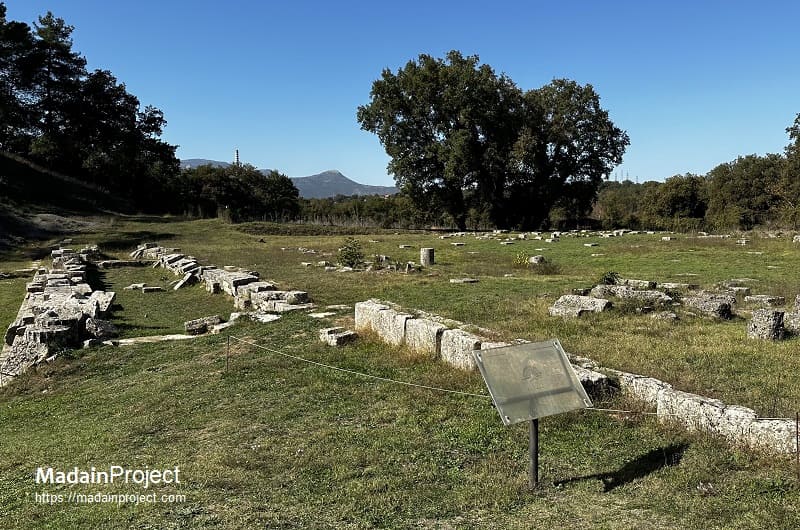
The ancient ruins of Megalopolis lie northwest of the modern town center on both banks of the Helisson (Elisson) River.
circa 370 BCE
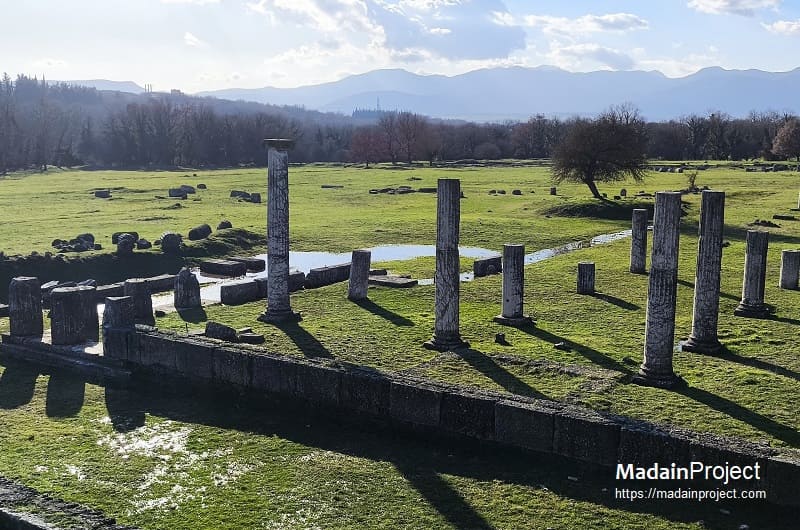
Agora
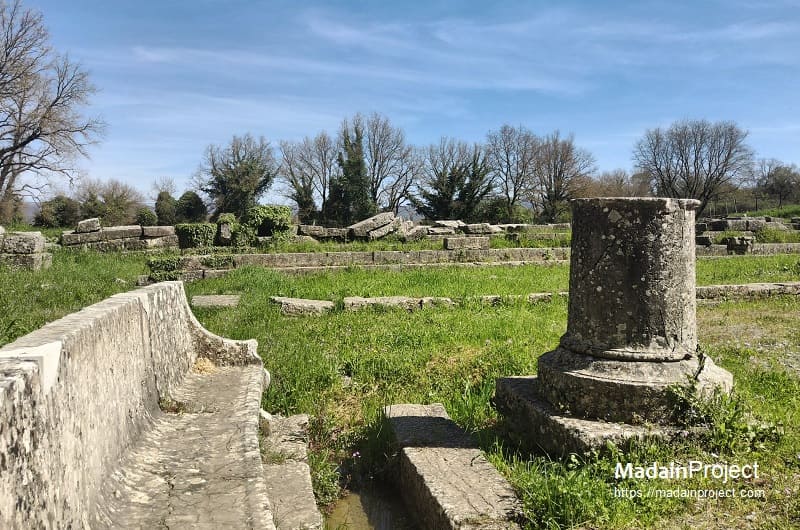
The agora of Megalopolis was among the largest in ancient Greece and was bounded on multiple sides by monumental stoai. The northern Stoa Philippeios, measuring approximately 156 meters in length, was constructed to honor Philip II of Macedon, while the eastern Stoa Myropolis extended roughly 125 meters. On the western side of the agora stood a complex containing the bouleuterion and prytaneion, built over the remains of an earlier city palace, along with a sanctuary dedicated to Zeus and Hestia. Sparse remains near the northwestern edge of the agora have been interpreted as a possible meeting place of the ecclesia, while at the northeastern edge stood the Archeia, a hall that housed statues. Together, these remains reflect the city’s original conception as a monumental federal capital, designed to embody Arcadian political unity and collective identity.
The agora of Megalopolis was exceptionally expansive, reputed in antiquity to be one of the largest in Greece. It formed the administrative and ceremonial heart of the city and housed key civic buildings, stoas, and sanctuaries. Within the agora stood the Thersilion, which served as the council hall for federal assemblies, integrating local urban life with regional governance. The size and layout of the agora emphasized collective political identity rather than commercial density, aligning with the city’s foundational purpose as a federal capital rather than a mercantile center.
circa 315 BCE
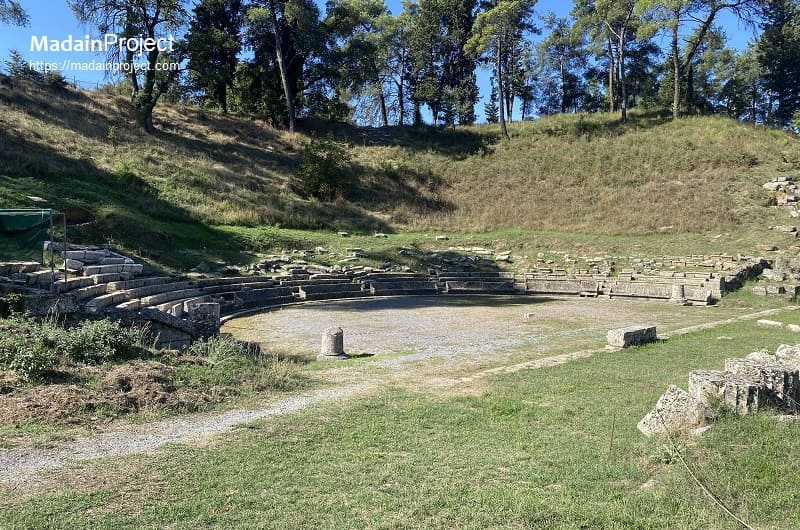
Theater
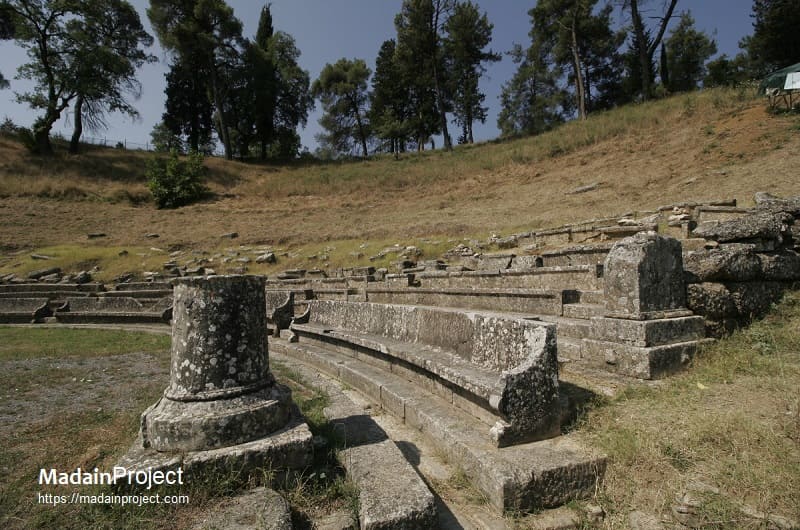
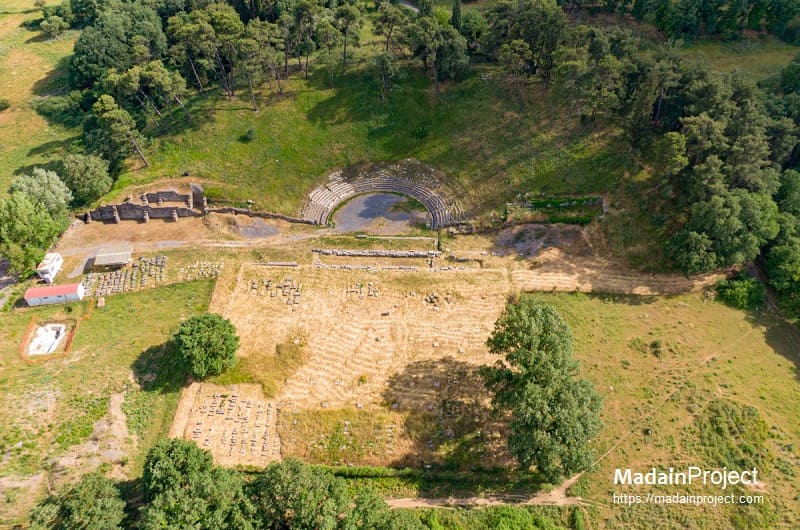
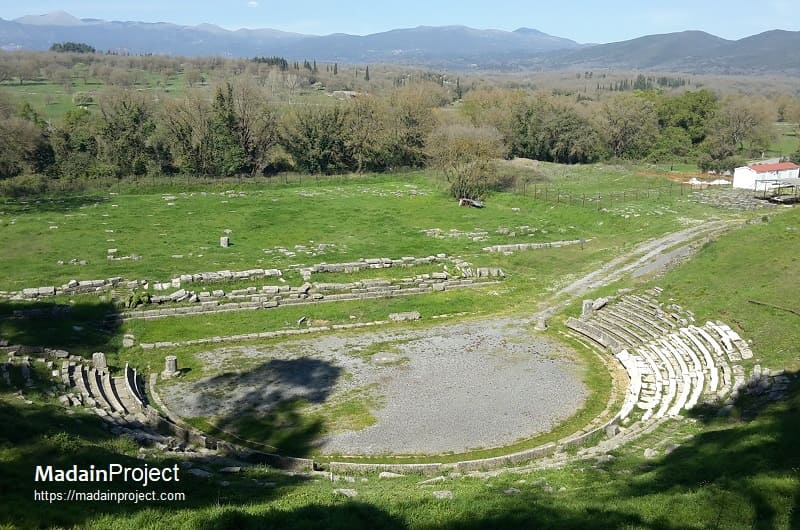
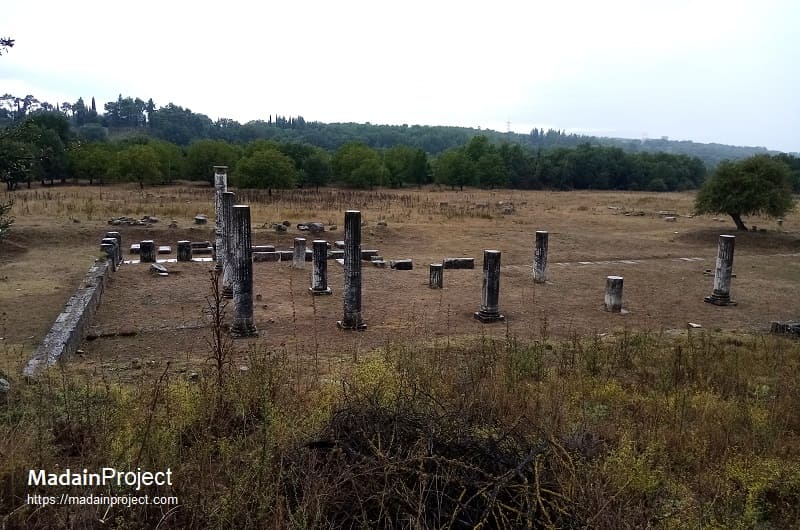
Among the most prominent remains is the theater, described by Pausanias as the largest in Greece, with an estimated diameter of about 30 meters. Architecturally connected to the theater is the Thersilion, a large pillared hall with sixty-seven columns, interpreted as a venue for both political assemblies and cultural events. Nearby, on an artificial terrace, stands a sanctuary generally identified with the sanctuary of Zeus Soter mentioned by Pausanias, consisting of a peristyle complex with two propyla and a Doric–Ionic temple with a stylobate measuring approximately 11.62 by 4.4 meters.
The theater of Megalopolis was among the largest in the Greek world and symbolized the city’s federal character. Constructed in the late fourth century BCE, it was designed not only for dramatic performances but also for large political gatherings. Adjacent to the theater stood the Thersilion, a monumental assembly building used by the Arcadian League, allowing theatrical space and political deliberation to function as a single civic complex. The scale of the cavea and orchestra reflects the intention to accommodate thousands of citizens and delegates, underscoring Megalopolis’s role as a meeting place for the Arcadian population as a whole.
circa 337 BCE
Others
In addition to the theater and agora complex, several other structures from ancient Megalopolis are known through archaeological remains and ancient literary testimony, though many survive only in fragmentary form due to the city’s early decline and later stone reuse.
Religious architecture is represented by multiple sanctuaries. Pausanias records temples dedicated to Zeus Lykaios, Athena Polias, Demeter, and the Great Goddesses, reflecting the city’s role as a religious as well as political center of Arcadia. Particularly significant was the sanctuary of Zeus Lykaios, closely connected to the Arcadian ethnic identity and to cult practices associated with Mount Lykaion. Although the principal cult center of Zeus Lykaios lay outside the city, Megalopolis functioned as an urban focal point for his worship. Archaeological traces of temple foundations and votive material confirm sustained cult activity within the city walls.
Megalopolis was also heavily fortified. Its circuit walls, constructed shortly after the city’s foundation in the late fourth century BCE, enclosed an exceptionally large area, far exceeding the population density the city ever achieved. Sections of these fortifications, including towers and gates, are still visible. Their scale reflects the strategic importance of Megalopolis as a bulwark against Sparta and demonstrates the military priorities that shaped its urban design.
Civic and athletic facilities are attested as well. A stadium is known from both archaeological remains and literary references, likely used for athletic contests connected to local and federal festivals. Gymnasium structures have also been identified, consistent with Megalopolis’s status as a major Greek city where physical training, education, and civic ideology were closely intertwined.
Residential quarters, though less well preserved, have been partially excavated and show a regular urban layout with streets and housing blocks, confirming that the city followed planned principles rather than organic growth. These domestic remains indicate a population that included elites, federal officials, and ordinary citizens relocated from rural Arcadia.
Signup for our monthly newsletter / online magazine.
No spam, we promise.

The Madain Project is an online archive of Abrahamic History and Archaeology.
Abrahamic History & Archaeology is the study of history and archaeology with respect to the three Abrahamic Faiths without considering the religious and theological aspects. The goal of Abrahamic History is to understand how and why the religious doctrines and behaviours have evlovled and changed over time. Searching for patterns in the evolution of significant cultural events such as the development of farming, the emergence of cities, or the collapse of major civilizations for clues of why and how these have influenced the three major Abrahamic religions.
Cloud Drive -
About -
Help -
Editorial Policy -
AI Policy -
Privacy Policy -
Contact
Madain Project: Encyclopedia of Abrahamic History & Archaeology.
Copyright MadainProject 2017 - 2026.


