
Apadana is the term used in Achaemenid studies to designate a monumental columned hall of the Persian imperial period, most famously exemplified by the great ceremonial hall at Persepolis and Susa, constructed during the reigns of Darius I and Xerxes I in the late sixth and early fifth centuries BCE. In its strict historical sense, the word refers not to a general architectural type across all Iranian history, but to a specific royal building concept associated with Achaemenid court ceremony, imperial display, and state ideology.
In most cases the Apadana functioned as a formal audience hall in which the Achaemenid king received delegations, dignitaries, and tribute-bearing representatives from across the empire. Its most complete and influential example is the Apadana at Persepolis, begun under Darius I around 518 BCE and completed under Xerxes I, though related halls existed at Susa and possibly other royal centers. These buildings were not residential spaces but ceremonial settings designed to stage the visual and ritual expression of imperial power.
The Apadana at Persepolis occupied a dominant elevated position within the palace complex, accessible via monumental stairways richly decorated with reliefs. These reliefs depict processions of subject peoples bringing gifts, royal guards, and court officials, presenting an idealized image of a harmonious and orderly empire united under the king. The hall’s scale and visibility made it a focal point for imperial gatherings during major events, including Nowruz celebrations, reinforcing the king’s role as the central axis of political and cosmic order.
Beyond its practical function, the Apadana embodied Achaemenid ideology. It expressed the empire’s universal reach, its administrative organization, and its emphasis on controlled diversity. Architectural influences drawn from Mesopotamian, Anatolian, and Egyptian traditions were deliberately integrated, reflecting the empire’s breadth while subordinating these elements to a distinctly Persian spatial and symbolic framework.
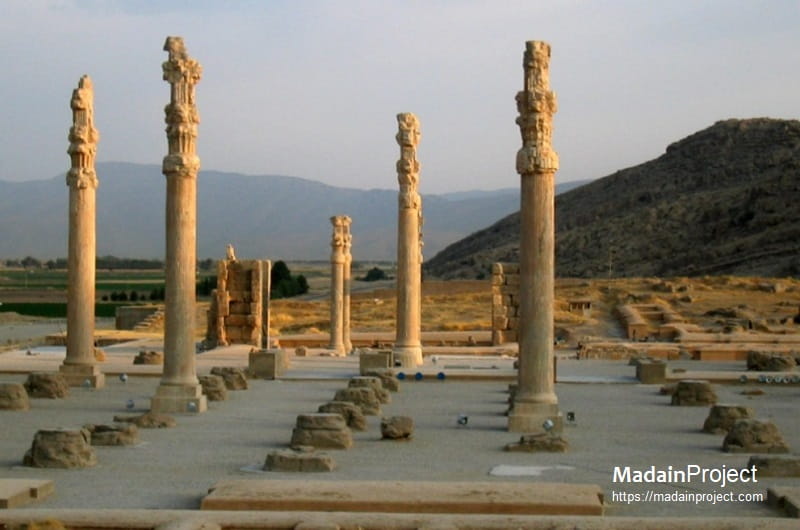
circa 520 BCE

Architecturally, the Apadana is defined by its vast hypostyle hall supported by tall, slender stone columns, a feature that distinguishes it from earlier Near Eastern audience halls. The Persepolis Apadana originally contained seventy-two columns arranged in a regular grid, each rising approximately twenty meters and crowned with elaborate capitals featuring paired animal protomes, most commonly bulls or lions. These capitals supported massive wooden roof beams, now lost, which spanned the wide interior space.
The hall was typically square or nearly square in plan, with three sides opening onto deep porticoes, creating a semi-open structure that mediated between interior and exterior ceremonial space. The use of stone for columns and walls, combined with mudbrick for upper structures, reflects a hybrid construction technique optimized for durability and monumentality. The raised stone platform on which the Apadana stood further emphasized its separation from ordinary space and enhanced its visibility across the complex.
Decorative programs were integral to the architecture rather than applied ornament. Sculpted reliefs covered staircases and terrace walls, carefully coordinated with the movement of visitors ascending toward the hall. These reliefs are characterized by restrained composition, repetitive rhythm, and meticulous detailing of garments and gestures, reinforcing themes of order and continuity. The Apadana’s architecture thus functioned simultaneously as structural achievement, ceremonial setting, and visual narrative of imperial authority, making it one of the most distinctive and influential expressions of Achaemenid architectural thought.
circa 520 BCE

Susa Apadana
The Apadana at ancient Susa represents the earliest fully developed example of this architectural concept and was constructed under Darius I in the late sixth century BCE as part of his program to establish Susa as a principal administrative capital of the Achaemenid Empire. Built on an artificial terrace adjacent to the royal palace complex, the Susa Apadana shared the essential features later seen at Persepolis, including a large hypostyle hall and columned porticoes, though it employed a greater proportion of glazed brick decoration in keeping with long-standing Elamite and Mesopotamian traditions. Archaeological evidence indicates the extensive use of polychrome glazed bricks depicting lions, archers, and floral motifs, underscoring the ceremonial and symbolic role of the structure. While much of the superstructure has been lost, inscriptions attribute its construction directly to Darius I, emphasizing the hall’s function as a space of royal audience and imperial representation within a long-established urban center.
circa 515 BCE

Apadana of Persepolis
The Apadana of ancient Persepolis, begun under Darius I and completed by Xerxes I, constitutes the most monumental and architecturally refined expression of the Apadana type. Situated on the northwestern sector of the Persepolis terrace, the hall was conceived as the primary ceremonial focus of the complex, both in scale and iconographic program. Its seventy-two columns, stone-built throughout and crowned with imposing animal capitals, supported an expansive roof that created one of the largest enclosed spaces of the ancient world. The monumental staircases leading to the hall are adorned with reliefs depicting delegations from across the empire, rendered in a highly formalized style that conveys order, hierarchy, and imperial unity. In contrast to Susa, where decorative emphasis relied heavily on color and glazed surfaces, the Persepolis Apadana articulated its ideological message through sculpted stone, making it the clearest architectural statement of Achaemenid kingship and ceremonial authority.


Signup for our monthly newsletter / online magazine.
No spam, we promise.

The Madain Project is an online archive of Abrahamic History and Archaeology.
Abrahamic History & Archaeology is the study of history and archaeology with respect to the three Abrahamic Faiths without considering the religious and theological aspects. The goal of Abrahamic History is to understand how and why the religious doctrines and behaviours have evlovled and changed over time. Searching for patterns in the evolution of significant cultural events such as the development of farming, the emergence of cities, or the collapse of major civilizations for clues of why and how these have influenced the three major Abrahamic religions.
Cloud Drive -
About -
Help -
Editorial Policy -
AI Policy -
Privacy Policy -
Contact
Madain Project: Encyclopedia of Abrahamic History & Archaeology.
Copyright MadainProject 2017 - 2026.


