
The Madrasa al-Firdaws (مدرسة الفردوس), literally meaning the "Paradise School", is a 13th-century educational complex located southwest of Bab al-Maqam in Aleppo, Syria and consists of a madrasa, mausoleum and other functional spaces. It was built by the queen regent Dayfa Khatun between 1235-36 CE, in the suburb of Aleppo, some distance outside the medieval city walls of Aleppo in the neighborhood known as al-Maqamat.
Located outside the southern walls of medieval Aleppo, near the road leading toward Hama, Madrasa al-Firdaws was conceived as both a center for religious learning and a visible statement of dynastic legitimacy and female patronage. The institution functioned primarily as a madrasa for the teaching of Islamic law, with strong associations to the Shafiʿi school, while also accommodating devotional practices. Its scale, architectural unity, and careful siting reflect the maturity of Ayyubid architectural patronage in northern Syria during the first half of the thirteenth century.
Architecturally, Madrasa al-Firdaws represents a highly controlled and symmetrical interpretation of the Syrian madrasa type. The complex is organized around a large rectangular courtyard, with carefully proportioned elevations and restrained ornamental programs. The building is constructed primarily of finely cut limestone, and its design emphasizes spatial clarity, axiality, and a measured balance between monumentality and seclusion. Unlike many urban madrasas integrated into dense city fabric, al-Firdaws occupies an open site, allowing its exterior massing and entrance façade to be fully articulated.

circa

The madrasa was commissioned by Dayfa Khatun, the Ayyubid regent of Aleppo and widow of al-Malik al-Zahir Ghazi, son of Saladin. Construction took place between 1235 and 1236 CE (633–634 AH), during a period when Dayfa Khatun exercised effective political authority on behalf of her grandson, al-Malik al-Nasir Yusuf. Her patronage of Madrasa al-Firdaws forms part of a broader program of religious and charitable foundations that reinforced Ayyubid rule at a time of internal dynastic tension and external threats, including Crusader states and the rising Mongol presence in the region. Contemporary inscriptions explicitly name Dayfa Khatun as founder, making the complex one of the most important monuments associated with female rulership in medieval Islamic Syria. After the Ayyubid period, the madrasa continued to function intermittently as a religious institution, though its educational role declined in later centuries as Aleppo’s urban center shifted.
circa

Prayer Hall
The prayer hall is situated on the southern side of the courtyard, aligned with the qibla. It is distinguished by a large, shallow mihrab framed by carved stone ornament and crowned by a semi-dome. The interior space is covered by a system of vaults that transition smoothly into the mihrab bay, creating a unified devotional space rather than a compartmentalized hall. Architectural decoration is concentrated around the mihrab and transitional elements, with vegetal and geometric carving executed in low relief, consistent with late Ayyubid aesthetic preferences that favored refinement over exuberance.
circa
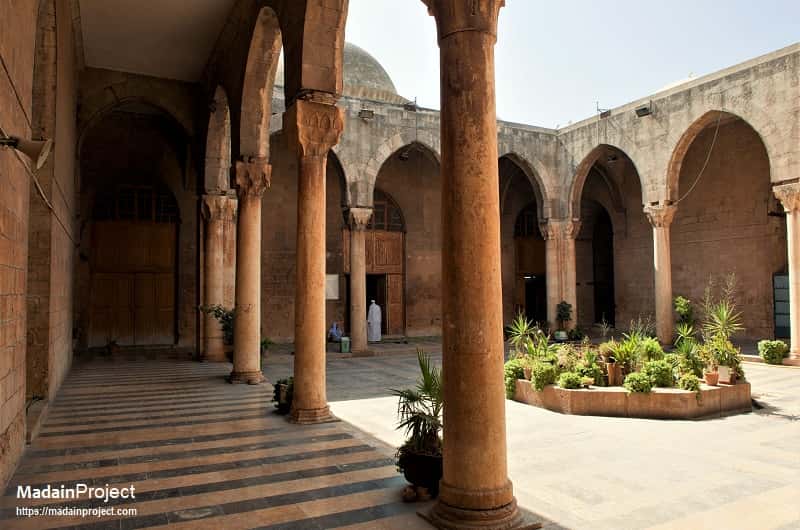
Courtyard
The central courtyard is the defining spatial element of the madrasa. It is expansive relative to the surrounding built volumes and includes a rectangular reflecting pool at its center, a feature that enhances both climatic comfort and visual harmony. Arcaded porticoes line the courtyard’s sides, providing shaded circulation and access to subsidiary rooms that likely served as study spaces and residential cells for students. The courtyard’s proportions, combined with the disciplined repetition of arches and the controlled use of ornament, produce a sense of calm and order that reflects the madrasa’s educational and spiritual functions.


Signup for our monthly newsletter / online magazine.
No spam, we promise.

The Madain Project is an online archive of Abrahamic History and Archaeology.
Abrahamic History & Archaeology is the study of history and archaeology with respect to the three Abrahamic Faiths without considering the religious and theological aspects. The goal of Abrahamic History is to understand how and why the religious doctrines and behaviours have evlovled and changed over time. Searching for patterns in the evolution of significant cultural events such as the development of farming, the emergence of cities, or the collapse of major civilizations for clues of why and how these have influenced the three major Abrahamic religions.
Cloud Drive -
About -
Help -
Editorial Policy -
AI Policy -
Privacy Policy -
Contact
Madain Project: Encyclopedia of Abrahamic History & Archaeology.
Copyright MadainProject 2017 - 2026.


