
Jameh al-Kabir (Yibna) is the historic Great Mosque of the medieval town of Yibna (Arabic: يبنا; also historically known as Jamnia or Jabneh) on the southern coastal plain of present-day Israel/Palestine, notable principally for its surviving Mamluk-era minaret and its embodiment of the religious and urban life of Yibna in the Islamic period.
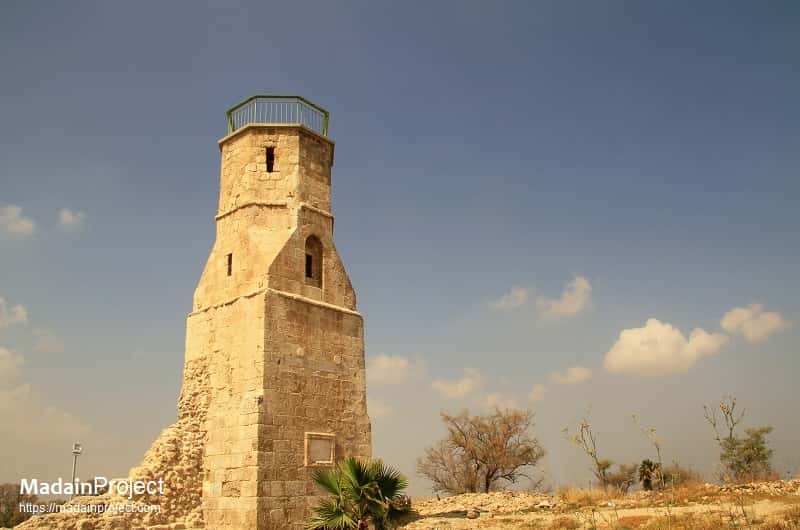
The Jameh al-Kabir (The Great Mosque) was an early fourteenth century mosque, which according to the inscription on the eastern side of the minaret was built on the orders of Suleiman al-Nasiri in 1337 CE (738 Hijri).
The term al-Kabir (Arabic: الكبير, “the Great”) in the context of mosque nomenclature signifies the central congregational mosque (jāmiʿ) of a town or city, the site where the Friday prayer (jumuʿa) was held and around which social and religious activities were organized. As with other great mosques in the medieval Islamic world, Jameh al-Kabir in Yibna served not merely as a place of worship but as a focal point of community identity and public life.
The remains of Jameh al-Kabir in Yibna are today limited, with the most conspicuous surviving element being its minaret, which bears an inscription dating its construction to November 1337 CE (738 AH). This inscription records that the minaret was erected by order of a Mamluk official identified as Suleiman al-Nasiri, reflecting the Mamluk Sultanate’s architectural and administrative imprint on the town during the fourteenth century.
Yibna itself occupied a strategically important locus on the historic Cairo–Damascus road during the Mamluk period, linking it to broader patterns of trade, pilgrimage, and military movements. Under Mamluk administration in the thirteenth and fourteenth centuries, the urban fabric of Yibna included religious, civic, and infrastructural elements such as mosques, bridges, and caravanserais (khans), with the Great Mosque forming a central part of this built environment.

circa 1337 CE

Minaret
This minaret is the only identifiable remain of the historic mosque on the southern side of the ancient city of Yibna. In 1244 Mamlukes captured Yavne and converted the Church to a mosque. The Mamlukes controlled the Holy Land until the Ottoman period. Although the church was converted into a mosque, it was still called el-Keniseh by the natives. The mosque itself had an internal measure of 49 feet along a line bearing 109°, with an internal breadth of 32 feet 6 inches. It was divided into two aisles, the southern 16 feet 3 inches in the clear, the northern 12 feet 9 inches in the clear.
Because the principal surviving element of Jameh al-Kabir at Yibna is its minaret, the architectural analysis of the mosque relies heavily on this feature and on documentary and archaeological context. The minaret stands on the southern side of the ancient town and is inscribed with its date and patron’s name; its survival provides critical evidence for the mosque’s fourteenth-century development under Mamluk influence.
circa 1337 CE

Arabic Inscription
The inscription on the eastern facade of the minaret reads; "In the name of God, the Merciful, the Compassionate. Ordered the construction of this blessed minaret, the one who needs the grace of God Most High, the Mawlawi, the Great Emir Suleiman en Nasiri, in the month Rabi al Akhir, 738 Hj. [November, 1337 CE]".


Signup for our monthly newsletter / online magazine.
No spam, we promise.

The Madain Project is an online archive of Abrahamic History and Archaeology.
Abrahamic History & Archaeology is the study of history and archaeology with respect to the three Abrahamic Faiths without considering the religious and theological aspects. The goal of Abrahamic History is to understand how and why the religious doctrines and behaviours have evlovled and changed over time. Searching for patterns in the evolution of significant cultural events such as the development of farming, the emergence of cities, or the collapse of major civilizations for clues of why and how these have influenced the three major Abrahamic religions.
Cloud Drive -
About -
Help -
Editorial Policy -
AI Policy -
Privacy Policy -
Contact
Madain Project: Encyclopedia of Abrahamic History & Archaeology.
Copyright MadainProject 2017 - 2026.


