
The Israelite city gate at Tel Hazor is a monumental six-chambered gate complex dating to the Iron Age II, conventionally attributed to the period of the United Monarchy in the 10th century BCE. Constructed of dressed stone and organized around a symmetrical plan of three chambers on each side of a central passageway, the gate formed part of the city’s fortification system and controlled access to the urban center. Archaeological analysis has linked the Hazor gate typologically and dimensionally to comparable six-chambered gates at Megiddo and Gezer, a correspondence frequently cited in discussions of centralized planning and state-level administration in early Israelite society.
Tel Hazor (Tell el-Qedah) was the largest urban center in the southern Levant during the Bronze Age and remained a major administrative and strategic city in the Iron Age. The Israelite city gate, located on the western side of the lower city, reflects Hazor’s continued importance following its incorporation into the Israelite polity. Excavated primarily in the mid-20th century, the gate has played a central role in archaeological discussions concerning state formation, urban planning, and centralized authority in Iron Age Israel. Its size, standardized plan, and association with substantial fortification walls distinguish it from smaller or irregular gates found at less prominent sites.
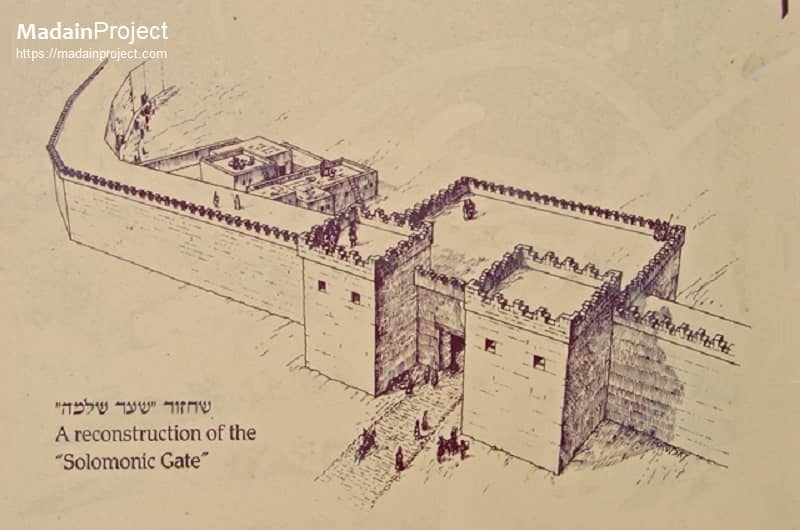
The gate is located in the center of the upper city, allowing entry in to the citadel from south-east direction. The gate is symmetric on both sides of the entrance, and is composed of two towers, three rooms within each tower, and two bastions projecting on both side. Dated to the 10th century BCE, this gate has six chambers and two towers. Similar gates have been uncovered at Megiddo, Lachish and Gezer, typologically called the Solomonic Gates.
The only complete vessel that belonged to an Iron Age I locus is a storage jar was found on a fragmentary floor that was sealed by the floor of the six-chambered gate passageway.

circa 1000 BCE

Following the destruction of Late Bronze Age Hazor in the 13th century BCE, the site experienced a period of reduced occupation before reemerging as a fortified city in the Iron Age. The six-chambered gate is generally dated to the early Iron Age II (Iron IIA), traditionally placed in the 10th century BCE in this part of the Levant region, though alternative chronologies propose a 9th-century BCE date associated with the Omride dynasty. The gate was first identified and excavated by Yigael Yadin and his team in the 1950s CE, who emphasized its close similarities to gates at Megiddo and Gezer as evidence of centralized planning. Later excavations and stratigraphic reassessments have refined its dating and context but have confirmed its role as part of a comprehensive urban fortification system that included casemate walls and administrative structures. The gate appears to have remained in use, with modifications, until Hazor’s destruction by the Assyrian king Tiglath-pileser III in 732 BCE.
circa 1000 BCE

In the Hebrew Bible, Hazor is portrayed as a leading Canaanite city prior to Israelite settlement and later as a significant Israelite administrative center. Joshua 11 describes Hazor as “the head of all those kingdoms” before its destruction by the Israelites, while 1 Kings 9:15 lists Hazor among the cities fortified during the reign traditionally attributed to King Solomon, alongside Megiddo and Gezer. This biblical passage has long influenced scholarly interpretation of the Hazor gate, particularly the proposal that its construction reflects a royal building program of the United Monarchy. While the historical reliability and precise dating of this tradition are debated, the biblical references underscore Hazor’s perceived political and strategic importance within Israelite memory.
A summary of king Solomon's activities indicates that the king built Hazor, Megiddo and Gezer. The connection between Hazor, Megiddo and Gezer is reflected in 1 Kings 9:15, where the Bible talks about Solomon's building activities: "This was the purpose of the forced labour which Solomon imposed, it was to build the house of the lord, his own palace, the Millo, and the wall of Jerusalem, and [to fortify] Hazor, Megiddo, anf Gezer."
circa 1000 BCE

Gate
The gate was built in a form that was common in this period, and is similar to the gates at Gezer and Megiddo. To the south of the gate are the remains of a casemate city wall from the same period (made of two parallel walls with a space between them, divided into chambers by partitions). Beneath the middle room in the southern wing of the gate, the basalt threshold of a Canaanite temple was found.
The Israelite city gate at Tel Hazor is a classic example of the six-chambered gate type, consisting of a central passageway flanked by three chambers on each side. Constructed of large, well-dressed basalt and limestone blocks, the gate was integrated into a substantial city wall and likely supported a superstructure, possibly including towers or an upper story. The chambers are interpreted as multifunctional spaces used for administrative activities, storage, and military control, while the gate complex as a whole regulated movement into and out of the city. Benches and installations found within the chambers parallel features observed at other Iron Age gates and fortifications, reinforcing interpretations of the gate as a focal point of civic and judicial life.
circa 1000 BCE

Fortifications
The casemate wall at Tel Hazor is a defining element of the Iron Age II fortification system that enclosed the western sector of the upper city (acropolis) and formed a major component of the settlement’s defensive architecture prior to its later expansion. The structure is of the double casemate type, consisting of two parallel stone walls with a series of transverse partition walls creating internal chambers in the space between them. These chambers, integral to the system’s construction, could be filled with earth and rubble to enhance the wall’s mass and defensive capacity or used for storage and auxiliary functions.
In the earliest phase of the Israelite occupation of Hazor, conventionally dated to the 10th century BCE, the casemate wall delineated and secured approximately half of the upper tell, extending north and south to converge with the six‑chambered city gate. This fortification defined the limits of the initial Iron Age urban footprint on the western half of the mound, which had been reoccupied after the Late Bronze Age destruction. Pottery and stratigraphic evidence associated with the casemate chambers support this early Iron Age chronology, aligning the construction of the defensive system with the period of urban revitalization described in biblical accounts of Solomonic building activity.
During the subsequent expansion of Hazor in the 9th century BCE under Israelite rule, the city’s inhabited area grew eastward to encompass the remainder of the upper tell, and the earlier casemate wall was ultimately supplemented and in some segments superseded by a continuous, solid‑walled circuit of fortification. Within this broader urban enlargement, the original casemate wall continued in use and, in contexts adjacent to the gate complex, the internal casemate chambers were repurposed for storage and domestic use, reflecting the evolving functional dynamics of the city’s built environment.
circa 1000 BCE

Cultic Shrine
Archaeological excavations at Tel Hazor city gate revealed significant cultic remains beneath the Israelite city gate, indicating the presence of earlier sacred architecture at the site. In the second chamber of the southern wing of the six-chambered gate, excavators uncovered the remains of a Late Bronze Age temple, including a standing cultic stele (maṣṣēbah), suggesting the deliberate incorporation or superposition of the Israelite gate over a preexisting Canaanite religious installation.
Beneath the central chamber of the same southern wing, a basalt threshold belonging to a Canaanite temple was discovered in situ, providing further evidence for a substantial cultic structure predating the Iron Age fortifications. These finds demonstrate continuity of sacred space at Hazor and reflect a broader pattern in the ancient Near East in which later urban and administrative constructions were erected atop earlier cultic loci. The integration of the Israelite gate complex above the remains of a Late Bronze Age temple has been interpreted as both a practical reuse of a prominent architectural location and a symbolic assertion of political and cultural transformation following the city’s transition from Canaanite to Israelite control.

Signup for our monthly newsletter / online magazine.
No spam, we promise.

The Madain Project is an online archive of Abrahamic History and Archaeology.
Abrahamic History & Archaeology is the study of history and archaeology with respect to the three Abrahamic Faiths without considering the religious and theological aspects. The goal of Abrahamic History is to understand how and why the religious doctrines and behaviours have evlovled and changed over time. Searching for patterns in the evolution of significant cultural events such as the development of farming, the emergence of cities, or the collapse of major civilizations for clues of why and how these have influenced the three major Abrahamic religions.
Cloud Drive -
About -
Help -
Editorial Policy -
AI Policy -
Privacy Policy -
Contact
Madain Project: Encyclopedia of Abrahamic History & Archaeology.
Copyright MadainProject 2017 - 2026.


