
Sultan Han, often referred to in scholarly literature as the Sultanhanı Caravansarai, is a monumental 13th‑century Seljuk caravanserai situated in the town of Sultanhanı in Aksaray Province, central Anatolia, Türkiye. In medieval Islamic architectural parlance, it exemplifies the khān or kārvānsarāy typology—roadside lodging complexes that provided secure accommodation, logistical support, and ancillary services for long‑distance traders, pilgrims, and official envoys traversing the overland Silk Road network across Anatolia and beyond.
The extant complex is notable within the corpus of Seljuk Anatolian architecture both for its monumental scale, covering some 4,900 square metres—making it the largest surviving medieval caravanserai in Turkey—and for the intricacy of its decorative stone carving and structural articulation.
The building is characterized by an imposing east‑facing portal (pishtaq), fortified exterior walls, and an internal spatial program comprising an open courtyard used in fair weather and a covered iwan hall for winter shelter. The architectural vocabulary includes muqarnas ornamentation, intricately worked geometric and interlace motifs on the main portal, and a centrally placed kiosk mosque (köşk mescidi) within the courtyard, considered one of the earliest examples of this mosque type in Turkish Seljuk architecture.
The khan is entered at the east, through a pishtaq, a 13 meters high gate made from marble, which projects from the front wall (itself 50 meters wide). The pointed arch enclosing the gate is decorated with muqarnas corbels and a geometrically patterned plaiting.
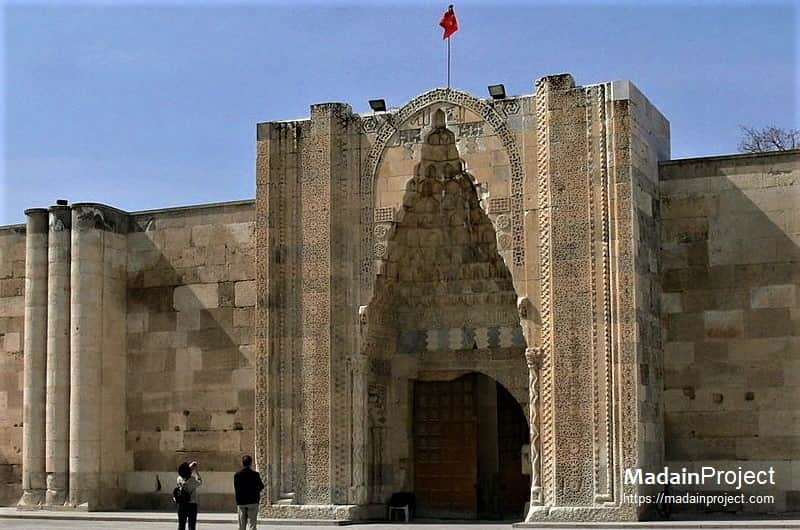
circa 1229 CE

The inception of Sultan Han is securely dated to the year 1229‑CE, based on epigraphic evidence on the structure itself, and it was commissioned by the Seljuk Sultan Alaeddin Kayqubad I (reigned 1220–1237). The architect responsible for the design and execution was Muhammad ibn Khalwan al‑Dimashqi, identified by the epithet al‑Dimashqi as originating from Damascus—an attribution that situates the work within a transregional milieu of Islamic architectural practice. The placement of the caravanserai along the Uzun Yolu (literally “long road”) underscores its strategic role in facilitating overland commerce and movement of peoples at a period when the Seljuk Sultanate of Rum sought to consolidate control over Anatolian trade networks and project political authority across the interior plateau.
In the later 13th century, Sultan Han suffered partial destruction by fire, the circumstances of which are not exhaustively documented in primary sources but may be linked to the broader milieu of social and political instability following the Mongol incursions and shifting patterns of regional authority. In 1278 CE, during the reign of Sultan Kaykhusraw III (r. 1265–1284), the structure underwent substantial restoration and enlargement under the patronage of the local governor Seraceddin Ahmed Kerimeddin bin El Hasan. This phase of work not only repaired the earlier damage but extended the complex, enhancing its capacity and reinforcing its status as a capacious and enduring infrastructural node on the trade route.
Throughout the Ottoman period and into the modern era, the commercial relevance of the historical caravan routes declined, with many such hans falling into disuse. However, Sultan Han has persisted both materially and in scholarly consciousness as an exemplar of Seljuk architectural ingenuity, benefitting from conservation and restoration efforts in the twentieth and twenty‑first centuries that have aimed to stabilize its fabric and facilitate its access as a cultural heritage site.
circa 1229 CE

Eighteenth century drawing of the Sultan Han, with the floor plan to the lower right and the mosque in the middle of the main courtyard, with the northern archway and stables. It is one of the three monumental caravanserais in the neighbourhood of Aksaray and is located about 40 kilometers (25 miles) west of Aksaray on the road to Konya.
The architectural composition of Sultan Han exemplifies the mature Seljuk caravanserai typology, combining defensive, functional, and ceremonial elements within a coherent plan. The complex occupies a roughly rectangular site measuring approximately 220 by 110 meters, enclosed by thick stone walls that provide both fortification and privacy. Its monumental east portal (pishtaq) functions as the principal ceremonial entrance, framed by a deeply recessed arch and adorned with intricate muqarnas stalactite work and geometric interlace patterns, which serve both structural and ornamental purposes. The portal is flanked by semi-cylindrical towers, reinforcing its defensive appearance while emphasizing its symbolic status as a threshold between the external trade routes and the controlled interior space.
The spatial organization centers on a vast open-air courtyard, which was used for the assembly of merchants, animals, and goods during favorable weather. At the courtyard’s midpoint rises the köşk mescidi, a small, elevated pavilion mosque, accessible via a short stair and integrated into the circulation of the complex. This placement exemplifies the Seljuk innovation of combining religious, commercial, and social functions in a single architectural ensemble. Surrounding the courtyard on all sides are vaulted iwans and storage rooms, designed for accommodation of travelers and secure storage of merchandise. The iwans feature pointed arches, supported by robust piers, and barrel-vaulted ceilings that demonstrate the Seljuk mastery of load distribution in large-span stone structures.
The covered hall, accessible from the main portal, functions as winter accommodation, providing shelter from the harsh Anatolian climate. It is roofed with a sequence of pointed barrel vaults supported on thick walls and piers, with small clerestory windows admitting natural light. Stone corbels and muqarnas ornamentation are deployed at transitional points between walls and arches, reflecting both technical sophistication and aesthetic refinement. The masonry consists primarily of locally quarried limestone, with finely dressed blocks for the portal and more roughly hewn stone in peripheral walls, indicating a hierarchical approach to material usage.
circa 1229 CE

Kiosk Mosque
The recently restored kiosk-style mosque (Turkish: köşk mescidi), centrally positioned within the open courtyard of the Sultan Han Aksaray (1229 CE), is recognized as a seminal example of Seljuk religious architecture integrated into a secular commercial context. Functioning as a small-scale, free-standing oratory, the structure is elevated on a baldachin composed of four massive, carved barrel-vaulted arches to provide a sanctified space distinct from the "tumult" of merchants and beasts below. Access to the second-floor prayer hall is provided by a twin stone staircase situated on the western side, which is characterized by elaborate muqarnas-carved steps and decorative rosettes.

Signup for our monthly newsletter / online magazine.
No spam, we promise.

The Madain Project is an online archive of Abrahamic History and Archaeology.
Abrahamic History & Archaeology is the study of history and archaeology with respect to the three Abrahamic Faiths without considering the religious and theological aspects. The goal of Abrahamic History is to understand how and why the religious doctrines and behaviours have evlovled and changed over time. Searching for patterns in the evolution of significant cultural events such as the development of farming, the emergence of cities, or the collapse of major civilizations for clues of why and how these have influenced the three major Abrahamic religions.
Cloud Drive -
About -
Help -
Editorial Policy -
AI Policy -
Privacy Policy -
Contact
Madain Project: Encyclopedia of Abrahamic History & Archaeology.
Copyright MadainProject 2017 - 2026.


