
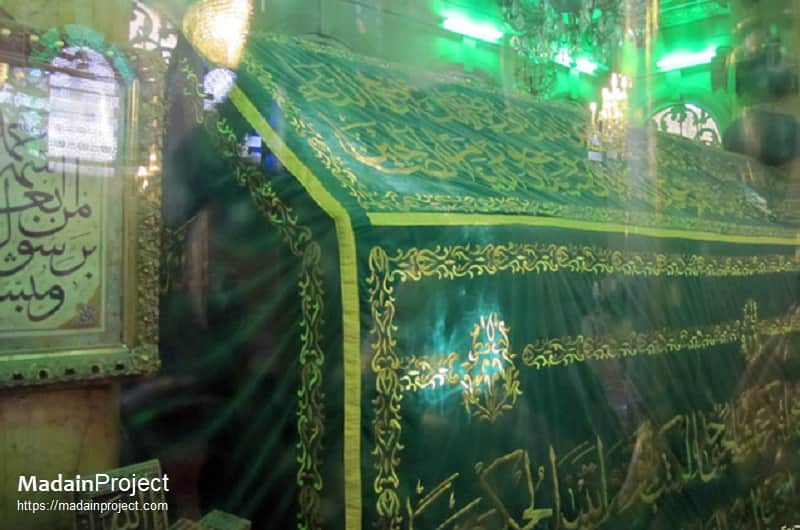
The Shrine of Yahya, or the Maqam Nabi Yahya (مقام نبي يحيى), is a small Islamic funerary shrine located inside the Umayyad Mosque, Damascus. The small domed shrine which is located inside the main prayer hall of the Islamic mosque may still contain the head of John the Baptist, honored as a prophet by both Christians and Muslims alike. Though it is one of at least six locations claiming to contain the head of John the Baptist (Nabi Yahya).
John is honored as a prophet in Islam as Yahya ibn Zakariya (يحيى بن زكريا). He is believed by Muslims to have been a witness to the word of God, and a prophet who would herald the coming of Jesus. Islamic tradition maintains that John was one of the prophets whom prophet Muhammad met on the nightly journey of the Mi'raj, his ascension through the Seven Heavens.
The son of Zechariah is a figure of prime importance in the history of Christianity, for he was the precursor who prepared the way for Jesus's coming. John’s life, wholly dedicated to God, was crowned by martyrdom.

circa 780

Muslim Tradition
According to al-Suyuti, Ibrahim stated that since the creation of the world the Heavens and the Earth wept only for two people: John the Baptist and Husayn ibn Ali. In Islam, the Prophet Yahya is an exemplar of righteousness, kindness and piety. Sufi commentaries emphasize his divinely-given wisdom (19:12)—which he received as a child. In the Qur’an, the Prophet Yahya is “a prophet from among the righteous” (6:85 & 3:39).
Christian Tradition
According to Christian tradition, (legend had it that) Saint John's head was buried there. Ibn al-Faqih relays the story that during the construction of the mosque, workers found a cave-chapel which had a box containing the head of St. John the Baptist, or Yaḥyā ibn Zakarīyā in Islam. Upon learning of that and examining it, al-Walid I ordered the head buried under a specific pillar in the mosque that was later inlaid with marble.
circa 780
Exterior
The Shrine of Yahya (Maqām Nābī Yaḥyā) within the Umayyad Mosque of Damascus constitutes a distinct funerary structure embedded in the larger architectural ensemble of one of the earliest and most significant monuments of early Islamic architecture. The mosque itself, commissioned by Caliph al-Walīd I (reigned 705–715 CE), exemplifies Umayyad architectural synthesis, integrating pre-Islamic fabric and newly articulated spatial devices derived from Late Antique precedents.
The shrine is situated within the main prayer hall (ḥaram) of the mosque and is traditionally held to contain the head of Prophet Yahya (John the Baptist), a figure venerated in both Islamic and Christian traditions.
Architecturally, the shrine manifests as a compact domed edifice demarcated from the surrounding hypostyle interior. Its plan is based on a quadrangular podium or base, upon which rises a polygonal drum articulated by engaged columns and bays, supporting a ribbed dome. The upper superstructure is rhythmically divided into a series of openings, capped by semicircular arches that unify the elevation and allow light penetration, establishing an interplay of structural articulation and illumination within the mosque’s larger spatial field.
The dome, while smaller in scale relative to the monumental dome over the mosque’s transept, functions both as a symbolic covering for the sacred relic beneath and as an architectural marker within the axial procession of the prayer hall. Ornamental detail on the shrine includes carved window tracery and refined masonry that contrasts with the broader architectural vocabulary of the surrounding sanctuary. The use of a dome supported on a polygonal drum reflects an adaptation of Byzantine precedents to an Islamic commemorative context, consistent with the mosque’s broader stylistic engagement with Byzantine decorative motifs and structural forms.
Shrine Interior
Internally, the shrine contains a cenotaph marking the locus of the relic beneath a ribbed dome supported on a polygonal drum, which is fenestrated by carved windows capped with semicircular arches; these openings allow filtered light to animate the enclosure, contrasting with the broader spatial rhythm of the mosque’s aisles and arcades.
circa 780
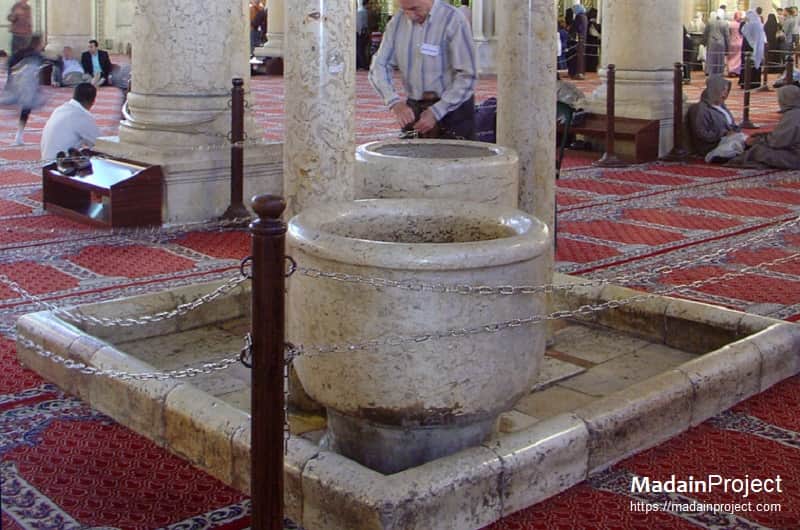
In 2001 Pope John Paul II visited the mosque, primarily to visit the relics of John the Baptist. It was the first time a pope paid a visit to a mosque. Similar to the account of John the Baptist in the Bible, the birth of the Prophet Yahya in the Qur’an is miraculous, since Zechariah and his wife were unable to conceive together—before Zechariah’s desperate prayers for a child were answered.

Signup for our monthly newsletter / online magazine.
No spam, we promise.

The Madain Project is an online archive of Abrahamic History and Archaeology.
Abrahamic History & Archaeology is the study of history and archaeology with respect to the three Abrahamic Faiths without considering the religious and theological aspects. The goal of Abrahamic History is to understand how and why the religious doctrines and behaviours have evlovled and changed over time. Searching for patterns in the evolution of significant cultural events such as the development of farming, the emergence of cities, or the collapse of major civilizations for clues of why and how these have influenced the three major Abrahamic religions.
Cloud Drive -
About -
Help -
Editorial Policy -
AI Policy -
Privacy Policy -
Contact
Madain Project: Encyclopedia of Abrahamic History & Archaeology.
Copyright MadainProject 2017 - 2026.


