
The Bab Quba (باب قباء), gate no. 5, is one of the major gates of Masjid al-Nabawi, located on the south-western flank of the Masjid al-Nabawi's King Fahad bin Abdulaziz block. Bab Quba is named after the village of al-Quba, situated some six kilometers from Masjid al-Nabawi, where Masjid al-Quba is located.
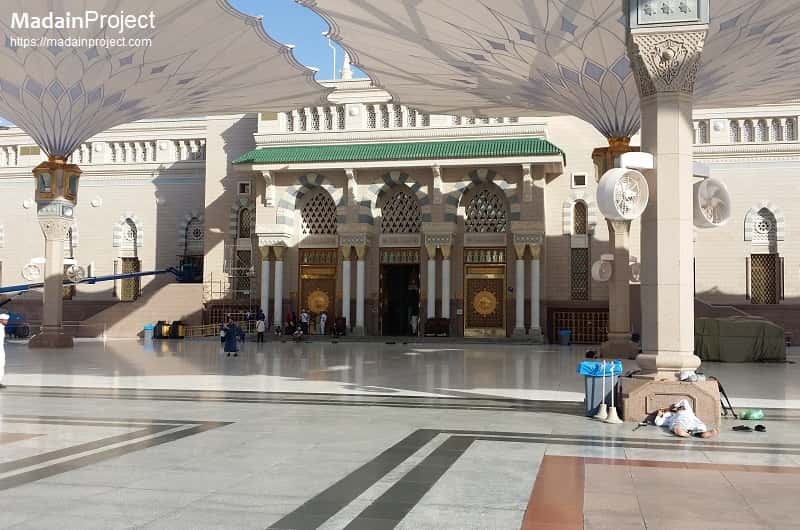
Gate of Quba (Bab-i Quba), gate no. 5 of the prophet's mosque, is a tripple arched gate with four pairs of decorative pillars and two central pillars. It was installed during the second Saudi expansion of masjid by malik Fahad bin Abdulaziz al-Saud. It is located west of the Bab ul-Hijrah (gate of migration) and south-east of Bab malik al-Saud.
No gate by the name of Bab e Quba existed before 1990/92 CE expansion of the mosque, this is a new gate.
It is one of the two identical gates of Masjid al-Nabawi; other being the bab e Makkah located on the south-western flank of the prophet's mosque. It's name derives it's significance from the village of Quba, where the first mosque of Islam was built by prophet Muhammad.
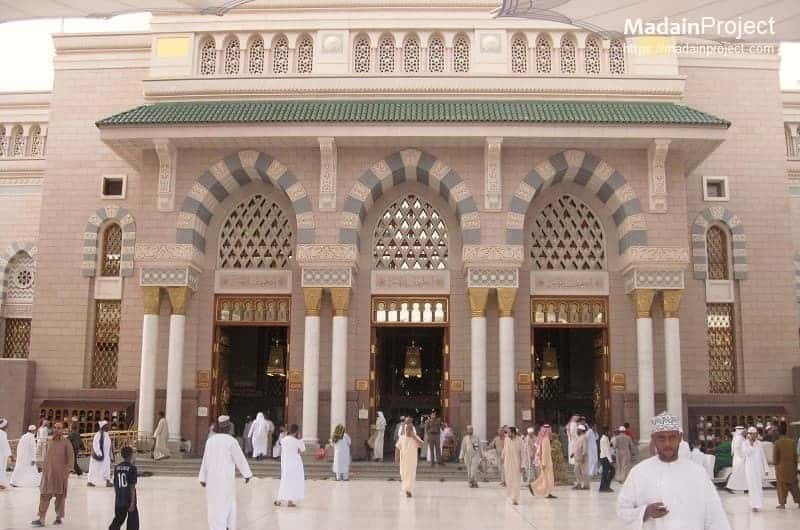
circa 1990 CE

The Quba Gate exemplifies a carefully orchestrated architectural synthesis characteristic of the Saudi expansions, wherein elements of classical Islamic and late antique Mediterranean architectural traditions are selectively appropriated, abstracted, and rearticulated within a modern monumental framework. The larger architectural scheme of the gate exemplifies the Neo-Islamic style characteristic of the late 20th-century CE Saudi expansions.
It features a massive triple-arch portal system constructed from reinforced concrete, clad in high-quality beige stone and decorated with intricate polychrome stone arches. The arches employ an ablaq treatment, characterized by alternating light and dark stone, which visually recalls earlier Islamic polychrome traditions while functioning here as a decorative revetment rather than a structural system. This visual rhythm and polychromatic banding effect recalls Umayyad, Andalusian and Ottoman precedents. It not only emphasizes the structural logic of the arch but also serves as an aesthetic device that draws the eye toward the central entrance axis, reinforcing the hierarchy of entry.
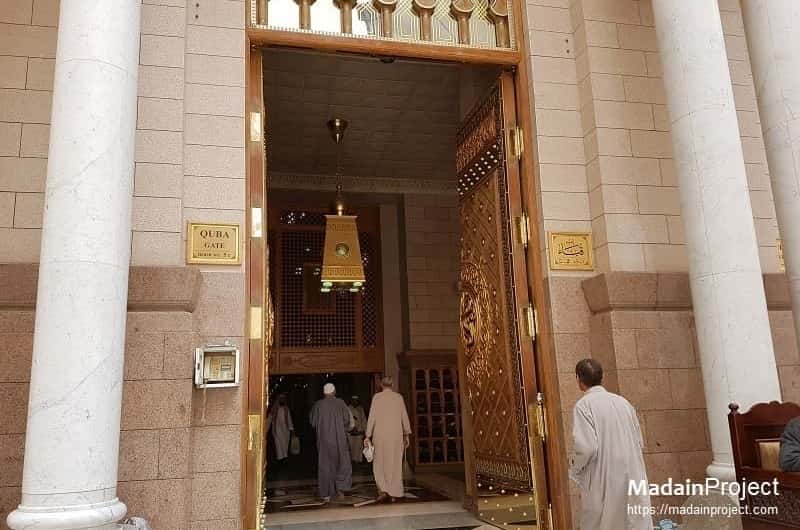
The interior facade of the gateway is adorned with gold-leaf inscriptions of Quranic verses and features heavy, carved teakwood doors inlaid with solid brass and gold-plated motifs.
The three arches entrances of the gate are framed by duel slender cylindrical columns, topped by arabesque style brass panelled capitals.
The decorative program of the Quba Gate is characterized by restrained yet sophisticated ornamentation. Carved stucco and stone panels exhibit repeating arabesque motifs and geometric tessellations, avoiding figural representation in accordance with Islamic artistic conventions. The use of muqarnas is notably absent at this gate, suggesting a preference for planar clarity over tri-dimensional transitional elements.
The chromatic palette—dominated by sandy beige, muted red, and dark gray stone—harmonizes with the broader materiality of Medina while subtly distinguishing the entrance gate as a point of architectural emphasis.
At the uppermost level, a projecting cornice supports a low-pitched green tiled roof, a feature strongly associated with the modern identity of the mosque complex.
The three portals of the Quba Gate of al-Masjid an-Nabawi are surmounted by Qur’anic inscription (Surah al-Hijr, verse 46) that reads:
ادْخُلُوهَا بِسَلَامٍ آمِنِينَ
Enter it in peace, safe and secure.
Architecturally, this epigraphic band functions as a formal crowning register above the tripartite arcade, operating at the intersection of ornament, theology, and spatial transition. Its placement directly above the three entrance bays reinforces the threshold condition of the gate: the inscription is not merely decorative but semantically programmatic, articulating the passage from exterior circulation into the sanctified precinct of the mosque, referring to the concept of ḥaram (sacred space) in Islam.
Signup for our monthly newsletter / online magazine.
No spam, we promise.

The Madain Project is an online archive of Abrahamic History and Archaeology.
Abrahamic History & Archaeology is the study of history and archaeology with respect to the three Abrahamic Faiths without considering the religious and theological aspects. The goal of Abrahamic History is to understand how and why the religious doctrines and behaviours have evlovled and changed over time. Searching for patterns in the evolution of significant cultural events such as the development of farming, the emergence of cities, or the collapse of major civilizations for clues of why and how these have influenced the three major Abrahamic religions.
Cloud Drive -
About -
Help -
Editorial Policy -
AI Policy -
Privacy Policy -
Contact
Madain Project: Encyclopedia of Abrahamic History & Archaeology.
Copyright MadainProject 2017 - 2026.


