
Herodian stone, more precisely termed Herodian ashlar, refers to a distinctive type of finely dressed limestone masonry developed and extensively employed in Judea during the reign of Herod the Great in the late first century BCE, characterized by large rectangular blocks with a flat, smoothly dressed central boss framed by a finely chiseled marginal draft. This masonry technique became a defining architectural marker of Herodian monumental construction and remains one of the most diagnostic features of late Second Temple period architecture in the southern Levant.
Herodian ashlar emerged within the broader context of Herod the Great’s ambitious building program, which sought to express political legitimacy, royal authority, and cultural sophistication through architecture on a monumental scale. Influenced by Hellenistic and Roman stone-working traditions yet adapted to local materials and craftsmanship, this masonry style was applied across a range of major projects, including the expansion of the Jerusalem Temple platform, the fortresses of Masada and Herodium, and urban developments in Caesarea Maritima and Jerusalem.
The technique reflects a high level of technical organization, quarrying logistics, and skilled labor, suggesting centralized planning and sustained state investment. Over time, Herodian ashlar became closely associated with royal, elite and religious construction, functioning not merely as a structural solution but as a visual language signaling power, permanence, and architectural refinement.

circa 37-4 BCE
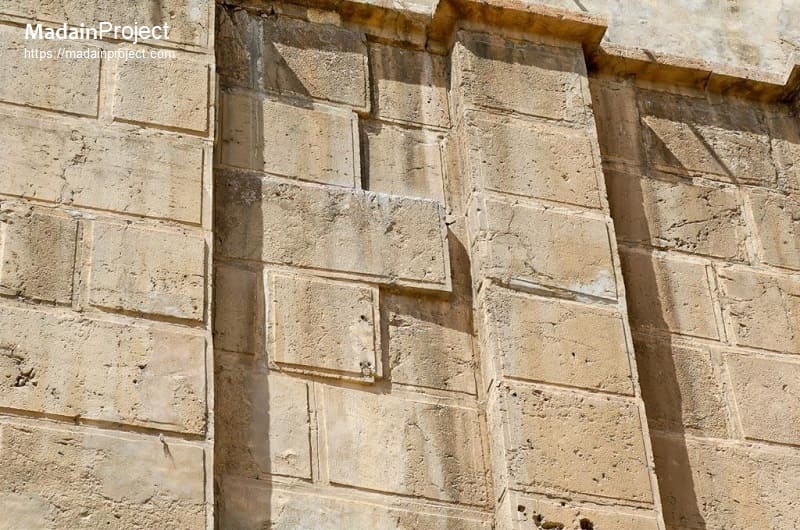
Herodian ashlar is defined foremost by its precise surface treatment. Each stone block is cut from local meleke limestone, a durable and fine-grained material that allows for sharp edges and controlled carving. The most distinctive feature is the drafted margin: a narrow, recessed frame carefully chiseled around the perimeter of the block’s exposed face. This margin encloses a slightly projecting central boss that is typically left smooth or minimally dressed, creating a subtle play of light and shadow across the wall surface. The depth and width of the drafted margin are consistent within individual structures, indicating standardized workmanship rather than ad hoc stone dressing.
The blocks themselves are often exceptionally large, especially in prestige constructions such as the Temple Mount (Haram Sharif) retaining walls, where some stones exceed several meters in length and weigh many tons. Despite their size, joints between blocks are extremely tight, achieved through meticulous cutting rather than the use of mortar. The stones are laid in regular horizontal courses, with careful attention to leveling and alignment, producing walls that appear both massive and visually disciplined.
Tool marks on Herodian ashlars provide further insight into their production. The margins were typically cut using a narrow chisel to create crisp, straight lines, while the central boss was smoothed with broader tools, leaving faint, controlled striations rather than rough quarry marks. This contrast was intentional, emphasizing craftsmanship while avoiding excessive ornamentation. Importantly, the faces of the stones were dressed after placement, allowing margins to align seamlessly across adjacent blocks, a practice that required precise planning and skilled execution.
Structurally, Herodian ashlar walls rely on the sheer mass of the stones and the accuracy of their fit rather than binding agents. The depth of the blocks often extends far into the wall, contributing to stability and enabling the construction of high retaining structures capable of supporting vast architectural platforms. The consistent use of this technique across multiple sites and building types underscores its role as a hallmark of Herodian engineering and aesthetic control, distinguishing it clearly from both earlier Judean masonry traditions and later Roman provincial styles.
circa 37-4 BCE
Western Stone
The so-called Western Stone represents the most extreme and technically ambitious example of Herodian ashlar construction. Located in the western retaining wall of the Temple Mount, this monolithic limestone block measures over thirteen meters in length and is among the largest dressed stones known from antiquity. Its exposed face displays the canonical Herodian treatment, with a sharply defined drafted margin enclosing a smooth, slightly protruding central boss. The precision of the margins, the minimal joint tolerances with adjacent stones, and the sheer scale of the block demonstrate advanced quarrying, transport, and placement capabilities. The Western Stone exemplifies the Herodian preference for visual monumentality achieved through mass and refinement rather than decorative carving, reinforcing the ideological message of permanence and divine grandeur associated with the Temple complex.
circa 37-4 BCE
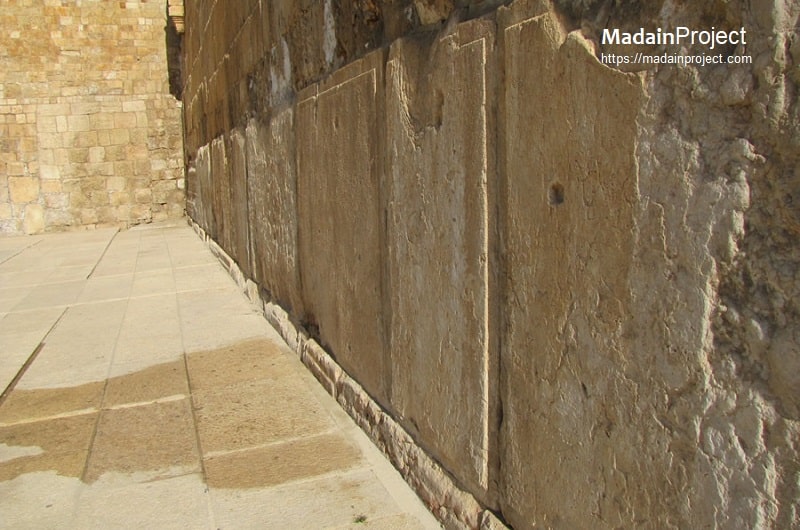
Ashlar Masonry of the Southern Temple Mount Wall
The southern retaining wall of the Temple Mount preserves extensive stretches of Herodian ashlar masonry that illustrate the systematic application of the technique across large architectural surfaces. These stones, primarily visible between the Double Gate and the Triple Gate, are twice the height of the other Herodian courses. These were a stabilizing band known as the great course.
The stones are arranged in uniform horizontal courses, with consistent drafted margins that align seamlessly across multiple blocks, indicating that final dressing occurred after placement. In contrast to the Western Stone, the blocks here vary more in size, though many remain exceptionally large by ancient standards. The regularity of the margins and the restrained treatment of the central bosses create a rhythmic façade that balances structural necessity with visual order. These ashlars formed part of a massive substructure designed to support the expanded Temple platform, and their careful execution reflects both engineering foresight and an aesthetic program intended to be visible from the lower city.
circa 37-4 BCE

Haram al-Ibrahimi
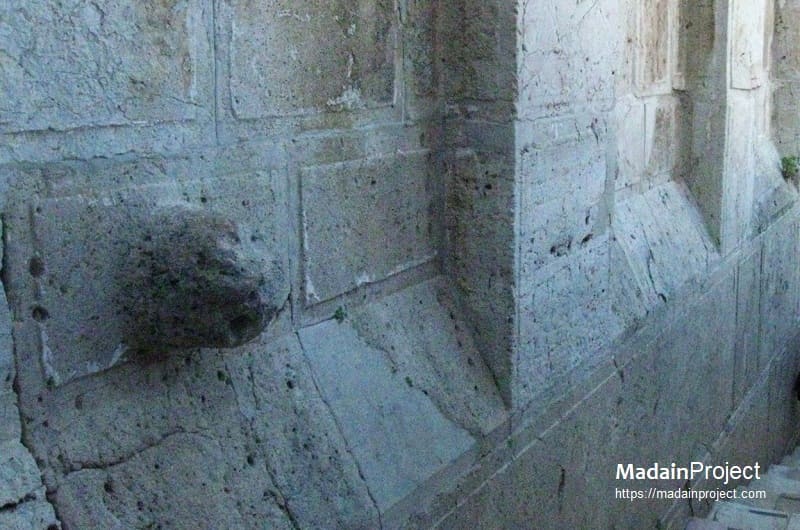
The enclosure surrounding the Haram al-Ibrahimi (Cave of Machpelah) in Hebron constitutes one of the best-preserved examples of Herodian ashlar architecture outside Jerusalem. The perimeter walls are constructed almost entirely of large drafted-margin ashlars, closely comparable in style and workmanship to those of the Temple Mount. The stones exhibit deeply cut margins and prominent central bosses, with remarkably consistent proportions across the structure. Unlike the Temple Mount retaining walls, the Machpelah enclosure functions as a freestanding monumental edifice rather than a substructure, allowing the full visual impact of the Herodian ashlar technique to be appreciated on all sides. The building’s preservation provides critical evidence for identifying Herodian masonry in other contexts and confirms the deliberate transfer of royal architectural language to sites of ancestral and religious significance.
circa 37-4 BCE / 70 CE

Additional Herodian Ashlar Contexts
The rubble in the Herodian Street from the 70 CE. Beyond the Old City of Jerusalem and Hebron, Herodian ashlar appears in a range of royal and administrative constructions that further illuminate its use and symbolic role. At Herodium, both the palace-fortress and associated architectural elements incorporate drafted-margin ashlars, though often on a smaller scale than those of the Temple Mount. Masada also preserves examples of Herodian ashlar, particularly in fortification walls and palace structures, where the technique was adapted to challenging topography. In Caesarea Maritima, while concrete and imported Roman architecture methods dominate, Herodian ashlar is still present in select monumental components, reflecting a hybrid architectural approach. Collectively, these examples demonstrate that Herodian ashlar was not an isolated stylistic choice but a coherent and widely deployed construction system, closely tied to royal authority and the architectural identity of King Herod’s reign.

Signup for our monthly newsletter / online magazine.
No spam, we promise.

The Madain Project is an online archive of Abrahamic History and Archaeology.
Abrahamic History & Archaeology is the study of history and archaeology with respect to the three Abrahamic Faiths without considering the religious and theological aspects. The goal of Abrahamic History is to understand how and why the religious doctrines and behaviours have evlovled and changed over time. Searching for patterns in the evolution of significant cultural events such as the development of farming, the emergence of cities, or the collapse of major civilizations for clues of why and how these have influenced the three major Abrahamic religions.
Cloud Drive -
About -
Help -
Editorial Policy -
AI Policy -
Privacy Policy -
Contact
Madain Project: Encyclopedia of Abrahamic History & Archaeology.
Copyright MadainProject 2017 - 2026.


