
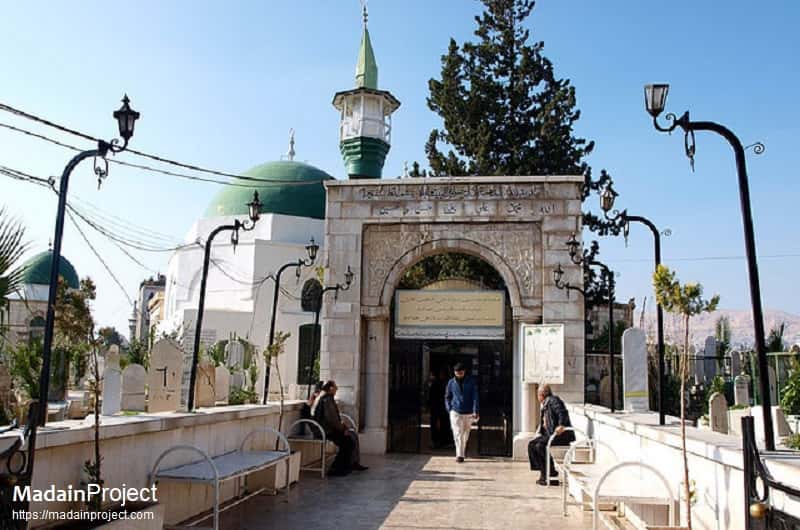
Bāb Saghīr Cemetery (مقبرة باب الصغير), also called "Goristan-e-Ghariban", is an ancient cemetery and street in the historic city of Damascus, Syria, with tombs on either side of the road. It is located in the Dimashq neighborhood, southwest of Umayyad Mosque, adjacent to the Bab al-Saghir.
According to a tradition the heads of 16 martyrs of the Battle of Karbala were buried in Bab al-Saghir. The cemetery also contains a number of cenotaphs (empty grave markers) created for the purpose of ziyārah (زِيَـارَة), with the actual graves being at Jannaṫul-Baqī' (جَـنَّـةُ الْـبَـقِـيـع), in Medinah, Saudi Arabia. Bab al-Saghir Cemetery is one of the oldest cemeteries in Damascus which traces back to the early years when Islam entered the area duirng the mid-seventh century CE.
circa 650 CE

Era of Third Caliph 'Ali
During the caliphate of the Ali ibn abi Talib, Damascus became a stronghold for the Umayyads, a powerful faction which had supported the previous caliph Uthman ibn Affan. After Ali’s death, the Umayyads seized control of the caliphate, establishing a new capital city at Damascus. Almost overnight, the Bab al-Saghir became a preeminent place for prominent Muslims to be buried. It is uncertain exactly why so many relatives of Ali ibn abi Talib are buried here.
circa 650 CE

Background
Ali’s control over Damascus was never strong during his own lifetime, and none of the subsequent Imams resided any closer to Syria than the city of Samarra in Iraq. Nevertheless, at least half a dozen members of Ali’s clan are buried in the Bab Al-Saghir, including his daughter Umm Kulthum. Perhaps even stranger that so many of Ali’s descendents are buried here is that the Umayyads, their bitter rivals, permitted it. Bab Al-Saghir was also used by the Ummayad dynasty, and Muawiyah, the first of the Ummayad caliphs and nominal successor to Ali, was interred here in 680 CE. It also is where millions of ordinary Damascenes are buried, along with prominent ones like former President Shukri al-Quwatli and Syriann poet Nizar Qabbani.
circa 650 CE

The Bab Al-Saghir Cemetery is situated near the Bab al-Saghir gate near the southwestern wall of the Old City of Damascus. The cemetery is an open site, and both Muslims and non-Muslims are permitted to visit and pay their respects.
circa 650 CE

general
A typical grave headstone (foreground) in the cemetery is made of marble and mentions the names of twelve imams, starting with Imam Ali at the very top.
circa 650 CE

Tomb of Fidha
The Tomb of Fidha, situated within the western precinct of the historic Bab al-Saghir Cemetery in Damascus, serves as a significant site of veneration for the Fiḍḍa al-Nūbīyya, the renowned housemaid and confidante of Fatima al-Zahra. Architecturally, the mausoleum is characterized by a modest square chamber constructed from traditional black basalt stone, surmounted by a distinctive small green dome. The interior houses the sarcophagus of Fidha, who is traditionally identified as being of Nubian or Indian royal descent and is celebrated in Islamic hagiography for her piety and knowledge of the Qur'an.
Located in close proximity to the tomb of Abd Allah ibn Ja'far ibn Abi Talib, the site is a focal point of Shia pilgrimage, reflecting the historical layering of Alid traditions within Damascus. While much of the cemetery’s pre-modern history is subject to varied independent verification, the tomb remains a critical landmark for understanding the domestic and spiritual legacy of the Ahl al-Bayt (Prophet's family) in Syria. As of 2025, the structure continues to be maintained as part of the broader Bab al-Saghir complex, which is regarded as one of the oldest and most intact Islamic burial grounds in the region.
circa 650 CE
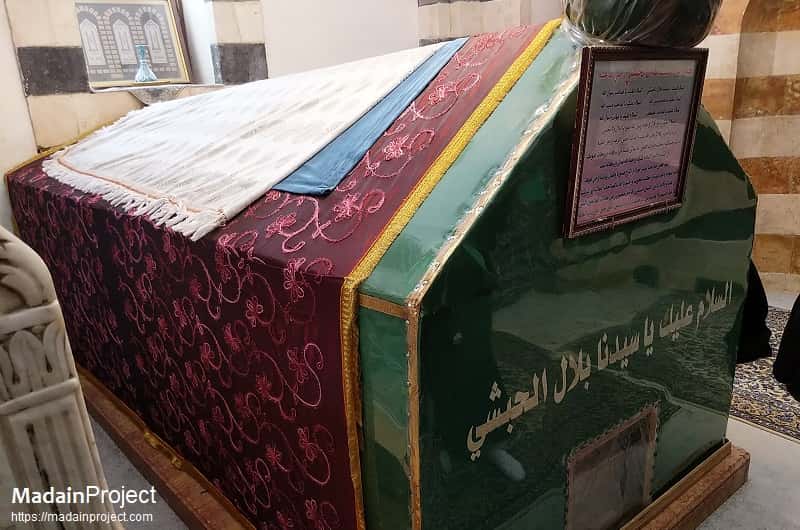
Tomb of Bilal ibn Rabaha
The Tomb of Bilal ibn Rabaha, situated within the historic Bab al-Saghir Cemetery in Damascus, serves as the most widely recognized burial site of the Prophet Muhammad's first muezzin and prominent sahabi. Although a competing tradition identifies a cenotaph in Rabahiyya, Jordan, as his resting place, historians such as al-Suyuti maintain that Bilal was interred in Damascus following his death circa 20 Hijri (640–641 CE). The mausoleum is a modest, square structure of traditional Damascene masonry, characterized by a white dome—later painted green—and an interior housing a wooden cenotaph typically draped in green liturgical fabric.
Architecturally, the tomb reflects the broader aesthetic of the Bab al-Saghir complex, which has served as a preeminent site for Alid and early Islamic interments since the Umayyad period. The site functions as a major focal point for both Sunni and Shia pilgrimage, symbolizing the themes of piety, steadfastness against persecution, and the early Islamic rejection of racial hierarchy. After being largely inaccessible for over a decade due to regional conflict, the tomb was reportedly reopened to visitors in late 2024, facilitating renewed scholarly and religious engagement with one of the city's oldest and most significant hagiographic landmarks.
circa 1350 CE

ibn Qayyim al-Jawziyya
The grave of Ibn Qayyin al-Jawziyya, a preeminent Hanbali jurist, is located in the Bab al-Saghir cemetery, beside the grave of his father. Following his funeral at the Umayyad Mosque, he was interred in a modest family plot alongside his father, Abu Bakr ibn Ayyub, who served as the superintendent (qayyim) of the al-Jawziyya Madrasa.
Architecturally, the tomb is characterized by its relative simplicity, adhering to the traditional Damascene funerary style found throughout the cemetery. A traditional marker inscribed with the scholar's lineage and date of death, often distinguished by its proximity to other major scholarly figures of the Mamluk period, such as Ibn Rajab. While some surrounding tombs in the complex are surmounted by domes or elaborate darihs, Ibn Qayyim's grave remains an unostentatious stone structure, reflecting his own theological critiques of excessive grave veneration and monumentalism.
He was among Ibn Taymiyya's most important pupils. Ibn Qayyim al-Jawziyyah's contributions to the Islamic library are extensive, and they particularly deal with the Qur'anic commentaries, and understanding and analysis of the prophetic traditions (Fiqh-us Sunnah, فقه).
circa 650 CE

Mosque Complex of Badr al-Din
Badr al-Din al-Hassani mosque, is a nine-storey complex comprising of a mosque, a mausoleum, a religious education school, dormitory facilities, a dining hall, and administrative offices, designed around an open atrium through the centre of the building.
The Mosque Complex of Badr al-Din (or Badr al-Din al-Hassani Mosque), located within the northern periphery of the Bab al-Saghir Cemetery in Damascus, represents a contemporary architectural evolution of the traditional Islamic madrasa-mosque typology. Unlike the medieval stone-cut structures that dominate the cemetery, this facility is a multifaceted nine-story complex designed by architect Abdul-Razzaq Samhouri to serve as a center for religious education and communal welfare. The complex is architecturally distinguished by its integration of diverse functions—including a mosque, a religious school (madrasa), dormitory facilities, a dining hall, and administrative offices—all organized around a central open atrium that facilitates natural light and ventilation through the vertical structure.
A defining feature of the design is the mosque’s orientation; situated at the northern end, the prayer hall intentionally breaks from the orthogonal grid of the surrounding building to align strictly with the qibla toward Mecca. While the building utilizes a modern geometric vocabulary, it incorporates subtle Mamluk revivalist elements, such as abstracted mashrabiya latticework and arched window openings, to maintain historical continuity with the adjacent funerary landscape. The complex also houses the mausoleum of Sheikh Badr al-Din al-Hassani (d. 1935), a highly revered Hadith scholar and Sufi leader, alongside the tombs of his children, reinforcing the site's status as a contemporary datum for scholarly and spiritual heritage in Damascus.


Signup for our monthly newsletter / online magazine.
No spam, we promise.

The Madain Project is an online archive of Abrahamic History and Archaeology.
Abrahamic History & Archaeology is the study of history and archaeology with respect to the three Abrahamic Faiths without considering the religious and theological aspects. The goal of Abrahamic History is to understand how and why the religious doctrines and behaviours have evlovled and changed over time. Searching for patterns in the evolution of significant cultural events such as the development of farming, the emergence of cities, or the collapse of major civilizations for clues of why and how these have influenced the three major Abrahamic religions.
Cloud Drive -
About -
Help -
Editorial Policy -
AI Policy -
Privacy Policy -
Contact
Madain Project: Encyclopedia of Abrahamic History & Archaeology.
Copyright MadainProject 2017 - 2026.


