
The al-Khanqah al-Salahiyya Mosque (Arabic: مسجد الخانقاه الصلاحية, Masjid al-Khānqāh al-Ṣalāḥiyya) is a small historic mosque situated within the Christian Quarter in the Old City of Jerusalem. The mosque is historically and architecturally associated with the Islamic institutions of the Ayyubid period (12th–13th centuries CE), particularly reflecting the charitable and religious foundations established under Ṣalāḥ al-Dīn (Saladin) following the recapture of Jerusalem in 1187 CE.
Its designation as a khānqāh indicates its original function as part of a Sufi lodge or religious complex intended for spiritual retreat, instruction, and communal worship, often integrated with social and charitable services such as provision of food and lodging for travelers and the needy.
According to tradition, Salah ul-Din sat for Aiteqaf here during his stay in Jerusalem in 1189 CE. The minaret of the of Mosque was the only place in Jerusalem where a Palestinian flag could be seen, it was removed in 2009.

circa 1189 CE

After the Crusader surrender of Jerusalem in 1187 to Saladin, it was established as a waqf. Alhanka Alzalahhiyeh Mosque; the place was used during the Crusader period as the Latin Patriarch's residence and after the conquest of Jerusalem by Salah a-Din the building was appropriated and consecrated in approx. 1189 as a Hanka, that is, a hostel for Sufi mystics.
circa 1189 CE
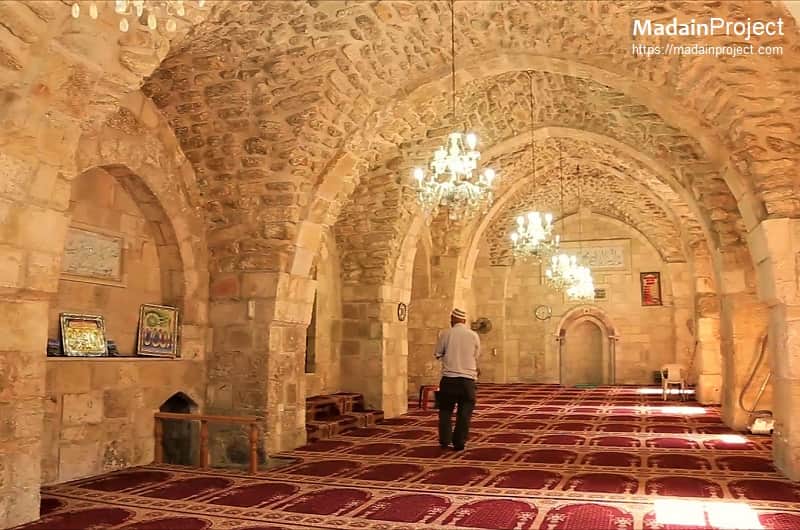
The al‑Khanqah al‑Salahiyya Mosque (مسجد الخانقاه الصلاحية) in the Christian Quarter of the Old City of Jerusalem is a complex architectural ensemble that originated in the late 12th century as an Islamic khanqah (Sufi lodge) following the reconquest of Jerusalem by Ṣalāḥ al‑Dīn (Saladin) in 1187 CE. The extant built fabric reflects successive phases of construction and renovation executed under Ayyubid and later Mamluk patronage, with further modifications in the Ottoman period. The complex’s architectural articulation embodies functional requirements associated with its dual roles as a religious institution (mosque) and a Sufi center, as well as the urban constraints of its historic quarter.
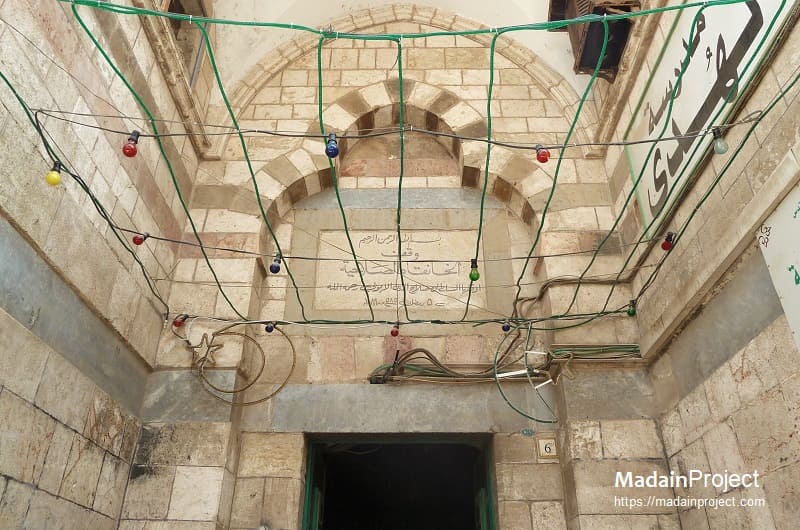
The principal architectural components are arranged around a sequence of internal spaces accessed from a pronounced entrance on al‑Khanqah al‑Salahiyya Street. The entrance portal is composed in the ablaq technique (inspect), employing alternating courses of light and dark stone—an aesthetic and structural trait typical of Ayyubid and Mamluk Jerusalem architecture—facilitating the transition from the dense urban exterior to the interior complex.
Internally, the plan is organized as a series of interconnected vaulted units articulated around an open or semi‑enclosed courtyard space. This courtyard functions as a spatial nucleus mediating between ancillary service rooms, residential quarters, and the principal prayer area. The courtyard and circulation zones are distinguished by stepped transitions and staircases leading to halls, cells (khala’), and retreat chambers that were historically allocated for Sufi meditation and communal functions.
The mosque element of the complex is oriented towards the qiblah, and incorporates a dedicated prayer hall. Documentation indicates the presence of at least one dome over the principal prayer space, consistent with regional Islamic architectural norms for expressing spatial hierarchies within prayer complexes. A prominently sited minaret, constructed in the early 15th century (1417 CE) during the Mamluk period, punctuates the skyline of the Christian Quarter. The minaret’s form and proportions, recorded in comparative studies of Jerusalem’s historic minarets, indicate its design was intended to correspond visually with that of the nearby Mosque of ‘Umar; both minarets are aligned in relation to the Church of the Holy Sepulchre, suggesting a deliberate urban architectural dialogue in the multi‑religious context of the Old City.
Materially, the complex employs locally quarried limestone, with surviving dressed stonework exhibiting tooling and finish characteristic of Ayyubid and Mamluk workshops. Decorative motifs are restrained, focusing on structural articulation and geometric clarity; ablaq masonry, recessed stone panels, and molded openings reflect the broader architectural vocabulary of medieval Jerusalem under Islamic rule. While ornamental carving is limited, the integration of functional and ceremonial spaces within a compact urban footprint exemplifies adaptive architectural responses to site constraints and programmatic diversity.
Signup for our monthly newsletter / online magazine.
No spam, we promise.

The Madain Project is an online archive of Abrahamic History and Archaeology.
Abrahamic History & Archaeology is the study of history and archaeology with respect to the three Abrahamic Faiths without considering the religious and theological aspects. The goal of Abrahamic History is to understand how and why the religious doctrines and behaviours have evlovled and changed over time. Searching for patterns in the evolution of significant cultural events such as the development of farming, the emergence of cities, or the collapse of major civilizations for clues of why and how these have influenced the three major Abrahamic religions.
Cloud Drive -
About -
Help -
Editorial Policy -
AI Policy -
Privacy Policy -
Contact
Madain Project: Encyclopedia of Abrahamic History & Archaeology.
Copyright MadainProject 2017 - 2026.


